

 £1699Unit price Translation missing: en.products.product.price.unit_price_separatorUnavailable924 In Stock

 Save 11%£7999£9000Unit price Translation missing: en.products.product.price.unit_price_separatorUnavailable78 In Stock

 Save 11%£7999£9000Unit price Translation missing: en.products.product.price.unit_price_separatorUnavailable174 In Stock

 Save 7%£16199£17400Unit price Translation missing: en.products.product.price.unit_price_separatorUnavailable171 In Stock
 Free UK Delivery

 Save 13%£3399£3900Unit price Translation missing: en.products.product.price.unit_price_separatorUnavailableAvailable to Order

 Save 11%£3099£3500Unit price Translation missing: en.products.product.price.unit_price_separatorUnavailable346 In Stock

 Save 11%£7999£9000Unit price Translation missing: en.products.product.price.unit_price_separatorUnavailable614 In Stock
 £6199Unit price Translation missing: en.products.product.price.unit_price_separatorUnavailable
Sally LED Trimless Square Recessed Downlight 11W 3000K - White
87 In Stock £6199Unit price Translation missing: en.products.product.price.unit_price_separatorUnavailable
Sally LED Square Recessed Trimless Downlight 11W 3000K - Black
42 In Stock £6199Unit price Translation missing: en.products.product.price.unit_price_separatorUnavailable
Sally LED Trimless Round Recessed Downlight 11W 3000K - White
266 In Stock £6199Unit price Translation missing: en.products.product.price.unit_price_separatorUnavailable
Sally LED Trimless Round Recessed Downlight 11W 3000K - Black
573 In Stock £18499Unit price Translation missing: en.products.product.price.unit_price_separatorUnavailable
Phosix 10 Light Trimless LED Recessed Downlight 20W 4000K - Black
183 In StockFree UK Delivery £11699Unit price Translation missing: en.products.product.price.unit_price_separatorUnavailable
Phosix Trimless 5 Light LED Recessed Downlight 12W 4000K - Black
42 In StockFree UK Delivery £7399Unit price Translation missing: en.products.product.price.unit_price_separatorUnavailable2 In Stock

 £18499Unit price Translation missing: en.products.product.price.unit_price_separatorUnavailable
Phosix 10 Light Trimless LED Recessed Downlight 20W 3000K - Black
Available to OrderFree UK Delivery
 £11699Unit price Translation missing: en.products.product.price.unit_price_separatorUnavailable
Phosix 5 Light Trimless LED Recessed Downlight 12W 3000K - Black
1423 In StockFree UK Delivery £7399Unit price Translation missing: en.products.product.price.unit_price_separatorUnavailable1003 In Stock

 £2799Unit price Translation missing: en.products.product.price.unit_price_separatorUnavailable192 In Stock

 £1699Unit price Translation missing: en.products.product.price.unit_price_separatorUnavailable
Share Plaster-in Recessed Swivel Downlight - White & Matt Gold
555 In Stock
 £1999Unit price Translation missing: en.products.product.price.unit_price_separatorUnavailable96 In Stock

 £1999Unit price Translation missing: en.products.product.price.unit_price_separatorUnavailable987 In Stock

 £2799Unit price Translation missing: en.products.product.price.unit_price_separatorUnavailable
Share Round Plaster-In Fixed Recessed Downlight GU10 - White
118 In Stock
 £2799Unit price Translation missing: en.products.product.price.unit_price_separatorUnavailable428 In Stock

 £1699Unit price Translation missing: en.products.product.price.unit_price_separatorUnavailable
Share Round Plaster-In Recessed Swivel Downlight - White & Black
46 In Stock
 £3599Unit price Translation missing: en.products.product.price.unit_price_separatorUnavailable77 In Stock

 £3599Unit price Translation missing: en.products.product.price.unit_price_separatorUnavailable51 In Stock

 £4299Unit price Translation missing: en.products.product.price.unit_price_separatorUnavailable81 In Stock

 £4299Unit price Translation missing: en.products.product.price.unit_price_separatorUnavailableAvailable to Order

 £1999Unit price Translation missing: en.products.product.price.unit_price_separatorUnavailable
Dot Single Tilt Square Plaster-In Recessed Downlight - Black
661 In Stock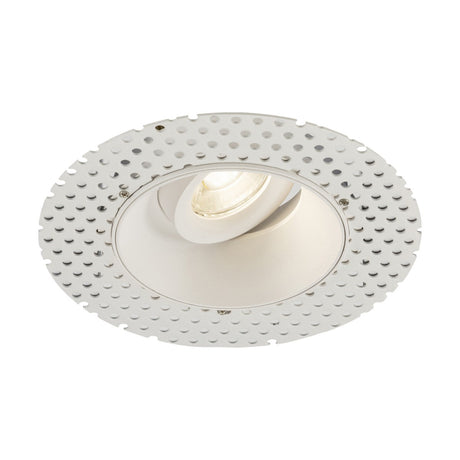 £1799Unit price Translation missing: en.products.product.price.unit_price_separatorUnavailable600 In Stock


How plaster-in downlights sit in the ceiling
A standard recessed downlight has a trim, or bezel, that rests on the ceiling and hides the edge of the hole. A plaster-in downlight leaves it out. Its frame is set into the cut-out and the edge is plastered over, so the ceiling runs straight up to the light and nothing breaks the line of the plaster. That is why you will also see them called trimless downlights or plaster-in spotlights.
We stock round designs, the familiar shape for a downlight. Some are square, a shape that lines up neatly with cabinets, tiles and other straight edges in a room. Some tilt, so you can angle the light onto a picture, shelving or a chimney breast instead of straight down.
When to fit plaster-in downlights
Plaster-in downlights are easiest to fit while a ceiling is being boarded or skimmed, because the frames need to be in place before the plaster is finished. The usual order runs like this: the circuit is wired and the frames are fixed into their cut-outs, the edges are plastered over so they sit flush, and the ceiling is painted before the lights are finished off as their instructions describe.
You can add them to an existing ceiling, but expect to fill, sand and repaint around the openings. We recommend a qualified electrician for the wiring, and it helps if your electrician and plasterer talk before work starts.
Planning a layout of trimless downlights
We suggest starting with the ceiling rather than the lights. Find the joists, pipes and cables first, because a trimless downlight needs a clear cut-out and enough depth in the void above it. Compare the cut-out and depth on the product page with your ceiling before anyone picks up a saw.
Space the lights evenly so their pools of light just meet, and keep them a little away from the walls unless you want to wash a wall with light. Where the product page gives a beam angle, it tells you how far that pool spreads: a narrow beam picks out a worktop or a picture, while a wide beam lights a room more evenly from fewer openings.
Integrated LED or bulb in a plaster-in downlight
We stock plaster-in downlights of both kinds. An integrated LED design has its light source built in, so there is no bulb to buy or change, and the colour of its light is set by the version you order. A design that takes a replaceable bulb uses the common twist-and-lock spotlight cap, so you choose the brightness and colour by the bulb you fit, and can change them later.
Check dimming before you buy. Many are non-dimmable and work from an ordinary on and off switch, so look for the dimming details on the product page if you want to dim. With a replaceable bulb, dimming depends on the bulb you fit and a dimmer switch that suits it.
Warm or cool white from plaster-in downlights
Colour temperature sets the mood of a room. Warm white, around 3000K, gives a soft, slightly golden light that feels relaxed in living rooms and hallways in the evening. Cool white, around 4000K, is crisper and more neutral, which helps with close work and suits kitchens and commercial spaces where clarity matters more than mood.
We stock warm white designs. A few are cool white. With a replaceable bulb, the bulb you buy decides the colour. Whichever you choose, keep to the same colour throughout a room, because mixing warm and cool white on the same ceiling looks patchy.
Choosing a finish for plaster-in spotlights
The finish decides how much you notice the fitting itself. White melts into a white ceiling, so the eye goes to the light. Black reads as a crisp, deliberate opening and suits darker ceilings or a pared-back modern scheme. We stock trimless spotlights in both. A few come in gold, a warm accent that pairs well with brass taps and handles. Many have a matt finish, which avoids shiny reflections around the light.
If you prefer a metal body, many are made of aluminium. If you want the fitting to blend in fully, a few are made of gypsum, which you can paint along with the rest of the ceiling.
Trimless downlights room by room
We stock plaster-in downlights for kitchens, hallways and living rooms, and many suit commercial spaces too. Many are rated for dry indoor rooms. In a kitchen, place them over the front edge of the worktops rather than the middle of the floor, so you are not working in your own shadow, and give them a separate switch. In a hallway, a line down the centre lights the floor evenly and draws you through the space.
In a living room, plaster-in lights work best as part of a layered scheme. Use them for general light and add table lamps and floor lamps for the evening, so the ceiling is not doing the whole job.
Frequently Asked Questions
What is the difference between a plaster-in downlight and a standard recessed downlight?
What is the difference between a plaster-in downlight and a standard recessed downlight?
Can I fit plaster-in downlights into an existing ceiling?
Can I fit plaster-in downlights into an existing ceiling?
Do I need an electrician and a plasterer to fit trimless downlights?
Do I need an electrician and a plasterer to fit trimless downlights?
Are plaster-in spotlights dimmable?
Are plaster-in spotlights dimmable?
Should I choose integrated LED or a replaceable bulb?
Should I choose integrated LED or a replaceable bulb?
Is warm white or cool white better for plaster-in downlights?
Is warm white or cool white better for plaster-in downlights?
How much space do plaster-in lights need above the ceiling?
How much space do plaster-in lights need above the ceiling?
Related Collections


BestSellers
-

 £63999Unit price Translation missing: en.products.product.price.unit_price_separatorUnavailable1 In Stock3 In Production · 26 NovFree Delivery
-

 £49499Unit price Translation missing: en.products.product.price.unit_price_separatorUnavailable
Caelith 1 Light Medium Carved Alabaster Wall Light - Brushed Brass
4 In Production · 26 NovFree Delivery In our showroom
-

 £1,31999Unit price Translation missing: en.products.product.price.unit_price_separatorUnavailable1 In Production · 26 NovFree Delivery
-

 £1,07799Unit price Translation missing: en.products.product.price.unit_price_separatorUnavailable
Aleron LED Large Round Alabaster Flush Ceiling Light - Soft White & Brushed Brass
Made to OrderFree Delivery -

 £23999Unit price Translation missing: en.products.product.price.unit_price_separatorUnavailable2 In StockFree DeliveryIn our showroom
-

 Save 8%£49999£54299Unit price Translation missing: en.products.product.price.unit_price_separatorUnavailable
Helia 100cm LED Circular Pendant Light 55W 3000K - Matt Black
Available to OrderFree UK Delivery -

 £80299Unit price Translation missing: en.products.product.price.unit_price_separatorUnavailable1 In Production · 26 NovFree Delivery
-

 £2,96999Unit price Translation missing: en.products.product.price.unit_price_separatorUnavailable
Sorrelis 9 Light Alabaster Chandelier - Soft White & Brushed Brass
Made to OrderFree Delivery -

 £2,96999Unit price Translation missing: en.products.product.price.unit_price_separatorUnavailableMade to OrderFree Delivery
-

 £1,53999Unit price Translation missing: en.products.product.price.unit_price_separatorUnavailableMade to OrderFree Delivery
-

 £1,42999Unit price Translation missing: en.products.product.price.unit_price_separatorUnavailable
Seraphis LED Medium Alabaster Ring Chandelier - Brushed Brass
Made to OrderFree Delivery -

 £2,09999Unit price Translation missing: en.products.product.price.unit_price_separatorUnavailable
Auriel 19 Light Alabaster Cluster Chandelier - Brushed Brass
Made to OrderFree Delivery


Recommended For You
Our Reviews
-

Birmingham Based
British heritage. Worldwide delivery.
