

 £299Unit price Translation missing: en.products.product.price.unit_price_separatorUnavailable
Energizer LED GLS Bulb E27 5W Filament Dimmable - Warm White 2700K
1008 In Stock
 £299Unit price Translation missing: en.products.product.price.unit_price_separatorUnavailable
Energizer LED Golf Ball E14 5W Filament Dimmable - Warm White 2700K
1728 In Stock
 £299Unit price Translation missing: en.products.product.price.unit_price_separatorUnavailable
Energizer GLS B22 4.2W Filament Non-Dimmable - Very Warm White 2200K
36 In Stock
 £299Unit price Translation missing: en.products.product.price.unit_price_separatorUnavailable
Energizer LED Golf Ball E27 5W Filament Dimmable - Warm White 2700K
Available to Order
 £399Unit price Translation missing: en.products.product.price.unit_price_separatorUnavailable
Energizer LED GLS Bulb E27 7W Filament Dimmable - Warm White 2700K
10258 In Stock
 £299Unit price Translation missing: en.products.product.price.unit_price_separatorUnavailable
Energizer LED Candle Bulb E27 5W Filament Dimmable - Cool White 4000K
1932 In Stock
 £299Unit price Translation missing: en.products.product.price.unit_price_separatorUnavailable
Energizer LED Candle Bulb E14 5W Filament Dimmable - Cool White 4000K
924 In Stock
 £299Unit price Translation missing: en.products.product.price.unit_price_separatorUnavailable
Energizer LED Candle Bulb B15 5W Filament Dimmable - Cool White 4000K
1812 In Stock
 £299Unit price Translation missing: en.products.product.price.unit_price_separatorUnavailable
Energizer LED Candle Bulb B22 5W Filament Dimmable - Cool White 4000K
1632 In Stock
 £399Unit price Translation missing: en.products.product.price.unit_price_separatorUnavailable
E14 (SES) LED Filament Bulb 4W 440lm - Warm White 3000K, 2 Pack
19826 In Stock
 £399Unit price Translation missing: en.products.product.price.unit_price_separatorUnavailable
Energizer LED GLS Bulb B22 7W Filament Dimmable - Warm White 2700K
14031 In Stock
 £299Unit price Translation missing: en.products.product.price.unit_price_separatorUnavailable
Energizer LED Candle Bulb B22 5W Filament Dimmable - Warm White 2700K
15744 In Stock
 £299Unit price Translation missing: en.products.product.price.unit_price_separatorUnavailable
Energizer Candle E14 Filament Non-Dimmable - Very Warm White 2200K
7724 In Stock
 £299Unit price Translation missing: en.products.product.price.unit_price_separatorUnavailable
B22 (BC) LED Filament GLS Bulb 4W 470lm - Warm White 2700K - Energizer
2426 In Stock
 £199Unit price Translation missing: en.products.product.price.unit_price_separatorUnavailable
Energizer LED Candle E14 2W Filament Non-Dimmable - Warm White 2700K
972 In Stock
 £299Unit price Translation missing: en.products.product.price.unit_price_separatorUnavailable
Energizer Golf Ball B22 4W Filament Non-Dimmable - Warm White 2700K
Available to Order
 £299Unit price Translation missing: en.products.product.price.unit_price_separatorUnavailable
Energizer Pygmy E14 Filament Non-Dimmable - Warm White 3000K
Available to Order
 £399Unit price Translation missing: en.products.product.price.unit_price_separatorUnavailable
Energizer Squirrel Cage E27 Filament Dimmable - Very Warm White 2200K
2016 In Stock
 £599Unit price Translation missing: en.products.product.price.unit_price_separatorUnavailable
E27 (ES) LED Filament Globe Bulb 5W 550lm - Warm White 2200K
493 In Stock
 £299Unit price Translation missing: en.products.product.price.unit_price_separatorUnavailable708 In Stock

 £299Unit price Translation missing: en.products.product.price.unit_price_separatorUnavailable
Energizer Golf Ball E27 4W Filament Non-Dimmable - Warm White 2700K
Available to Order
 £299Unit price Translation missing: en.products.product.price.unit_price_separatorUnavailable
Energizer LED Golf Ball B15 5W Filament Dimmable - Warm White 2700K
960 In Stock
 £299Unit price Translation missing: en.products.product.price.unit_price_separatorUnavailable
Energizer Golf Ball B15 4W Filament Non-Dimmable - Warm White 2700K
1548 In Stock
 £299Unit price Translation missing: en.products.product.price.unit_price_separatorUnavailable
Energizer LED Golf Ball B22 5W Filament Dimmable - Warm White 2700K
924 In Stock £299Unit price Translation missing: en.products.product.price.unit_price_separatorUnavailable
Energizer LED Candle Bulb E27 5W Filament Dimmable - Warm White 2700K
1428 In Stock
 £299Unit price Translation missing: en.products.product.price.unit_price_separatorUnavailable
Energizer LED Candle B15 4W Filament Non-Dimmable - Warm White 2700K
216 In Stock
 £299Unit price Translation missing: en.products.product.price.unit_price_separatorUnavailable
Energizer LED Candle E14 2.2W Filament Non-Dimmable - Daylight 6500K
2076 In Stock
 £299Unit price Translation missing: en.products.product.price.unit_price_separatorUnavailable
Energizer LED Candle E14 2.2W Filament Non-Dimmable - Warm White 2700K
996 In Stock
 £299Unit price Translation missing: en.products.product.price.unit_price_separatorUnavailable
Energizer LED Candle B22 2.2W Filament Non-Dimmable - Daylight 6500K
4860 In Stock
 £299Unit price Translation missing: en.products.product.price.unit_price_separatorUnavailable
Energizer LED Candle B22 2.2W Filament Non-Dimmable - Warm White 2700K
4500 In Stock
 £299Unit price Translation missing: en.products.product.price.unit_price_separatorUnavailable
Energizer LED Candle E27 2.2W Filament Non-Dimmable - Daylight 6500K
924 In Stock
 £299Unit price Translation missing: en.products.product.price.unit_price_separatorUnavailable
Energizer LED Candle E27 2.2W Filament Non-Dimmable - Warm White 2700K
612 In Stock
 £499Unit price Translation missing: en.products.product.price.unit_price_separatorUnavailable
Energizer LED GLS B22 7.2W Filament Non-Dimmable - Daylight 6500K
1608 In Stock
 £499Unit price Translation missing: en.products.product.price.unit_price_separatorUnavailable
Energizer LED GLS B22 7.2W Filament Non-Dimmable - Warm White 2700K
1080 In Stock
 £499Unit price Translation missing: en.products.product.price.unit_price_separatorUnavailable
Energizer LED GLS E27 7.2W Filament Non-Dimmable - Daylight 6500K
2424 In Stock
 £499Unit price Translation missing: en.products.product.price.unit_price_separatorUnavailable
Energizer LED GLS E27 7.2W Filament Non-Dimmable - Warm White 2700K
2460 In Stock
 £399Unit price Translation missing: en.products.product.price.unit_price_separatorUnavailable
Energizer LED GLS B22 3.8W Filament Non-Dimmable - Daylight 6500K
3563 In Stock
 £399Unit price Translation missing: en.products.product.price.unit_price_separatorUnavailable
Energizer LED GLS E27 3.8W Filament Non-Dimmable - Daylight 6500K
3756 In Stock
 £399Unit price Translation missing: en.products.product.price.unit_price_separatorUnavailable
Energizer LED GLS E27 3.8W Filament Non-Dimmable - Warm White 2700K
1752 In Stock
 £499Unit price Translation missing: en.products.product.price.unit_price_separatorUnavailable
Energizer LED Globe Bulb E27 4W Filament Dimmable - Cool White 4000K
3906 In Stock
 £399Unit price Translation missing: en.products.product.price.unit_price_separatorUnavailable
E27 LED Smokey ST64 Filament Bulb 4W 400lm - Cool White 4000K
1698 In Stock
 £499Unit price Translation missing: en.products.product.price.unit_price_separatorUnavailable
Energizer Globe E27 G125 5W Filament Dimmable - Very Warm White 2200K
4690 In Stock
 £599Unit price Translation missing: en.products.product.price.unit_price_separatorUnavailable
Energizer Globe E27 G95 5W Filament Dimmable - Very Warm White 2200K
5356 In Stock
 £399Unit price Translation missing: en.products.product.price.unit_price_separatorUnavailable
Energizer Pygmy E14 Filament Non-Dimmable - Warm White 3000K, 2 Pack
16543 In Stock
 £299Unit price Translation missing: en.products.product.price.unit_price_separatorUnavailable
Energizer Golf Ball E14 4W Filament Non-Dimmable - Warm White 2700K
2052 In Stock
 £299Unit price Translation missing: en.products.product.price.unit_price_separatorUnavailable
Energizer LED Candle E27 4W Filament Non-Dimmable - Warm White 2700K
4484 In Stock
 £299Unit price Translation missing: en.products.product.price.unit_price_separatorUnavailable
Energizer LED Candle B22 4W Filament Non-Dimmable - Warm White 2700K
8 In Stock
 £299Unit price Translation missing: en.products.product.price.unit_price_separatorUnavailable
Energizer LED GLS E27 4W Filament Non-Dimmable - Very Warm White 2200K
5172 In Stock


Why choose filament bulbs
A filament bulb shows you where its light comes from. Rather than hiding the source behind frosted or opal glass, it lets the strands glow in plain sight, so the bulb is worth choosing with care. Most of the filament bulbs we stock are LED filament bulbs, where the strands are thin strips of tiny LEDs made to look like the glowing wire of an incandescent bulb.
That makes filament bulbs the natural choice wherever the bulb is on show: a bare pendant, an open cage or a clear glass shade. If you would rather not see the light source, an opal bulb is the better pick, because its milky glass diffuses the light into an even glow.
Filament bulb shapes
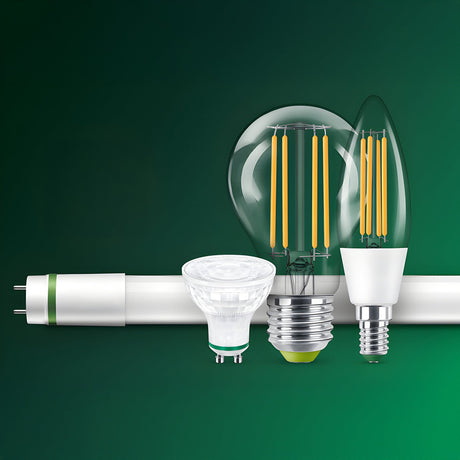
Because the bulb is on show, its shape matters as much as its light. We stock GLS bulbs, the familiar household pear shape, for pendants, table lamps and floor lamps. Candle bulbs suit chandeliers and wall lights, while golf ball shapes are a neat, rounded choice for small shades.
Globe bulbs come into their own hanging from a bare flex, and tube shapes suit slim cages and pendants hung in a row. Squirrel cage bulbs have their strands arranged like the bars of a cage, so the filament becomes the focus. We also stock a few giant shapes, such as a beehive, a teardrop or a star, to hang over a table or in a stairwell.
Clear and tinted filament bulbs
The glass sets the character of the light, and we stock clear, amber and gold finishes. Clear glass gives the crispest look, with the strands sharp and easy to see. Amber lends a deep honey glow and gold a softer golden tone, and either makes the light look warmer.
Some of our filament bulbs are smoke-tinted, which darkens the glow for a moodier look. Tinted glass trades a little brightness for colour, so for a reading lamp or a kitchen pendant, clear glass is usually the better choice; save amber and gold for a glow over the dining table.
Colour temperature for filament bulbs
Colour temperature decides how the light feels, so choose it room by room. We stock very warm white bulbs with a rich, candle-like glow for a dining room or a bedroom in the evening. Warm white is the usual household tone, and many of our bulbs sit at 2700K, the soft white you would expect from a living room lamp.
For a kitchen, a study or a utility room, we stock cool white bulbs with a crisper, more neutral light. A few are daylight white, the coolest tone, for work areas where you need to judge colour. Keep to the same white within a room so the fittings match.
Filament bulb caps
The cap is the part that goes into the lamp holder, and it decides whether a bulb fits your light, so the surest check is to take out the old bulb and match its cap. Most of our range uses an E27 cap, the large screw cap. We also stock many with an E14 cap, the small screw cap common in chandeliers and wall lights, and many with a B22 cap, the push-and-twist bayonet cap long used in UK homes.
A few of our filament bulbs use B15, the small bayonet cap. Screw and bayonet caps are not interchangeable, and a small cap will not fit a large holder, so match the type and the size. Check too that the shade or cage leaves room around the glass, especially with a globe.
Dimming filament bulbs
Many of our filament bulbs are dimmable. Most are not, though, so if the bulb will sit on a dimmer switch, check that it is marked dimmable before you buy. A non-dimmable bulb on a dimmer can flicker or buzz, so keep those on an ordinary switch.
For a dimmable bulb, use a dimmer made for LED, usually a trailing-edge type. Older dimmers built for incandescent bulbs expect a much heavier load, so with LED bulbs they can flicker, hum or fail to dim smoothly. If a dimmer runs a group of lights, check that its minimum load suits the total load on the circuit.
Filament bulb brightness
Brightness is measured in lumens, not watts. Watts tell you the power a bulb draws, and an LED needs far less power than an incandescent bulb for the same light, so its watts say little about how bright it will be. To match an old bulb, compare lumen figures; many of our bulbs also give a wattage equivalent, which tells you the old bulb they match.
We stock filament bulbs with a soft, low glow for lamps and wall lights, and brighter bulbs for a main ceiling light. Where a pendant is the only light in a room, choose a brighter bulb. A bright clear bulb at eye level can glare, so for a low pendant or a lamp you look straight at, a softer output is easier on the eyes.
Frequently Asked Questions
What colour temperature should I choose for a living room or bedroom?
What colour temperature should I choose for a living room or bedroom?
Will a filament bulb fit my existing light?
Will a filament bulb fit my existing light?
Can I use filament bulbs with a dimmer switch?
Can I use filament bulbs with a dimmer switch?
How do I match the brightness of my old bulb?
How do I match the brightness of my old bulb?
Should I choose a filament bulb or an opal bulb?
Should I choose a filament bulb or an opal bulb?
Are your filament bulbs LED?
Are your filament bulbs LED?
Which filament bulbs suit a bare pendant?
Which filament bulbs suit a bare pendant?
Related Collections


BestSellers
-

 £63999Unit price Translation missing: en.products.product.price.unit_price_separatorUnavailable1 In Stock3 In Production · 26 Nov
 Free Delivery
-

 £49499Unit price Translation missing: en.products.product.price.unit_price_separatorUnavailable
Caelith 1 Light Medium Carved Alabaster Wall Light - Brushed Brass
4 In Production · 26 NovFree Delivery In our showroom
-

 £1,31999Unit price Translation missing: en.products.product.price.unit_price_separatorUnavailable1 In Production · 26 NovFree Delivery
-

 £1,07799Unit price Translation missing: en.products.product.price.unit_price_separatorUnavailable
Aleron LED Large Round Alabaster Flush Ceiling Light - Soft White & Brushed Brass
Made to OrderFree Delivery -

 Save 8%£49999£54299Unit price Translation missing: en.products.product.price.unit_price_separatorUnavailable
Helia 100cm LED Circular Pendant Light 55W 3000K - Matt Black
Available to OrderFree Delivery -

 £79999Unit price Translation missing: en.products.product.price.unit_price_separatorUnavailable4 In StockFree DeliveryIn our showroom
-

 £80299Unit price Translation missing: en.products.product.price.unit_price_separatorUnavailable1 In Production · 26 NovFree Delivery
-

 £2,96999Unit price Translation missing: en.products.product.price.unit_price_separatorUnavailable
Sorrelis 9 Light Alabaster Chandelier - Soft White & Brushed Brass
Made to OrderFree Delivery -

 £2,96999Unit price Translation missing: en.products.product.price.unit_price_separatorUnavailableMade to OrderFree Delivery
-

 £1,53999Unit price Translation missing: en.products.product.price.unit_price_separatorUnavailableMade to OrderFree Delivery
-

 £1,42999Unit price Translation missing: en.products.product.price.unit_price_separatorUnavailable
Seraphis LED Medium Alabaster Ring Chandelier - Brushed Brass
Made to OrderFree Delivery -

 £2,09999Unit price Translation missing: en.products.product.price.unit_price_separatorUnavailable
Auriel 19 Light Alabaster Cluster Chandelier - Brushed Brass
Made to OrderFree Delivery


Recommended For You
Our Reviews
-

Birmingham Based
British heritage. Worldwide delivery.
