


 £399Unit price Translation missing: en.products.product.price.unit_price_separatorUnavailable
 £899Unit price Translation missing: en.products.product.price.unit_price_separatorUnavailable
 £199Unit price Translation missing: en.products.product.price.unit_price_separatorUnavailable
E14 Candle 3.4W 40W-eq 470lm 240° IQ-LED LED Bulb - Daylight

 £399Unit price Translation missing: en.products.product.price.unit_price_separatorUnavailable
 £399Unit price Translation missing: en.products.product.price.unit_price_separatorUnavailable
 £399Unit price Translation missing: en.products.product.price.unit_price_separatorUnavailable
B22 (BC) LED GLS Bulb 14W 1521lm Non-Dimmable - Cool White 4000K

 £299Unit price Translation missing: en.products.product.price.unit_price_separatorUnavailable
B15 (SBC) LED Candle Bulb 4.2W 470lm Dimmable - Cool White 4000K

 £399Unit price Translation missing: en.products.product.price.unit_price_separatorUnavailable
 £199Unit price Translation missing: en.products.product.price.unit_price_separatorUnavailable6 In Stock
 £399Unit price Translation missing: en.products.product.price.unit_price_separatorUnavailable1200 In Stock
 £299Unit price Translation missing: en.products.product.price.unit_price_separatorUnavailable
G9 LED Capsule Bulb 4.2W 470lm Non-Dimmable - Cool White 4000K

 Save 25%£769£1030Unit price Translation missing: en.products.product.price.unit_price_separatorUnavailable862 In Stock
 £299Unit price Translation missing: en.products.product.price.unit_price_separatorUnavailable
 £799Unit price Translation missing: en.products.product.price.unit_price_separatorUnavailable
 £699Unit price Translation missing: en.products.product.price.unit_price_separatorUnavailable
 Save 28%£1299£1800Unit price Translation missing: en.products.product.price.unit_price_separatorUnavailable
 £399Unit price Translation missing: en.products.product.price.unit_price_separatorUnavailable
 Save 25%£1789£2397Unit price Translation missing: en.products.product.price.unit_price_separatorUnavailable1508 In Stock
 £299Unit price Translation missing: en.products.product.price.unit_price_separatorUnavailable1000 In Stock
 £599Unit price Translation missing: en.products.product.price.unit_price_separatorUnavailable
 £699Unit price Translation missing: en.products.product.price.unit_price_separatorUnavailable


Read the code on the cap
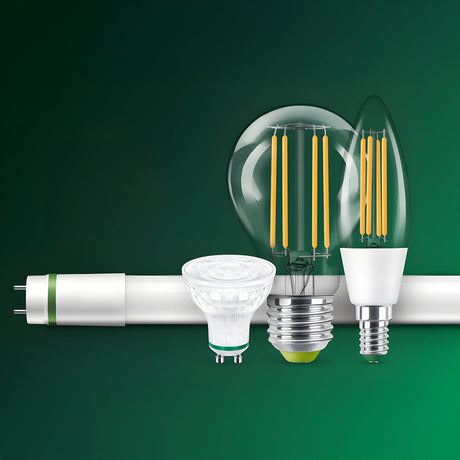
The letters and numbers on a bulb's base are the whole specification of its fitting, and they are worth reading before buying a replacement. The letter gives the type of cap: E is an Edison screw, B is a bayonet with two side pins, and G covers the pin caps used by spotlights, capsules and tubes. The number is a size in millimetres, either the width of the cap or the gap between its pins. So an E27 is a screw cap 27mm across, a B22 is a bayonet 22mm across, and a GU10 has pins 10mm apart. Two bulbs with the same code fit the same holder, whatever their shape or brand.
Screw and bayonet caps
These are the caps on most household bulbs. The E27, often called ES, is the standard screw cap in table lamps, floor lamps and many pendants, and the E14, or SES, is its small sibling in candle bulbs, chandeliers and bedside lamps. The B22, or BC, is the traditional British bayonet: push it in and turn it, and the two pins lock it into the holder. The B15, or SBC, is the small bayonet found in older candle fittings and some appliances. A screw bulb will not go into a bayonet holder or the other way round, although an adaptor can convert one to the other where the shade and the fitting allow it.
Spotlight caps: GU10, GU5.3 and GX53
Recessed ceiling spotlights take one of three caps. The GU10 runs at mains voltage: its two pins have small feet, and it pushes in and turns a quarter to lock. The GU5.3, the cap on an MR16 lamp, has two thin straight pins and runs at 12 volts, so the fitting contains a transformer or driver and an LED replacement has to be compatible with it. The GX53 is a flat disc roughly 75mm across, used in low-profile downlights and under-cabinet fittings, and it twists into place. If the old bulb has straight pins, it is a GU5.3, not a GU10.
Capsule and linear caps: G9, G4 and R7S
Small decorative fittings often hide a capsule bulb. The G9 is a mains capsule with two looped pins that push straight into the holder, and it is common in wall lights, pendants and bathroom fittings. The G4 is smaller again, with two fine straight pins, and it usually runs at 12 volts in cabinet lights, cooker hoods and some chandeliers. The R7S is a linear lamp with a contact at each end, used in floodlights and uplighter floor lamps. It comes in set lengths, most often 78mm and 118mm, so measure the old one before ordering: a different length will not fit.
Tubes and the G13 cap
The long tubes in garages, kitchens and workshops almost always use the G13 cap, two pins at each end 13mm apart, and the T8 in the name is the tube's width, one inch. Tubes are sold by length, from two foot to six foot, and an LED tube of the same length drops into the same holders. Some fittings need the starter removed or the ballast bypassed before an LED tube goes in, so check the fitting's instructions and the tube's own page before changing one.
The shape is a separate choice
Once the cap is known, the shape is free to suit the fitting. The same E27 cap comes on the classic GLS pear shape, a globe, a candle, a golfball, a reflector and a tube, and the same E14 cap on candles and golfballs for smaller shades. Choose a shape that sits inside the shade with a little room around it, and a clear or filament style where the bulb will be seen. Then choose the colour of the light: warm white for living rooms and bedrooms, cool white for kitchens and bathrooms, and daylight for workspaces.
Frequently Asked Questions
What are the most common light bulb fittings in the UK?
What are the most common light bulb fittings in the UK?
What is the difference between ES and SES?
What is the difference between ES and SES?
What is the difference between BC and SBC?
What is the difference between BC and SBC?
How do I tell a GU10 from a GU5.3?
How do I tell a GU10 from a GU5.3?
What does the number after the letter mean?
What does the number after the letter mean?
Can I replace a halogen bulb with an LED that has the same cap?
Can I replace a halogen bulb with an LED that has the same cap?
Which bulb does an uplighter floor lamp take?
Which bulb does an uplighter floor lamp take?
Related Collections

BestSellers
-

 £49499Unit price Translation missing: en.products.product.price.unit_price_separatorUnavailable
Caelith 1 Light Medium Carved Alabaster Wall Light - Brushed Brass
 Free Delivery
 In our showroom
 -

 £63999Unit price Translation missing: en.products.product.price.unit_price_separatorUnavailable3 In StockFree Delivery
 -

 £11,87999Unit price Translation missing: en.products.product.price.unit_price_separatorUnavailableFree Delivery
 -

 £1,42999Unit price Translation missing: en.products.product.price.unit_price_separatorUnavailable
Seraphis LED Medium Alabaster Ring Chandelier - Brushed Brass
Free Delivery -

 £1,31999Unit price Translation missing: en.products.product.price.unit_price_separatorUnavailableFree Delivery
 -

 £80299Unit price Translation missing: en.products.product.price.unit_price_separatorUnavailableFree Delivery
 -

 £1,20999Unit price Translation missing: en.products.product.price.unit_price_separatorUnavailableFree Delivery
 -

 Save 25%£65199£87000Unit price Translation missing: en.products.product.price.unit_price_separatorUnavailableFree Delivery
 -

 £1,64999Unit price Translation missing: en.products.product.price.unit_price_separatorUnavailableFree Delivery
 -

 £2,96999Unit price Translation missing: en.products.product.price.unit_price_separatorUnavailableFree Delivery
 -

 £1,53999Unit price Translation missing: en.products.product.price.unit_price_separatorUnavailableFree Delivery
 -

 £2,30999Unit price Translation missing: en.products.product.price.unit_price_separatorUnavailable
Stratalux LED Stacked Alabaster Column Floor Lamp - Matt Black
Free Delivery


Recommended For You
Our Reviews
-

Birmingham Based
British heritage. Worldwide delivery.
