

 £299Unit price Translation missing: en.products.product.price.unit_price_separatorUnavailable
 £299Unit price Translation missing: en.products.product.price.unit_price_separatorUnavailable
 £299Unit price Translation missing: en.products.product.price.unit_price_separatorUnavailable
 £1099Unit price Translation missing: en.products.product.price.unit_price_separatorUnavailable
 £1099Unit price Translation missing: en.products.product.price.unit_price_separatorUnavailable
 £299Unit price Translation missing: en.products.product.price.unit_price_separatorUnavailable
E27 GLS LED Bulb 7.3W 60W-eq Dimmable 806lm 220° - Warm White

 £1099Unit price Translation missing: en.products.product.price.unit_price_separatorUnavailable
 £299Unit price Translation missing: en.products.product.price.unit_price_separatorUnavailable
E27 GLS 7.3W 60W-eq Dimmable LED Bulb 806lm 220° - Cool White

 £399Unit price Translation missing: en.products.product.price.unit_price_separatorUnavailable
E27 GLS 10.5W Dimmable LED Bulb 75W-eq 1060lm 220° - Warm White

 £399Unit price Translation missing: en.products.product.price.unit_price_separatorUnavailable
E27 GLS 10.5W Dimmable LED Bulb 75W-eq 1060lm 220° - Cool White

 £299Unit price Translation missing: en.products.product.price.unit_price_separatorUnavailable
E14 (SES) LED Candle Bulb 7.3W 806lm Dimmable - Warm White 2700K

 £699Unit price Translation missing: en.products.product.price.unit_price_separatorUnavailable
E27 GLS 13.6W 100W-eq Dimmable LED Bulb 220° 1521lm - Warm White

 £499Unit price Translation missing: en.products.product.price.unit_price_separatorUnavailable
 £499Unit price Translation missing: en.products.product.price.unit_price_separatorUnavailable
E27 GLS 5W Filament LED Bulb 75W-eq 320° 1055lm - Warm White

 £699Unit price Translation missing: en.products.product.price.unit_price_separatorUnavailable
E27 GLS 13.6W LED Bulb 100W-eq 1521lm 220° Dimmable - Cool White

 £499Unit price Translation missing: en.products.product.price.unit_price_separatorUnavailable
 £499Unit price Translation missing: en.products.product.price.unit_price_separatorUnavailable
E27 GLS 5W Filament LED Bulb 75W-eq 1055lm 320° - Cool White

 £199Unit price Translation missing: en.products.product.price.unit_price_separatorUnavailable
E27 GLS 4.5W Filament LED Bulb 40W-eq 470lm 320° - Warm White

 £199Unit price Translation missing: en.products.product.price.unit_price_separatorUnavailable
E27 GLS 4.5W Filament LED Bulb 40W-eq 470lm 320° - Cool White

 £899Unit price Translation missing: en.products.product.price.unit_price_separatorUnavailable
E27 GLS Filament LED Bulb 7.2W 40W-eq 470lm 320° - Warm White

 £899Unit price Translation missing: en.products.product.price.unit_price_separatorUnavailable
E27 GLS 7.2W 40W-eq Filament LED Bulb 470lm 320° - Cool White

 £199Unit price Translation missing: en.products.product.price.unit_price_separatorUnavailable
 £199Unit price Translation missing: en.products.product.price.unit_price_separatorUnavailable
 £199Unit price Translation missing: en.products.product.price.unit_price_separatorUnavailable
 £299Unit price Translation missing: en.products.product.price.unit_price_separatorUnavailable
E27 GLS 8W Filament LED Bulb 75W-eq 320° 1055lm - Warm White

 £299Unit price Translation missing: en.products.product.price.unit_price_separatorUnavailable
E27 GLS 10W Filament LED Bulb 99W-eq 1520lm 320° - Warm White

 £299Unit price Translation missing: en.products.product.price.unit_price_separatorUnavailable
E27 GLS 8W Filament LED Bulb 75W-eq 320° 1055lm - Cool White

 £299Unit price Translation missing: en.products.product.price.unit_price_separatorUnavailable
E27 GLS 10W Filament LED Bulb 100W-eq 320° 1520lm - Daylight

 £299Unit price Translation missing: en.products.product.price.unit_price_separatorUnavailable
E27 GLS 10W Filament LED Bulb 99W-eq 1520lm 320° - Cool White

 £899Unit price Translation missing: en.products.product.price.unit_price_separatorUnavailable
E27 GLS 18W A70 Filament LED Bulb 149W-eq 320° 2450lm - Warm White

 £299Unit price Translation missing: en.products.product.price.unit_price_separatorUnavailable
E27 GLS 4.5W Filament Opal LED Bulb 40W-eq 320° 470lm - Warm White

 £299Unit price Translation missing: en.products.product.price.unit_price_separatorUnavailable
B15 (SBC) LED Candle Bulb 7.3W 806lm Dimmable - Warm White 2700K

 £299Unit price Translation missing: en.products.product.price.unit_price_separatorUnavailable
E27 GLS 4.5W Filament Opal LED Bulb 470lm 40W-eq 320° - Cool White

 £899Unit price Translation missing: en.products.product.price.unit_price_separatorUnavailable
E27 GLS 18W A70 Filament LED Bulb 149W-eq 320° 2450lm - Cool White

 £299Unit price Translation missing: en.products.product.price.unit_price_separatorUnavailable
E27 GLS 7W Filament Opal LED Bulb 60W-eq 810lm 320° - Warm White

 £299Unit price Translation missing: en.products.product.price.unit_price_separatorUnavailable
E27 GLS 7W Filament LED Bulb Opal 60W-eq 320° 810lm - Cool White

 £399Unit price Translation missing: en.products.product.price.unit_price_separatorUnavailable
E27 GLS 10W 99W-eq Filament Opal LED Bulb 320° 1520lm - Cool White

 £399Unit price Translation missing: en.products.product.price.unit_price_separatorUnavailable
E27 GLS 8W Filament LED Bulb 75W-eq Opal 320° 1055lm - Warm White

 £399Unit price Translation missing: en.products.product.price.unit_price_separatorUnavailable
E27 GLS 10W Filament LED Bulb Opal 99W-eq 320° 1520lm - Warm White

 £299Unit price Translation missing: en.products.product.price.unit_price_separatorUnavailable
 £399Unit price Translation missing: en.products.product.price.unit_price_separatorUnavailable
E27 GLS 8W Filament LED Bulb Opal 75W-eq 320° 1055lm - Cool White
 £299Unit price Translation missing: en.products.product.price.unit_price_separatorUnavailable
 £399Unit price Translation missing: en.products.product.price.unit_price_separatorUnavailable
 £299Unit price Translation missing: en.products.product.price.unit_price_separatorUnavailable
 £399Unit price Translation missing: en.products.product.price.unit_price_separatorUnavailable
 £499Unit price Translation missing: en.products.product.price.unit_price_separatorUnavailable
E27 GLS 7W Filament Dimmable LED Bulb 60W-eq 320° 810lm - Warm White

 £499Unit price Translation missing: en.products.product.price.unit_price_separatorUnavailable
E27 GLS 7W Filament Dimmable LED Bulb 60W-eq 810lm 320° - Cool White
 £699Unit price Translation missing: en.products.product.price.unit_price_separatorUnavailable


Choose by lumens, not by watts
Watts measure how much power a bulb draws, not how much light it gives, and an LED breaks the old link between the two. The figure to shop by is lumens. As a guide, 470 lumens is roughly what a 40W incandescent bulb gave and 806 lumens a 60W one, which is why most of our range lists an equivalent beside the actual wattage. If a room felt right with the old bulb, match its lumens rather than its watts and it will feel the same with the new one, at a small part of the running cost. A higher lumen figure in the same fitting is the simplest way to brighten a room that has always felt a little dim, and it costs almost nothing extra to run.
Start with the fitting
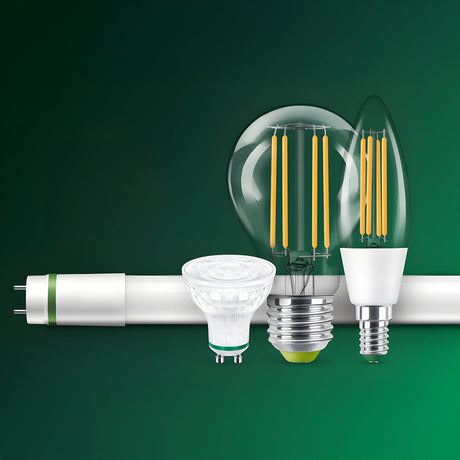
The cap has to match the lampholder, and it is the one thing that cannot be worked around. Screw caps are E27, the standard size, and E14, the small one used in candles and many lamps. Bayonet caps are B22 and the smaller B15. Spotlights in ceilings are usually GU10, which push in and twist, and the tiny two-pin capsules in pendants and wall lights are G9. If in doubt, take the old bulb out and read the letters on its base: they are the whole answer.
Warm white, cool white and daylight
Colour temperature decides the feel of a room more than brightness does. Warm white sits around 2700 to 3000 kelvin and is closest to the light of an old filament bulb, which is why it is the usual choice for living rooms and bedrooms. Cool white is crisper and suits kitchens, hallways and anywhere tasks happen. Daylight is the bluest and brightest to the eye, and is best kept for workspaces, garages and bathrooms rather than somewhere you relax. Mixing temperatures in one room is the most common reason a new set of bulbs looks wrong.
Dimmable and non-dimmable
Not every LED bulb will dim, and a non-dimmable bulb on a dimmer switch will flicker, buzz or fail early. If the circuit has a dimmer, choose a bulb marked dimmable, and ideally check the dimmer too: older dimmers were built for the heavy load of incandescent bulbs and can behave badly with the much lower draw of an LED. A modern trailing-edge dimmer is the reliable pairing. On an ordinary switch, a dimmable bulb works perfectly well and simply never uses the feature.
Filament LEDs
A filament LED looks like an old clear bulb, with thin glowing strands inside the glass, and it is still an LED underneath. That is the reason to choose one for a bulb that is on show: a pendant with no shade, a wall light with clear glass, a lamp where the bulb is part of the look. They are available in the same caps and shapes as standard LEDs, and in a warm amber tint as well as clear. For a bulb hidden inside a shade, a standard opal LED spreads the light more evenly and is the practical choice.
Shape, and why it matters more than it seems
The same cap comes in several shapes, and the shape changes how the light falls. A classic GLS spreads light in every direction and suits a shade. Candle and golf ball bulbs are smaller and suit chandeliers, wall lights and anything with a decorative arm. Spotlight bulbs throw their light forward in a beam, so they are right in a downlight and wrong in a table lamp. Check the length against the fitting as well: a bulb that pokes below a shade or will not fit a glass enclosure is the second most common return after the wrong cap.
Replacing halogen spotlights and capsules
Halogen is the bulb most people are replacing now, and the swap is usually straightforward. A mains GU10 halogen takes a GU10 LED directly. A G9 halogen capsule takes a G9 LED, though the LED is often a little longer, so check it clears the glass of the fitting. The one to watch is the low-voltage MR16 on a GU5.3 pin base, which runs through a transformer: an LED draws so little power that some older transformers never switch on properly, which shows up as flicker or a bulb that will not light at all. If that happens the transformer is the thing to change, not the bulb. LEDs also run far cooler than halogen, which is kinder to fittings, to shades and to anything mounted close to a spotlight.
Frequently Asked Questions
What wattage LED bulb do I need?
What wattage LED bulb do I need?
How do I know which fitting I have?
How do I know which fitting I have?
Can I use an LED bulb on a dimmer switch?
Can I use an LED bulb on a dimmer switch?
Warm white or cool white?
Warm white or cool white?
Are filament bulbs LED?
Are filament bulbs LED?
Why does my new LED bulb look different from the old one?
Why does my new LED bulb look different from the old one?
Related Collections


BestSellers
-

 £49499Unit price Translation missing: en.products.product.price.unit_price_separatorUnavailable
Caelith 1 Light Medium Carved Alabaster Wall Light - Brushed Brass
 Free Delivery
 In our showroom
 -

 £63999Unit price Translation missing: en.products.product.price.unit_price_separatorUnavailable3 In StockFree Delivery
 -

 £11,87999Unit price Translation missing: en.products.product.price.unit_price_separatorUnavailableFree Delivery
 -

 £1,42999Unit price Translation missing: en.products.product.price.unit_price_separatorUnavailable
Seraphis LED Medium Alabaster Ring Chandelier - Brushed Brass
Free Delivery -

 £1,31999Unit price Translation missing: en.products.product.price.unit_price_separatorUnavailableFree Delivery
 -

 £80299Unit price Translation missing: en.products.product.price.unit_price_separatorUnavailableFree Delivery
 -

 £1,20999Unit price Translation missing: en.products.product.price.unit_price_separatorUnavailableFree Delivery
 -

 Save 25%£65199£87000Unit price Translation missing: en.products.product.price.unit_price_separatorUnavailableFree Delivery
 -

 £1,64999Unit price Translation missing: en.products.product.price.unit_price_separatorUnavailableFree Delivery
 -

 £2,96999Unit price Translation missing: en.products.product.price.unit_price_separatorUnavailableFree Delivery
 -

 £1,53999Unit price Translation missing: en.products.product.price.unit_price_separatorUnavailableFree Delivery
 -

 £2,30999Unit price Translation missing: en.products.product.price.unit_price_separatorUnavailable
Stratalux LED Stacked Alabaster Column Floor Lamp - Matt Black
Free Delivery


Recommended For You
Our Reviews
-

Birmingham Based
British heritage. Worldwide delivery.
