
 £499Unit price Translation missing: en.products.product.price.unit_price_separatorUnavailable280 In Stock
 £299Unit price Translation missing: en.products.product.price.unit_price_separatorUnavailable1920 In Stock
 £3799Unit price Translation missing: en.products.product.price.unit_price_separatorUnavailable270 In Stock
 £3299Unit price Translation missing: en.products.product.price.unit_price_separatorUnavailable180 In Stock
 £2499Unit price Translation missing: en.products.product.price.unit_price_separatorUnavailable180 In Stock
 £2099Unit price Translation missing: en.products.product.price.unit_price_separatorUnavailable300 In Stock
 £1899Unit price Translation missing: en.products.product.price.unit_price_separatorUnavailable120 In Stock
 £299Unit price Translation missing: en.products.product.price.unit_price_separatorUnavailable5230 In Stock
 £399Unit price Translation missing: en.products.product.price.unit_price_separatorUnavailable480 In Stock
 £399Unit price Translation missing: en.products.product.price.unit_price_separatorUnavailable1110 In Stock
 £599Unit price Translation missing: en.products.product.price.unit_price_separatorUnavailable240 In Stock


What cool white is
Colour temperature is measured in kelvin, and cool white sits around 4000, in the middle of the household range. Warm white is lower, at about 2700 to 3000, and gives the yellow glow of an old filament bulb; daylight is higher, from about 5000 upwards, and reads as bright and blue. Cool white is neither yellow nor blue to most eyes. It is simply clean, neutral light, which is why it suits rooms where you want to see clearly without the room feeling clinical.
The rooms it suits
Kitchens are the classic cool white room, because food, surfaces and colours look true under it and a worktop is easier to work at. Bathrooms benefit for the same reason, especially around a mirror. Hallways, landings, utility rooms and garages all suit it, since they are places people move through or work in rather than sit in for an evening. A home office in cool white feels alert without the harshness of daylight. Living rooms and bedrooms are the exception, and most people prefer warm white there. A room that serves both purposes, such as a kitchen with a sofa at one end, is best handled with two circuits: cool white over the working area on one switch and warm white over the seating on another.
Cool white, warm white and daylight side by side
The three colours are best kept apart. Next to warm white, cool white can look faintly blue; next to daylight, it can look faintly yellow. In a single room, choose one colour for every fitting, and in an open-plan space let the change happen where the use changes, cool white over the kitchen and warm white over the sofa, far enough apart that the eye treats them as separate areas. Mixing colours across one ceiling is the most common reason new bulbs look wrong.
Spotlights and tubes
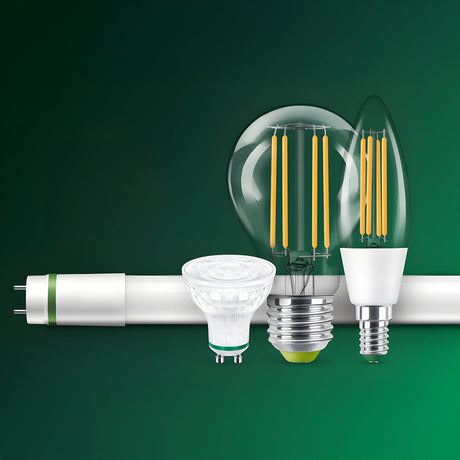
Much of this range is GU10 spotlights and tubes, because those are the bulbs that light kitchens and working spaces. A cool white GU10 downlight over a worktop throws clean light exactly where it is needed, and a run of them across a kitchen ceiling is the modern standard. Cool white tubes light garages, workshops and long utility rooms evenly, and an LED tube is the replacement for the old fluorescent kind: it starts instantly, does not hum and does not flicker as it warms up.
GLS, candle and golf ball
For shades and decorative fittings, cool white is available in GLS, candle and golf ball shapes, in E27 and E14 screw caps. A cool white GLS in a pendant over a kitchen table works well; a cool white candle in a bathroom wall light keeps the room bright and fresh. In a dining room chandelier, warm white is usually the better choice, because a dining room is an evening room. The shape and the colour are separate decisions: start with the cap and the shape the fitting needs, then choose the colour for the room.
Brightness and dimming
Shop by lumens rather than watts, because an LED gives far more light per watt than the bulb it replaces. Match the lumens of the old bulb and the room will look the same, at a fraction of the running cost. Cool white is often fitted for task lighting, so it is worth choosing enough lumens for the job rather than the minimum. If the circuit has a dimmer, choose a bulb marked dimmable; a non-dimmable LED on a dimmer will flicker or fail early. On an ordinary switch, a dimmable bulb works perfectly well and simply never uses the feature.
Changing a whole room at once
When a room is changed from old bulbs to cool white LEDs, change every fitting in the room together rather than one at a time as they fail. The first cool white bulb among warm ones will always look wrong, and it is the mixture rather than the new colour that people object to. Changing a kitchen or a bathroom in one go also means every bulb comes from the same range, so they match in colour and, on a dimmer, dim together. Keep one spare from the same range, so a future failure can be replaced without starting over.
Frequently Asked Questions
What kelvin is cool white?
What kelvin is cool white?
Is cool white good for a kitchen?
Is cool white good for a kitchen?
Cool white or daylight?
Cool white or daylight?
Can I mix cool white and warm white bulbs?
Can I mix cool white and warm white bulbs?
Are cool white bulbs dimmable?
Are cool white bulbs dimmable?
Can I replace a fluorescent tube with a cool white LED tube?
Can I replace a fluorescent tube with a cool white LED tube?
Related Collections


BestSellers
-

 £49499Unit price Translation missing: en.products.product.price.unit_price_separatorUnavailable
Caelith 1 Light Medium Carved Alabaster Wall Light - Brushed Brass
 Free Delivery
 In our showroom
 -

 £63999Unit price Translation missing: en.products.product.price.unit_price_separatorUnavailable3 In StockFree Delivery
 -

 £11,87999Unit price Translation missing: en.products.product.price.unit_price_separatorUnavailableFree Delivery
 -

 £1,42999Unit price Translation missing: en.products.product.price.unit_price_separatorUnavailable
Seraphis LED Medium Alabaster Ring Chandelier - Brushed Brass
Free Delivery -

 £1,31999Unit price Translation missing: en.products.product.price.unit_price_separatorUnavailableFree Delivery
 -

 £80299Unit price Translation missing: en.products.product.price.unit_price_separatorUnavailableFree Delivery
 -

 £1,20999Unit price Translation missing: en.products.product.price.unit_price_separatorUnavailableFree Delivery
 -

 Save 25%£65199£87000Unit price Translation missing: en.products.product.price.unit_price_separatorUnavailableFree Delivery
 -

 £1,64999Unit price Translation missing: en.products.product.price.unit_price_separatorUnavailableFree Delivery
 -

 £2,96999Unit price Translation missing: en.products.product.price.unit_price_separatorUnavailableFree Delivery
 -

 £1,53999Unit price Translation missing: en.products.product.price.unit_price_separatorUnavailableFree Delivery
 -

 £2,30999Unit price Translation missing: en.products.product.price.unit_price_separatorUnavailable
Stratalux LED Stacked Alabaster Column Floor Lamp - Matt Black
Free Delivery


Recommended For You
Our Reviews
-

Birmingham Based
British heritage. Worldwide delivery.
