
 Save 23%£13799£18000Unit price Translation missing: en.products.product.price.unit_price_separatorUnavailable
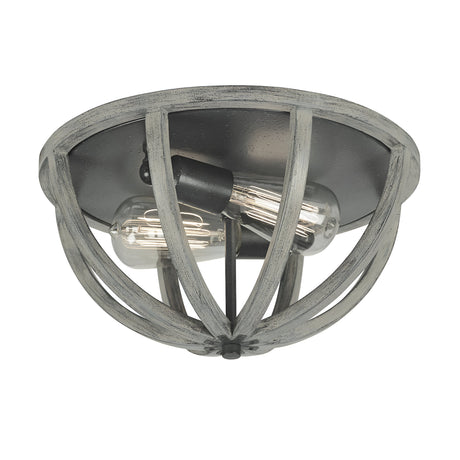
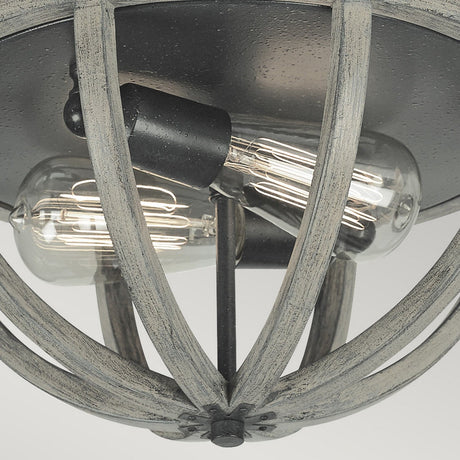
Allier 2 Light Flush Ceiling Light - Weathered Oak Wood & Antique Forged Iron
 Free Delivery
Flush, semi-flush and why it matters
A flush ceiling light, called a flush mount in the US, fixes straight to the ceiling with almost no drop. A semi-flush sits on a short stem and leaves a gap of 100 to 250mm, which lets light wash upward and softens the room. In a hallway, on a landing or under a low ceiling the flush version keeps headroom; anywhere above about 2.4 metres a semi-flush adds depth without getting in the way.
Bulkhead and cage designs
The bulkhead is the most recognisably industrial ceiling fitting: a round or oval body, a glass or polycarbonate diffuser and often a cage guard over it. It came from ships and factory corridors, where a fitting had to survive being knocked, and it still reads that way. Prismatic glass diffusers are the other workshop signature, moulded with ridges that scatter light sideways in a way plain opal does not, so a prismatic bulkhead lights a corridor further along its length than its size suggests. Polycarbonate versions do the same job and take an impact better, which is why they turn up in garages and workshops.
Rooms that suit them
Hallways, landings, utility rooms, garages and kitchens take industrial ceiling lights well, because the style tolerates hard surfaces and does not need soft furnishings around it to look settled. In a living room a semi-flush in aged brass warms the look and stops it reading as purely functional. A cage bulkhead over a back door works indoors and out if it carries the right IP rating, which is a useful way to make the inside and outside of a back entrance match. On a landing, keep the fitting clear of the swept path of the loft hatch if there is one, which is a detail that is easier to check than to fix.
IP ratings and where they are needed
Many industrial ceiling fittings are rated for damp or exposed positions, which is why they suit bathrooms, porches and garages. IP44 covers splashing and is the usual minimum for a bathroom ceiling or a sheltered porch. IP65 handles jets of water and suits an exposed outdoor soffit. IP20 is for dry indoor rooms whatever the fitting looks like.
Bulbs, output and colour
Some industrial ceiling lights take a replaceable bulb and others have a fixed LED module. A replaceable fitting lets you choose the tone: warm white around 2700K to 3000K for living spaces, cooler 4000K for a garage or utility room where you want clarity. On a fixed-LED fitting the colour is set at the factory, so check it on the product page.
Ceiling light or pendant?
The choice is usually settled by ceiling height and by what the room is for. A pendant puts light where you need it and defines a table or an island, but it needs height and it sits in the way in a corridor. A ceiling light gives even general light across a whole room and stays out of reach. Many rooms want both: a flush or semi-flush fitting for everyday light and a pendant over the table for the evening, on separate switches so either can be used alone.
Fitting and upkeep
Flush fittings need a level ceiling surface and enough space behind for the connection block, which is worth checking on a sloped or beamed ceiling before ordering. Glass diffusers on bulkheads unscrew or unclip for cleaning, and dust shows more on prismatic glass than on opal, so a prismatic fitting in a kitchen needs wiping more often than one in a hallway. Powder-coated metal wipes clean dry. Turn off at the consumer unit before removing a diffuser, and let a fitting that has been on for a while cool first.
Frequently Asked Questions
What is the difference between flush and semi-flush?
What is the difference between flush and semi-flush?
Which should I choose for a low ceiling?
Which should I choose for a low ceiling?
Can an industrial ceiling light go in a bathroom?
Can an industrial ceiling light go in a bathroom?
Are bulkhead lights only for outdoors?
Are bulkhead lights only for outdoors?
Do they take a normal bulb?
Do they take a normal bulb?
What colour temperature should I choose?
What colour temperature should I choose?
Related Collections


BestSellers
-

 £49499Unit price Translation missing: en.products.product.price.unit_price_separatorUnavailable
Caelith 1 Light Medium Carved Alabaster Wall Light - Brushed Brass
Free Delivery In our showroom
 -

 £63999Unit price Translation missing: en.products.product.price.unit_price_separatorUnavailable3 In StockFree Delivery
 -

 £11,87999Unit price Translation missing: en.products.product.price.unit_price_separatorUnavailableFree Delivery
 -

 £1,42999Unit price Translation missing: en.products.product.price.unit_price_separatorUnavailable
Seraphis LED Medium Alabaster Ring Chandelier - Brushed Brass
Free Delivery -

 £1,31999Unit price Translation missing: en.products.product.price.unit_price_separatorUnavailableFree Delivery
 -

 £80299Unit price Translation missing: en.products.product.price.unit_price_separatorUnavailableFree Delivery
 -

 £1,20999Unit price Translation missing: en.products.product.price.unit_price_separatorUnavailableFree Delivery
 -

 £2,96999Unit price Translation missing: en.products.product.price.unit_price_separatorUnavailable
Sorrelis 9 Light Alabaster Chandelier - Soft White & Brushed Brass
Free Delivery -

 £1,64999Unit price Translation missing: en.products.product.price.unit_price_separatorUnavailableFree Delivery
 -

 £2,96999Unit price Translation missing: en.products.product.price.unit_price_separatorUnavailableFree Delivery
 -

 £1,53999Unit price Translation missing: en.products.product.price.unit_price_separatorUnavailableFree Delivery
 -

 £2,30999Unit price Translation missing: en.products.product.price.unit_price_separatorUnavailable
Stratalux LED Stacked Alabaster Column Floor Lamp - Matt Black
Free Delivery


Recommended For You
Our Reviews
-

Birmingham Based
British heritage. Worldwide delivery.
