
 Sold out£999Unit price Translation missing: en.products.product.price.unit_price_separatorUnavailableOut of Stock
 £999Unit price Translation missing: en.products.product.price.unit_price_separatorUnavailable90 In Stock
 £999Unit price Translation missing: en.products.product.price.unit_price_separatorUnavailable5 In Stock
 Sold out£899Unit price Translation missing: en.products.product.price.unit_price_separatorUnavailableOut of Stock
 £799Unit price Translation missing: en.products.product.price.unit_price_separatorUnavailable120 In Stock
 Sold out£799Unit price Translation missing: en.products.product.price.unit_price_separatorUnavailableOut of Stock
 £899Unit price Translation missing: en.products.product.price.unit_price_separatorUnavailable5 In Stock
 £799Unit price Translation missing: en.products.product.price.unit_price_separatorUnavailable
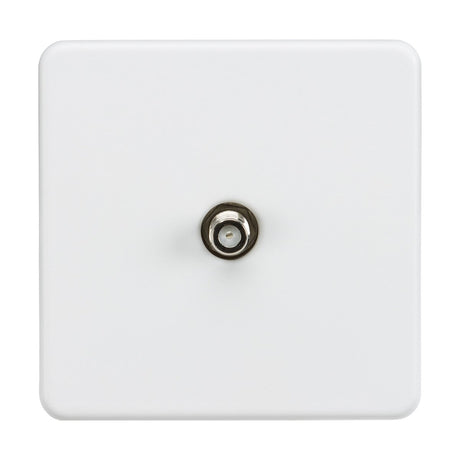
SAT TV Outlet F-Type Non-Isolated - Brushed Chrome Square Edge
60 In Stock


Terrestrial, satellite and why the connector differs
Three connector types cover almost everything. A coaxial socket takes the standard aerial plug and carries terrestrial television. An F-type connector, which screws rather than pushes, carries satellite and is what a dish feeds, and which we hold in smaller numbers than terrestrial. A cable connection uses its own arrangement depending on the provider. A plate can carry one, two or a mix, and the right one depends entirely on what arrives at the house rather than on what you watch.
One outlet per position, and how many positions
Almost every outlet here is single-gang, which suits the way aerial points are usually run: one plate per position, fed from a splitter or a distribution amplifier rather than doubled up at the wall. Where a satellite box needs two feeds for recording, that is two positions or a twin plate, and we hold a small number of twin and quad plates for exactly that case.
Count the inputs your equipment needs rather than the screens in the room, since one box can want two cables on its own. Then decide whether to run two cables to one wall or to split at the loft, which is usually the tidier answer in a house with an amplifier already in place.
Isolated, non-isolated, and the one that matters for safety
An isolated outlet places a capacitor between the aerial screen and the equipment, which prevents mains-borne currents travelling down the aerial cable. It is required where an aerial serves more than one property or where a communal system is involved, and it is sensible in a house with a loft-mounted amplifier. Non-isolated is fine for a single dwelling with a single aerial. Where a product is isolated we state it on the page, because it is not something you can see from the outside.
Screened and unscreened, and picture quality
A screened outlet maintains the cable's shielding through the plate. An unscreened one does not, and the break lets interference in. On a short run in a quiet electrical environment the difference may be invisible; on a long run near mains cable or a dimmer circuit it shows as picture breakup on digital terrestrial, which fails abruptly rather than degrading. If the outlet is going anywhere near lighting circuits, take the screened one.
Fitting one, and the two things that go wrong
Aerial work is not covered by Part P, so it is within reach of a competent person. Two things account for most poor results. The first is the plug: a coaxial plug wants the braid folded back over the outer sleeve and clamped, not twisted into a tail, and a badly made plug loses more signal than any length of cable. The second is bend radius — coax has a minimum bend it tolerates and forcing it into a shallow back box crushes the dielectric. Use a 35mm box rather than a 25mm one where you can.
Matching the plate to the wall
A television position usually sits at low level and often behind furniture, so this is one of the few plates where finish matters less than elsewhere. Where it is wall-mounted at eye level, it matters a great deal. Our outlets run in the same finishes and profiles as the switch and socket ranges, so a twin aerial plate beside a double socket reads as one installation. Where the television is bracket-mounted, check the plate clears the bracket before fixing.
What a wall outlet does not fix
Worth saying plainly: an outlet is a tidy termination, not an improvement. If reception is poor, the cause is upstream — the aerial, its alignment, the downlead, or a splitter dividing signal too many ways. A plate cannot add signal and a screened one only avoids losing more. Where one aerial feeds several rooms and every room is weak, the answer is a distribution amplifier rather than better outlets.
The one exception is a badly made termination, and that is worth checking before anything else. A plug with the braid twisted into a tail rather than folded back and clamped can cost several decibels on its own, which is the difference between a stable picture and one that breaks up on a windy evening. If a position has always been weak while others on the same aerial are fine, remake the plug at both ends before buying anything. It costs nothing and it resolves more complaints than any component swap. Where every room is weak, the fault is the aerial or the splitter, and no amount of work at the wall plate will reach it.
Frequently Asked Questions
What is the difference between a coaxial and an F-type outlet?
What is the difference between a coaxial and an F-type outlet?
Do I need an isolated outlet?
Do I need an isolated outlet?
What does screened mean?
What does screened mean?
Single or twin?
Single or twin?
Can I fit one myself?
Can I fit one myself?
Will an outlet improve my reception?
Will an outlet improve my reception?
Will it match my sockets?
Will it match my sockets?


BestSellers
-

 £63999Unit price Translation missing: en.products.product.price.unit_price_separatorUnavailable
 Free Delivery
 -

 £50599Unit price Translation missing: en.products.product.price.unit_price_separatorUnavailableFree Delivery
 -

 £11,87999Unit price Translation missing: en.products.product.price.unit_price_separatorUnavailableFree Delivery
 -

 £1,42999Unit price Translation missing: en.products.product.price.unit_price_separatorUnavailable
Seraphis LED Medium Alabaster Ring Chandelier - Brushed Brass
Free Delivery -

 Save 8%£49999£54299Unit price Translation missing: en.products.product.price.unit_price_separatorUnavailable
Helia 100cm LED Circular Pendant Light 55W 3000K - Matte Black
13 In StockFree Delivery -

 £80299Unit price Translation missing: en.products.product.price.unit_price_separatorUnavailableFree Delivery
 -

 £1,31999Unit price Translation missing: en.products.product.price.unit_price_separatorUnavailableFree Delivery
 -

 Save 25%£65199£87000Unit price Translation missing: en.products.product.price.unit_price_separatorUnavailableFree Delivery
 -

 £1,64999Unit price Translation missing: en.products.product.price.unit_price_separatorUnavailableFree Delivery
 -

 £2,96999Unit price Translation missing: en.products.product.price.unit_price_separatorUnavailableFree Delivery
 -

 £2,30999Unit price Translation missing: en.products.product.price.unit_price_separatorUnavailable
Stratalux LED Stacked Alabaster Column Floor Lamp - Matt Black
Free Delivery -

 £1,97999Unit price Translation missing: en.products.product.price.unit_price_separatorUnavailable
Caelith 10 Light Large Panel Alabaster Chandelier - Brushed Brass
Free Delivery


Recommended For You
Our Reviews
-

Birmingham Based
British heritage. Worldwide delivery.
