
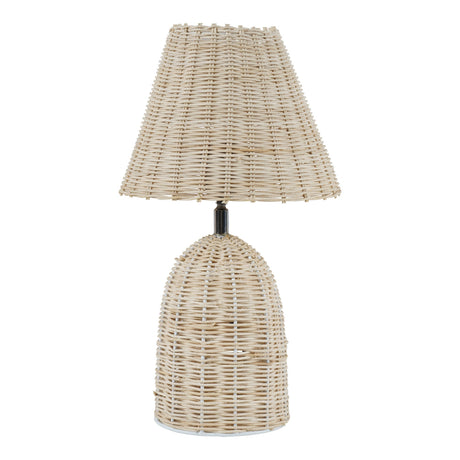
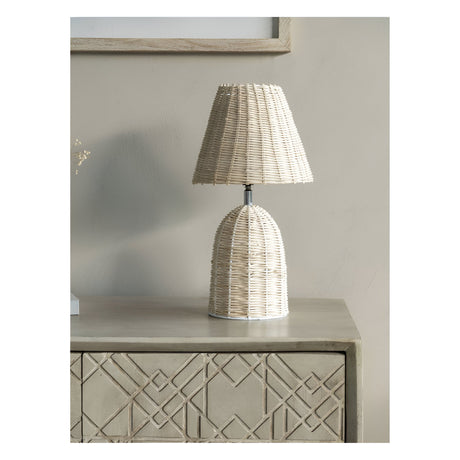
 £5099Unit price Translation missing: en.products.product.price.unit_price_separatorUnavailable1 In Stock
Height against the table it stands on
The working rule is that the bottom of the shade should sit near eye level when you are seated beside it, which on a standard side table means a lamp of roughly 40cm to 50cm overall. Too tall and you look straight at the lamp; too short and it lights the table rather than the room.
A console table behind a sofa is the other position worth planning for. A lamp there lights the wall and the back of the room rather than the seating, which is what stops a living room reading as a lit island in a dark space. It also keeps the cable behind the furniture, which solves the usual problem of where the flex goes.
Pairs, and when they are worth it
Two matching lamps at either end of a sofa give even light and read as deliberate. One lamp on its own works beside a chair but leaves the other end of the room dark. Where you buy a pair, buy them together: finishes drift between production runs and two antique brass lamps bought a year apart rarely match.
Shade width and the table underneath
Shades here run 10cm to 47cm across. The shade should not overhang the table it stands on, and a lamp whose shade is wider than its table looks unstable even when it is not. On a narrow console, the taller narrow lamps in this collection are the ones that fit.
The proportion inside the lamp matters as well. As a rough guide the shade should be about two thirds the height of the base and wide enough to hide the lamp holder from a seated eyeline. A shade that is too small leaves the fitting visible and a shade that is too large makes the base look like an afterthought.
Lamp caps and dimming
Most of these take E27, with E14 and G9 behind. If you want the lamp to dim, the dimming is done by the lamp and the switch, not the fitting: fit a dimmable LED and use either a plug-in inline dimmer on the cable or a dimmer on the socket circuit. A non-dimmable LED on a dimmer will flicker or buzz.
Finish and the metal already in the room
Antique brass, polished chrome and satin nickel lead here. A table lamp sits at eye level and is one of the few fittings people look directly at, so matching it to the nearest metal in the room, a door handle or a picture frame, does more for a scheme than matching it to the ceiling light.
Two or three table lamps at 400 to 600 lumens each will light a living room for an evening without the ceiling light, which is usually the point of buying them. Spread them around the room rather than grouping them, and put at least one on the far side from the seating so the room has depth after dark.
Sockets and cable runs
A table lamp is only as convenient as the socket behind it. Before settling on a position, check the run: a cable stretched taut across a walkway is the commonest reason a lamp ends up somewhere it was not meant to be, and it is a trip hazard.
Frequently Asked Questions
How tall should a living room table lamp be?
How tall should a living room table lamp be?
Should I buy table lamps in pairs?
Should I buy table lamps in pairs?
How wide should the shade be?
How wide should the shade be?
Can table lamps be dimmed?
Can table lamps be dimmed?
Which finish should I choose?
Which finish should I choose?
What lamp cap do these use?
What lamp cap do these use?
Is one table lamp enough?
Is one table lamp enough?
Related Collections


BestSellers
-

 £63999Unit price Translation missing: en.products.product.price.unit_price_separatorUnavailable1 In Stock3 In Production · 26 Nov
 Free Delivery
-

 £49499Unit price Translation missing: en.products.product.price.unit_price_separatorUnavailable
Caelith 1 Light Medium Carved Alabaster Wall Light - Brushed Brass
4 In Production · 26 NovFree Delivery In our showroom
-

 £1,31999Unit price Translation missing: en.products.product.price.unit_price_separatorUnavailable1 In Production · 26 NovFree Delivery
-

 £2,96999Unit price Translation missing: en.products.product.price.unit_price_separatorUnavailable
Sorrelis 9 Light Alabaster Chandelier - Soft White & Brushed Brass
Made to OrderFree Delivery -

 Save 8%£49999£54299Unit price Translation missing: en.products.product.price.unit_price_separatorUnavailable
Helia 100cm LED Circular Pendant Light 55W 3000K - Matt Black
Available to OrderFree Delivery -

 £79999Unit price Translation missing: en.products.product.price.unit_price_separatorUnavailable4 In StockFree DeliveryIn our showroom
-

 £1,07799Unit price Translation missing: en.products.product.price.unit_price_separatorUnavailable
Aleron LED Large Round Alabaster Flush Ceiling Light - Soft White & Brushed Brass
Made to OrderFree Delivery -

 £80299Unit price Translation missing: en.products.product.price.unit_price_separatorUnavailable1 In Production · 26 NovFree Delivery
-

 £2,96999Unit price Translation missing: en.products.product.price.unit_price_separatorUnavailableMade to OrderFree Delivery
-

 £1,53999Unit price Translation missing: en.products.product.price.unit_price_separatorUnavailableMade to OrderFree Delivery
-

 £1,42999Unit price Translation missing: en.products.product.price.unit_price_separatorUnavailable
Seraphis LED Medium Alabaster Ring Chandelier - Brushed Brass
Made to OrderFree Delivery -

 £2,09999Unit price Translation missing: en.products.product.price.unit_price_separatorUnavailable
Auriel 19 Light Alabaster Cluster Chandelier - Brushed Brass
Made to OrderFree Delivery


Recommended For You
Our Reviews
-

Birmingham Based
British heritage. Worldwide delivery.
