
 £90799Unit price Translation missing: en.products.product.price.unit_price_separatorUnavailable
Volute Cast Aluminium Outdoor 2 Light Lamp Post 256cm - Cast Plinth with Access Door
 Free Delivery
 £85099Unit price Translation missing: en.products.product.price.unit_price_separatorUnavailable
Volute Cast Aluminium Outdoor 2 Light Lamp Post 256cm - Cast Plinth Base
Free Delivery £1,11699Unit price Translation missing: en.products.product.price.unit_price_separatorUnavailable
Volute Cast Aluminium Outdoor 3 Light Lamp Post 256cm - Cast Plinth with Access Door
Free Delivery £1,04999Unit price Translation missing: en.products.product.price.unit_price_separatorUnavailable
Volute Cast Aluminium Outdoor 3 Light Lamp Post 256cm - Cast Plinth Base
Free Delivery £25499Unit price Translation missing: en.products.product.price.unit_price_separatorUnavailableFree Delivery
 £29099Unit price Translation missing: en.products.product.price.unit_price_separatorUnavailableFree Delivery
 £21599Unit price Translation missing: en.products.product.price.unit_price_separatorUnavailableFree Delivery
 £31499Unit price Translation missing: en.products.product.price.unit_price_separatorUnavailableFree Delivery
 £69999Unit price Translation missing: en.products.product.price.unit_price_separatorUnavailableFree Delivery
 £85099Unit price Translation missing: en.products.product.price.unit_price_separatorUnavailableFree Delivery
 £1,02199Unit price Translation missing: en.products.product.price.unit_price_separatorUnavailableFree Delivery
 £59399Unit price Translation missing: en.products.product.price.unit_price_separatorUnavailableFree Delivery
 £65899Unit price Translation missing: en.products.product.price.unit_price_separatorUnavailableFree Delivery
 £69699Unit price Translation missing: en.products.product.price.unit_price_separatorUnavailableFree Delivery
 £43199Unit price Translation missing: en.products.product.price.unit_price_separatorUnavailableFree Delivery
 £66099Unit price Translation missing: en.products.product.price.unit_price_separatorUnavailable
Mullion Cast Aluminium Outdoor Adjustable Lamp Post - 134-199cm
Free Delivery £69499Unit price Translation missing: en.products.product.price.unit_price_separatorUnavailable
Mullion Cast Aluminium Outdoor Adjustable Lamp Post - 153-237cm
Free Delivery £69999Unit price Translation missing: en.products.product.price.unit_price_separatorUnavailable
Mullion Cast Aluminium Outdoor Adjustable Lamp Post - 160-224cm
Free Delivery £85099Unit price Translation missing: en.products.product.price.unit_price_separatorUnavailable
Mullion Cast Aluminium Outdoor Adjustable 2 Light Lamp Post - 202-267cm
Free Delivery £1,02199Unit price Translation missing: en.products.product.price.unit_price_separatorUnavailable
Mullion Cast Aluminium Outdoor Adjustable 3 Light Lamp Post - 202-267cm
Free Delivery £21199Unit price Translation missing: en.products.product.price.unit_price_separatorUnavailableFree Delivery
 £25299Unit price Translation missing: en.products.product.price.unit_price_separatorUnavailableFree Delivery
 £25099Unit price Translation missing: en.products.product.price.unit_price_separatorUnavailableFree Delivery
 £37199Unit price Translation missing: en.products.product.price.unit_price_separatorUnavailableFree Delivery
 £69999Unit price Translation missing: en.products.product.price.unit_price_separatorUnavailableFree Delivery
 £90499Unit price Translation missing: en.products.product.price.unit_price_separatorUnavailable
Mullion Large Cast Aluminium Outdoor 2 Light Lamp Post - 262cm
Free Delivery £1,11399Unit price Translation missing: en.products.product.price.unit_price_separatorUnavailable
Mullion Large Cast Aluminium Outdoor 3 Light Lamp Post - 262cm
Free Delivery
 £69999Unit price Translation missing: en.products.product.price.unit_price_separatorUnavailableFree Delivery
 £96599Unit price Translation missing: en.products.product.price.unit_price_separatorUnavailable
Mullion Large Cast Aluminium Outdoor 2 Light Lamp Post - 300cm
Free Delivery £1,17299Unit price Translation missing: en.products.product.price.unit_price_separatorUnavailable
Mullion Large Cast Aluminium Outdoor 3 Light Lamp Post - 300cm
Free Delivery £65499Unit price Translation missing: en.products.product.price.unit_price_separatorUnavailableFree Delivery
 £69999Unit price Translation missing: en.products.product.price.unit_price_separatorUnavailableFree Delivery
 £69999Unit price Translation missing: en.products.product.price.unit_price_separatorUnavailable
Mullion Large Cast Aluminium Outdoor Lamp Post 262cm - Flange Plate Base
Free Delivery £47899Unit price Translation missing: en.products.product.price.unit_price_separatorUnavailable
Mullion Large Cast Aluminium Outdoor Adjustable Lamp Post - 148cm
Free Delivery
 £69999Unit price Translation missing: en.products.product.price.unit_price_separatorUnavailable
Mullion Large Cast Aluminium Outdoor Adjustable Lamp Post - 138-203cm
Free Delivery
 £69999Unit price Translation missing: en.products.product.price.unit_price_separatorUnavailable
Mullion Large Cast Aluminium Outdoor Adjustable Lamp Post - 157-241cm
Free Delivery
 £69999Unit price Translation missing: en.products.product.price.unit_price_separatorUnavailable
Mullion Large Cast Aluminium Outdoor Adjustable Lamp Post - 136-228cm
Free Delivery
 £69999Unit price Translation missing: en.products.product.price.unit_price_separatorUnavailable
Mullion Large Cast Aluminium Outdoor Adjustable Lamp Post - 193-258cm
Free Delivery £88699Unit price Translation missing: en.products.product.price.unit_price_separatorUnavailable
Mullion Large Cast Aluminium Outdoor Adjustable 2 Light Lamp Post - 193-258cm
Free Delivery £1,08999Unit price Translation missing: en.products.product.price.unit_price_separatorUnavailable
Mullion Large Cast Aluminium Outdoor Adjustable 3 Light Lamp Post - 193-258cm
Free Delivery £25199Unit price Translation missing: en.products.product.price.unit_price_separatorUnavailableFree Delivery
 £26199Unit price Translation missing: en.products.product.price.unit_price_separatorUnavailable
Mullion Large Cast Aluminium Outdoor Hanging Wall Lantern 41cm Projection
Free Delivery £16899Unit price Translation missing: en.products.product.price.unit_price_separatorUnavailableFree Delivery
 £24199Unit price Translation missing: en.products.product.price.unit_price_separatorUnavailableFree Delivery
 £11899Unit price Translation missing: en.products.product.price.unit_price_separatorUnavailableFree Delivery
 £26199Unit price Translation missing: en.products.product.price.unit_price_separatorUnavailable
Mullion Large Cast Aluminium Outdoor Wall Lantern 41cm Projection
Free Delivery £19299Unit price Translation missing: en.products.product.price.unit_price_separatorUnavailableFree Delivery
 £17999Unit price Translation missing: en.products.product.price.unit_price_separatorUnavailableFree Delivery


Why black is the default outdoor finish
Black is the finish most people reach for outside, and the reasons are practical before they are aesthetic. It disappears against a dark elevation at night, so what you see is the light rather than the fitting. It holds up against brick, render, stone, timber and painted joinery without needing to match any of them. And it hides the film of road dust and pollen that settles on everything outdoors between cleans, which a white or a polished finish does not. Against that, black shows salt bloom on a coast and it warms in direct sun, so an exposed south wall works the fitting harder than a north one.
Matt, gloss, satin and textured black are not the same thing
The word covers several surfaces that behave differently. A matt or textured powder coat scatters light, hides small scratches and reads as a modern finish. A gloss or enamel black reflects, picks out cast detail on a traditional lantern and shows a chip more clearly. Satin sits between them. Anthracite and graphite are separate finishes rather than shades of black, closer to a very dark grey, and they read lighter on a bright day. If you are matching an existing fitting, the sheen matters more than the colour name, so it is worth checking a product page for the exact wording before ordering a second piece.
Choosing an IP rating for the position
The number describes how well a fitting keeps dust and water out. IP44 covers splashing from any direction and suits a covered porch, a carport, a recessed entry or a sheltered wall. IP54 steps up for open elevations and coastal gusts. IP65 resists jets, which makes it the right choice for a fully open position, a garden wall, a driveway post or anywhere a pressure washer gets used. Our black outdoor range spans these levels and every product page states its rating. Fittings intended for permanent outdoor use should be installed by a qualified electrician on a suitably protected circuit.
Wall lights, posts, bollards and ground lights
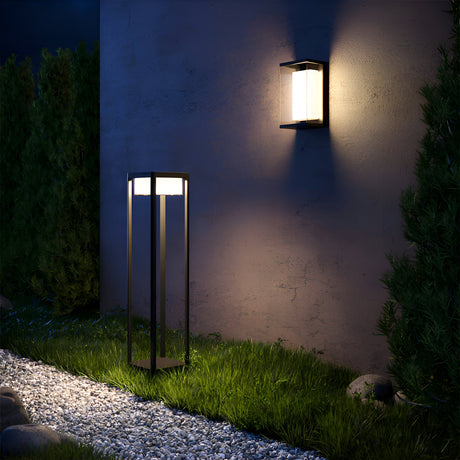
Wall lights do the most work: up and down cylinders for a modern elevation, lanterns and bulkheads for a period one, flush boxes where a door swings close. Lamp posts and pedestal lights light a drive or a path from their own column and need groundwork. Bollards mark an edge at knee to waist height without glare into a window. Ground and decking lights sit flush in a surface and graze it. Pillar lights stand on gate piers. Most schemes use two or three of these rather than one, and keeping them all in the same black is what makes a run of different shapes read as one decision.
Mounting heights and where to put things
Entrance lights go at roughly 1.8m to 2m, level with or just above eye height, so the lamp stays out of direct view. A pair either side of a door removes the shadow a single fitting leaves on the steps. Along a path or drive, space fittings evenly and keep the beam low so it does not throw into a window or a neighbour's garden. Bollards suit an edge rather than the middle of an open area. Think about where the cable can run before you settle on a position, because a route across newly pointed brick or fresh render is a conversation you want to have early.
Lamps, colour temperature and controls
Where a fitting takes a replaceable lamp, the output and the colour stay your choice. Around 2700K reads warm and suits a period elevation and most front doors; 3000K is a little cleaner; 4000K reads cold outdoors and is usually better kept for a working area than a house front. Integrated LED fittings fix that choice at the factory, which is worth knowing before you buy a run of them. For switching, a photocell or a timer on the circuit is tidier across several fittings than a sensor in each head, and it keeps the whole run behaving the same way.
Looking after a black outdoor finish
Rinse with clean water and a soft cloth, and do it more often within a few miles of the sea, where salt dulls a powder coat faster than anything else. Avoid abrasive pads and solvent cleaners, which take the sheen off and leave a patch that catches the eye. A chip on a painted finish is worth touching in early, because on a steel fitting it is the start of a rust bloom rather than a cosmetic mark. Aluminium and stainless bodies are more forgiving on that count. Check the gaskets and the lens seal every couple of years on anything in an exposed position.
Frequently Asked Questions
What IP rating do I need for a black outdoor light?
What IP rating do I need for a black outdoor light?
Is matt black or gloss black better outside?
Is matt black or gloss black better outside?
Is anthracite the same as black?
Is anthracite the same as black?
How high should outdoor wall lights be mounted?
How high should outdoor wall lights be mounted?
Will black fade in sunlight?
Will black fade in sunlight?
What colour temperature suits an outdoor light?
What colour temperature suits an outdoor light?
Can I mix wall lights, posts and bollards?
Can I mix wall lights, posts and bollards?
Related Collections


BestSellers
-

 £49499Unit price Translation missing: en.products.product.price.unit_price_separatorUnavailable
Caelith 1 Light Medium Carved Alabaster Wall Light - Brushed Brass
Free Delivery In our showroom
 -

 £63999Unit price Translation missing: en.products.product.price.unit_price_separatorUnavailable3 In StockFree Delivery
 -

 £11,87999Unit price Translation missing: en.products.product.price.unit_price_separatorUnavailableFree Delivery
 -

 £1,42999Unit price Translation missing: en.products.product.price.unit_price_separatorUnavailable
Seraphis LED Medium Alabaster Ring Chandelier - Brushed Brass
Free Delivery -

 £1,31999Unit price Translation missing: en.products.product.price.unit_price_separatorUnavailableFree Delivery
 -

 £80299Unit price Translation missing: en.products.product.price.unit_price_separatorUnavailableFree Delivery
 -

 £1,20999Unit price Translation missing: en.products.product.price.unit_price_separatorUnavailableFree Delivery
 -

 Save 25%£65199£87000Unit price Translation missing: en.products.product.price.unit_price_separatorUnavailableFree Delivery
 -

 £1,64999Unit price Translation missing: en.products.product.price.unit_price_separatorUnavailableFree Delivery
 -

 £2,96999Unit price Translation missing: en.products.product.price.unit_price_separatorUnavailableFree Delivery
 -

 £1,53999Unit price Translation missing: en.products.product.price.unit_price_separatorUnavailableFree Delivery
 -

 £2,30999Unit price Translation missing: en.products.product.price.unit_price_separatorUnavailable
Stratalux LED Stacked Alabaster Column Floor Lamp - Matt Black
Free Delivery


Recommended For You
Our Reviews
-

Birmingham Based
British heritage. Worldwide delivery.
