
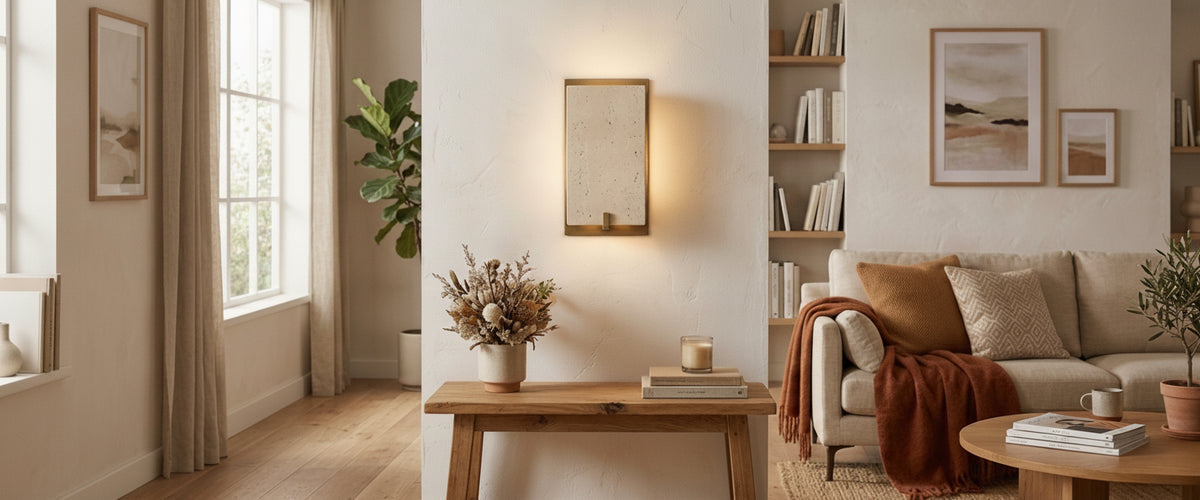

Hold a thin offcut of lighting travertine up to a bare bulb and you will see something odd. It does not light up like alabaster. Instead of that deep honeyed translucency, you get a soft, grainy blush of warmth across the surface and a firm shadow behind it. That difference is not a fault. It is the whole reason a travertine light fixture reads as quiet and architectural where alabaster reads as jewel-like, and knowing which effect you actually want is most of the buying decision.

At a Glance: What Light Travertine Does to a Room
- It reflects more than it transmits. Expect a warm wash on nearby surfaces rather than a lantern-like inner glow.
- Pores are the point. The stone's open cavities scatter light and give it a matt, chalky softness that polished marble cannot copy.
- Colour temperature is critical. 2700K flatters the beige and cream tones; 3000K is the practical ceiling, and by 3500K the stone reads grey and flat.
- Wall and ceiling placements win. Travertine earns its keep where the light grazes a surface, not where it has to fill a whole room alone.
- Care differs from other stone. Porosity means dust settles into the surface, and acidic cleaners will etch it permanently.

Pore Structure Versus Density: Why Light Travertine Refuses to Glow Like Alabaster
Travertine forms where mineral-rich water rises through the ground and calcium carbonate precipitates around escaping gas, which is why the finished stone is riddled with small voids and channels. The British Geological Survey groups it with the freshwater limestones, and that origin story is written all over the material: layered, banded, full of trapped bubbles.
Alabaster, by contrast, is a fine-grained gypsum with a crystal structure tight and even enough to let light travel some distance through the body of the stone. Put a lamp behind alabaster and the whole panel lifts. Put the same lamp behind light travertine and much of the light bounces off internal pore walls before it can get through. What escapes is diffuse, low in contrast, and slightly grainy.
In practice that gives you two different tools. Alabaster is what we reach for when a client wants a pendant that becomes a glowing object in its own right. Travertine is what we reach for when the fixture should sit back into a wall of plaster and let the light do the talking. We keep offcuts of both on the studio bench with a small lamp behind them, and it settles arguments quickly. Two pieces cut from the same travertine block can also read differently: one warms towards honey, the other stays cool and mineral. That variation is normal and, frankly, half the appeal.
Reading a Slab Before You Buy: Veining, Shell Fossils and What They Predict
Because most travertine lighting uses a relatively thick section of stone, you are judging surface behaviour more than transmission. A few things to look for:
- Banding direction. Vein-cut travertine (sliced against the bedding) gives long linear striations that suit vertical wall lights and read as calm and modern. Cross-cut (sliced with the bedding) gives cloudier, flower-like figuring that suits discs and domes.
- Filled or unfilled. Filled travertine has its pores packed with resin or cement, giving a smoother, more uniform face and a cleaner reflected wash. Unfilled keeps the cavities open, catches raking light beautifully, and collects dust more readily.
- Shell fossils and pore clusters. Small fossil traces and dense pockets of pores scatter light more aggressively, so those areas will read lighter and softer once the lamp is on. Hold the sample near a window at an angle before committing.
- Base colour. Light travertine ranges from bone and pale cream to warm beige with walnut-brown edges. Cream bases stay honest under warm bulbs; greyer stone can go flat.
One more thing worth checking, particularly if you are coordinating a whole scheme: interior fixtures rarely match paving exactly. Clients often ask whether a travertine wall light will tie into their light classic travertine pavers outside on a terrace. Usually it harmonises rather than matches, because paver grades are cut, finished and weathered differently. Aim for family resemblance, not a colour match.
Ceiling or Wall? Where a Travertine Light Fixture Actually Earns Its Price
Wall Lights: The Strongest Case
This is where travertine is at its best. A rectangular sconce or a hanging dome wall light throws warm light up and down a plaster surface, and the stone's matt face picks up that reflected glow without any glare. In a narrow hallway where a deep fixture would catch shoulders, a shallow, small-format piece such as the Bravora 1 Light Small Rectangular Travertine Wall Light holds the wall better than a broad panel. Mount at roughly 1.5 to 1.7m (about 60 to 66 inches) from the floor in a hallway, and lower over a headboard so the light lands on the pillow rather than in your eyes. Pairs work better than singles in corridors; the rhythm matters more than the output.
Ceiling and Flush Mounts: Quiet Competence
A travertine ceiling lights suits rooms with limited head height where a pendant would intrude. A travertine flush mount light in a 2.4m (roughly 8 foot) hallway or a boot room gives you a warm, low-glare disc that looks considered rather than utilitarian. The trade-off is honest: because the stone transmits so little, a flush mount alone will not light a large kitchen. Treat it as the ambient layer and add task lighting underneath.
Pendants: Good Over Something, Weak in Isolation
A travertine disc or cone pendant over an island or dining table is excellent, because the downward light pools on the surface and the stone body reads as a solid sculptural mass. Over a long table where the fixture should stay visually low and horizontal, a flat profile like the Torvane 1 Light Travertine Disc Pendant keeps sightlines clear in a way a deep cone does not. Hang the base around 75 to 85cm (30 to 33 inches) above a table top. Where travertine fades is the middle of a large open-plan room with nothing beneath it. Suspended in space with no surface to catch the light, it can look inert. That is the job for alabaster, and you can compare the two effects across the alabaster lighting collection before you decide which stone belongs where.
Why 2700K Is Almost Non-Negotiable With Light Travertine
Beige stone is unforgiving about colour temperature. At 2700K, the cream and biscuit tones in light travertine come forward and the walnut edges deepen. At 3500K and above, the same stone drifts towards a cold putty grey, and every pore reads as a dark speck rather than a soft shadow.
Specify LEDs at 2700K with a colour rendering index of 90 or higher. Low-CRI sources flatten the subtle mineral variation that you paid for in the first place. Dimming should be smooth down to around 5 per cent, and for any fixture with an integrated LED module, confirm the driver and dimmer are compatible before installation rather than after. Retrofit lamps in a travertine light will nearly always look better as a frosted globe or candle than a clear filament, because a visible bright point behind stone creates hot spots at the thinnest sections.
All mains wiring should be carried out by a qualified electrician, particularly with heavier stone fixtures where the ceiling fixing has to be right first time.
Pairing Travertine Light With Plaster, Limewash and Raw Concrete
Travertine has been having a long run in British interiors, and it sits most convincingly against surfaces with a similar tactile honesty. Polished plaster and limewash walls share the same soft, slightly irregular light response, so a travertine wall light reads as part of the wall rather than an object stuck onto it. Against raw or board-marked concrete, the warm beige does useful work, cutting the coolness without introducing a competing pattern.
Be careful with high-gloss lacquer, mirror and chrome. The contrast is not flattering; the stone starts to look dusty next to them. Aged brass, walnut, oiled oak and unlacquered bronze are far better companions, and a slim brass backplate under a travertine shade gives the eye somewhere to land. Where walnut joinery or dark timber is already doing the work in a room, a fixture that carries the same tone in its fittings, such as the Rovano Travertine Hanging Dome Wall Light, ties the wall back to the furniture rather than competing with it. The limewashed stairwell above makes the point: the decorator left the plaster deliberately uneven, and under 2700K the two textures read as one continuous surface.
If you are mixing stone types across a single home, keep one material dominant. Travertine in the circulation spaces and alabaster in the reception rooms works. Alternating them room by room does not. The wider lighting collection is worth scanning as a whole for that reason, since it is easier to see how finishes carry through a scheme when you look across a range instead of at one fixture in isolation.
Porous by Nature: Why Travertine Demands Different Care
Every open pore is somewhere for dust and cooking grease to settle, and travertine is calcium carbonate, which means acid attacks it. Vinegar, lemon juice, descaler and most bathroom sprays will etch a dull mark into the surface that cannot be wiped away. The Natural Stone Institute publishes clear guidance on cleaning and sealing calcareous stone, and it is worth reading before you buy any cleaner.
Practical routine for a travertine light fixture:
- Switch off and let the fixture cool completely before touching it.
- Dust with a dry soft brush, working across unfilled pores rather than pressing into them. A clean makeup brush is ideal.
- For marks, use a barely damp cloth with a pH-neutral stone cleaner. Never soak the stone or let water sit in a pore.
- Dry immediately with a soft microfibre cloth to prevent water spotting.
- Avoid ammonia, bleach, scouring pads and anything labelled for glass or limescale.
- In kitchens, wipe more often. Airborne grease darkens porous stone gradually and is much harder to remove once it has cured.
- Ask your supplier whether the piece was sealed at the factory and, if so, what type. Colour-enhancing sealers deepen the stone; neutral impregnating sealers keep it pale.
Buyer's Checklist for Light Travertine Fixtures
- Have you seen a photograph of the actual stone, not a generic sample? Variation is real.
- Filled or unfilled, and does that match the room's cleaning reality?
- Is there a surface for the light to land on, or will the fixture float unsupported?
- 2700K, CRI 90+, frosted lamp, dimmer confirmed compatible?
- Is the fixing point suitable for the weight, and is a qualified electrician booked?
- Does the metal detailing (brass, bronze, walnut) echo something else in the room?
- For international orders, has the crating been specified for stone rather than standard lighting packaging?
Budget for stone lighting depends on the block the piece is cut from, the scale, the complexity of the machining and the metalwork, plus installation and finishing on site. Rather than guess, ask for a tailored quote against your actual room dimensions and fixture count. If you are still weighing travertine against alabaster or onyx, start from the Niori homepage and compare how each stone handles light before you commit a whole scheme to one material.