
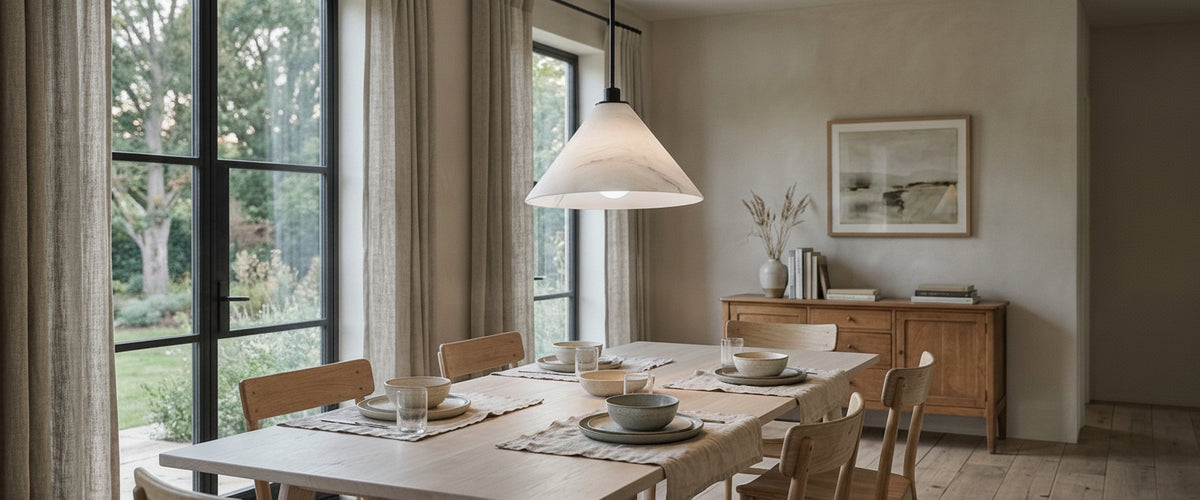

Most people buy a wood shade pendant lights at two in the afternoon and only find out what they bought at eight in the evening. In daylight you are judging colour, grain and silhouette. After dark, the shade becomes a light-control device, and every choice the maker made (species, thickness, the size of the opening at the bottom) shows up on your table, your walls and your guests' faces. As an alabaster and natural-stone lighting brand, Niori spends a lot of time thinking about how materials hold and release light. Wood behaves very differently from stone, and that difference is the point of this piece.
At a glance
- Solid wood is opaque. Light leaves only through the aperture, so the opening size decides how focused or generous the pool is.
- Thin veneer can glow faintly, and pale species glow more than dark ones.
- Dark timbers such as walnut absorb light inside the shade; pale timbers such as ash and maple bounce it back out.
- Hang 75 to 90 cm (30 to 36 inches) above a dining table and choose 2700K for warmth.
- Check seam finish, fitting quality and the maximum bulb wattage before you buy.

How Timber Species and Grain Sculpt the Light
Think of the inside of a wooden pendant lights shade as a reflector you cannot see. A pale timber like ash, maple or birch returns a good share of the light that hits it, so more of the bulb's output reaches the room and the pool below feels softer at the edges. Walnut and smoked oak do the opposite. They swallow light, which gives a tighter, moodier cone and a shade that reads almost black from across the room. The Wood Database entry on ash is a useful reference if you want to compare colour and grain character between species before choosing.
Grain direction matters more than most buyers expect. On a cylinder or cone, vertical grain pulls the eye downward toward the light source and makes a low-hung pendant look taller and calmer. Horizontal or rotary-cut grain wraps around the form and reads busier, especially when the bulb picks out every ripple near the rim. Open-grained oak catches raking light at the lower edge; close-grained maple stays quiet.

Veneer Versus Solid Wood: The Difference Shows Up After Dark
Pick up both in a showroom and they can look identical. Switch them on and they part ways. A solid turned or coopered shade is fully opaque, so its outer surface stays a warm, unlit object and all the drama happens below it. Veneer shades, usually laminated sheets well under a millimetre thick, let a faint amber glow through the walls, with the grain appearing as darker striations against the light.
A simple test: before buying any wood shade pendant light, hold it up to a bare bulb. If you can see the bulb's shape through the timber, you are looking at a translucent veneer, and the shade will behave a little like a paper lantern with a warmer, denser tint. If you see nothing, it is a directional downlight with a wooden jacket. Neither is better. They do different jobs, and buyers who expect one and get the other are the ones who end up disappointed.
This is also where wood and stone diverge most clearly. Alabaster and onyx stay translucent at a much greater thickness, so the whole body of the fixture glows evenly. A wood shade pendant light, even in veneer, gives you a darker body and a stronger contrast between shade and pool. Knowing which effect you want is the first real decision.
Aperture Size and Bulb Position: The Small Opening That Changes Everything
The aperture is the most underrated dimension on any opaque pendant. A narrow opening of around 10 to 13 cm (4 to 5 inches) produces a crisp, theatrical circle, good over a kitchen island or a bar counter where you want light on the surface and nowhere else. A wide, open-bottomed bell spreads light across a dining table and up into the faces of the people sitting at it.
Bulb position inside the shade works with the aperture. If the bulb sits deep in the crown, the shade cuts off glare and you see only a lit rim. If it drops close to the opening, the bulb becomes visible from a seated position, which is the most common complaint we hear about wood shade pendant lights. Ask whether the lampholder is adjustable, and if not, check the drop from the top of the shade to the bulb tip against the shade's overall depth.
Where a Wood Shade Pendant Light Enriches a Room and Where It Simply Darkens It
Wood earns its place in rooms that already have plenty of reflective surfaces: pale plaster, limestone floors, white oak joinery, marble worktops. In a Georgian kitchen in Bath with lime-washed walls, a pair of ash cylinders over the island adds warmth without cutting down usable light. In a room like that, a pale, upright form such as the Taria Cylinder Pendant Light in Ash is closer to the right design language than a dark, wide-mouthed cone. In a north-facing London basement with dark painted cabinetry, the same pair can feel like two holes in the ceiling.
Picture a small wine bar with dark walnut cones hung the full length of the counter. Handsome by day; by evening, the room beyond the bar top turns cave-like. The fix is not to remove them. Keep the walnut over the counter for focused task light and add alabaster wall lights along the opposite wall to lift the vertical surfaces. That combination is our most common recommendation: let wood handle the directional work and let stone supply the ambient glow. Browsing the full lighting range with both roles in mind makes the pairing easier to plan.
Where a wood shade pendant light struggles is as the sole light source in a large living room or a high-ceilinged hall. An opaque shade puts almost nothing on the ceiling, so the upper half of the room disappears. In those spaces a translucent stone chandelier or pendant does the ambient job far better, with wood introduced on a secondary pendant or lower down on table lamps. A short lamp with a whitewashed timber base, such as the Paihia White Wash Wood Textured Short Table Lamp with Rope Shade, brings grain and warmth into the room at eye level without being asked to light the whole space.
Hanging Height and Colour Temperature: The Two Decisions Most Buyers Leave Too Late
Hanging height should be settled before the electrician arrives, not on the day. Over a dining table, aim for the bottom of the shade at 75 to 90 cm (30 to 36 inches) above the tabletop. Over an island, 75 to 85 cm (30 to 34 inches) usually keeps sightlines clear for someone standing. In walkways, keep at least 2.1 m (7 feet) of clearance beneath the shade. With an opaque wood shade pendant light, every centimetre you drop narrows the pool and intensifies it, so a pendant hung too low can leave the corners of a table in shadow.
Colour temperature is the other late decision that ruins good shades. Timber already warms whatever light bounces off it. Put a 2700K lamp inside a pale ash shade and you get a honeyed glow; put a 4000K lamp inside walnut and the wood looks grey and the light looks clinical. For homes, 2700K is the reliable default, and 2200K suits bars and restaurants after dark. Choose a dimmable LED with a compatible dimmer, because a wood shade pendant light at full brightness and the same shade at 40 percent are two different fixtures.
What to Check Before Buying a Wooden Pendant Light Shade
Use this list in the showroom or against the product specification:
- Seam finish: run a finger down any joint. On coopered or veneer shades the seam should be tight and sanded flush. A visible gap lets a bright line of light escape and draws the eye straight to it.
- Inner surface: check whether the inside is raw, lacquered or painted white. A white interior throws noticeably more light into the room.
- Fittings: look at the lampholder, the gallery and the suspension. Solid brass or steel fittings and a properly rated cord grip carry a heavier shade safely for years.
- Heat clearance: confirm the maximum wattage and keep the bulb clear of the timber. Low-heat LED lamps are the sensible choice inside any wood shade pendant light.
- Weight: solid turned shades can be surprisingly heavy. Make sure the ceiling fixing point is suitable.
- Timber sourcing: ask whether the wood carries FSC certification or equivalent chain-of-custody documentation, particularly for commercial specifications.
- Installation: always have the pendant fitted by a qualified electrician, especially when adjusting drop length or connecting to a dimmer circuit.
Budget varies with timber species, construction method (veneer, coopered or solid turned), scale, finishing and any custom drop or ceiling plate. For a multi-pendant project, request a tailored quote rather than estimating from a single fixture.
Living With Wood Over the Years
Wood moves. In a centrally heated room it will dry and shrink slightly over its first winter, which is why seam quality matters so much at the start. Avoid hanging wooden shades directly over a hob unless there is good extraction, and dust with a soft dry cloth rather than anything damp. Pale species such as ash and maple will deepen to a warmer tone with light exposure; that patina is part of the appeal, but it means a replacement shade bought years later will not match exactly.
Stone ages differently. Alabaster is softer and more water-sensitive, so it asks for a dry cloth and protection from humidity, while marble and onyx are more forgiving. If you are mixing materials in one room, plan the care routine around the most delicate piece. Our alabaster lighting collection pairs naturally with timber pendants when you want a translucent glow working alongside wood's focused pool.
Choose the wood for what it does after dark, not just how it looks at noon. Get the aperture, height and lamp right, give the room a second source of soft ambient light, and a well-made wood shade pendant light will feel warmer every year it hangs.