
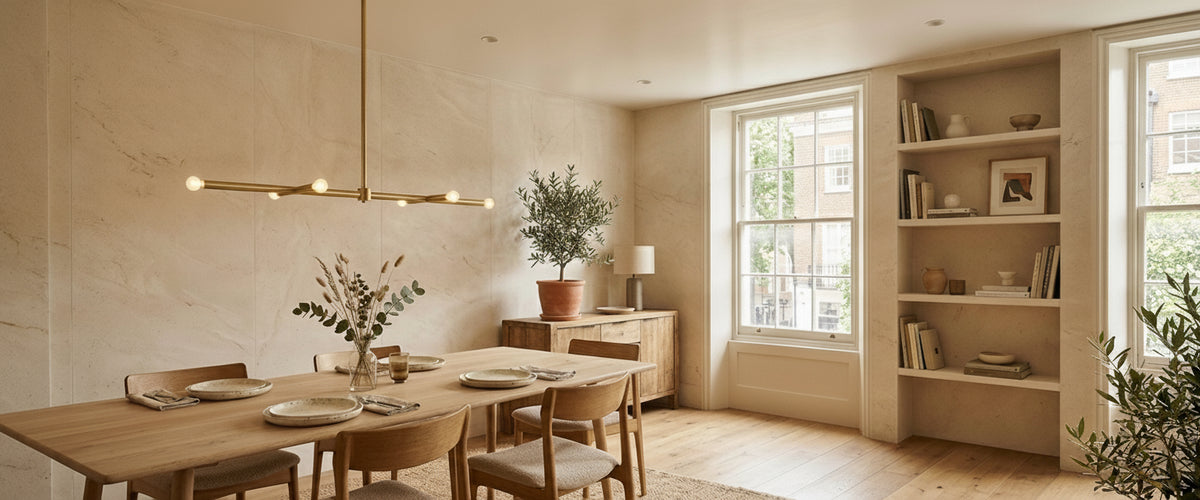

Most chandeliers fill a room. A brass tube chandelier draws in it. Those slim cylinders radiating from a central hub describe a shape in the air and leave the rest empty, so every choice you make (finish, arm count, bulb, even the plaster above it) gets magnified. Buyers who choose one by diameter alone tend to end up with a fixture that looks right in the photograph and wrong on the ceiling.
Key Takeaways
Negative space is the point. A tube chandelier reads as a drawing, so it needs a calm ceiling and clean sightlines.
Finish sets the wall color. Satin brass throws a soft champagne warmth; antique brass reads deeper and more amber.
Arm count and tube length beat diameter. They decide whether the piece feels airy or busy.
Bulbs change the character. Exposed filament gives sparkle and glare; frosted or diffused sources give calm.
Black tubes suit pale, cool or very bright rooms where brass would wash out.

What a Brass Tube Chandelier Does to Negative Space
Branched chandeliers carry visual weight in their curves. Globe chandeliers carry it in their glass. A tube design carries almost none: it is a set of straight lines and a set of light points, and the eye fills in the volume between them. That is why a brass tube chandelier can hang in a modest London flat with 8 ft (2.4 m) ceilings without feeling oppressive, while a crystal piece of the same span would swamp it.
The flip side is that the empty space becomes part of the fixture. Whatever sits behind it, whether that is a cluttered bookcase, a busy wallpaper or a tangle of downlights, gets framed by those tubes. Plan the view behind the chandelier as carefully as the chandelier itself. The form owes a lot to the starburst and Sputnik shapes of the 1950s and 1960s. The classic originals kept the hub small and let the arms do the talking, and anyone shopping for a brass tube chandelier midcentury in spirit should look for the same habit: a compact center, evenly spaced arms and nothing ornamental competing with the lines.

Satin Brass Versus Antique Brass: How Finish Temperature Rewrites Your Walls
Brass is a reflector before it is anything else. Each tube catches light from its own bulbs and bounces a faint wash onto nearby walls and ceiling, and the finish decides the color of that wash.
A tube chandelier satin brass finish has a brushed, slightly pale surface. It reflects a soft champagne tone that sits comfortably against white, warm gray and limestone-colored walls. Hang the same satin fixture under 2700K and then 3000K lamps and the difference is clearer than most people expect: at 2700K the walls turn gently honeyed; at 3000K the brass looks crisper and the room reads more contemporary. Neither is wrong, but you should choose deliberately.
Antique brass is darker and more uneven, with a patinated surface that reflects less and absorbs more. The reflected light shifts toward amber, which flatters deep greens, oxblood, walnut paneling and plaster pinks. It also hides fingerprints and tarnish better, which matters in a restaurant or hotel lobby where nobody is polishing daily. Polished brass, by contrast, mirrors the bulbs back at you and can make a tube design look noisy.
Arm Count and Tube Length Matter More Than Diameter
Two chandeliers can both measure 36 inches (about 90 cm) across and look nothing alike. One has six long arms and reads open and architectural; the other has eighteen short ones and reads like a dandelion clock. The overall diameter tells you how much ceiling it covers. Arm count and tube length tell you how dense it feels.
Six to eight arms suit low ceilings, smaller dining tables and rooms where you want the structure to stay legible.
Ten to fifteen arms give a fuller, rounder silhouette for living rooms and double-height halls.
Long tubes spread the light points wide, which flattens shadows across a large table.
Short tubes cluster the light near the center, which creates a brighter focal point and a darker perimeter.
Over a dining table, aim for a brass tube chandelier roughly half to two-thirds the table's width, hung 30 to 36 inches (75 to 90 cm) above the surface. In a hallway or open living space, keep at least 7 ft (2.1 m) of clearance beneath the lowest point.
The Ceiling Detail That Makes It Sing, and the One That Kills It
The detail that makes a brass tube chandelier sing is a quiet, flat ceiling with a single, well-centered fixing point and a canopy sized to the hub. When the plaster is plain, the tubes cast fine radiating shadows upward, and those shadows become part of the design.
The detail that kills it is competition. A heavy ornate ceiling rose, a grid of recessed downlights or an off-center junction box all fight the geometry. Picture a twelve-arm satin piece in a Georgian drawing room with 11 ft (3.4 m) ceilings and a deeply molded original rose. Mounted tight to the plaster, the rose and the starburst argue with each other. Drop the fixture on a longer rod so the tubes sit clearly below the plasterwork, and the rose becomes a backdrop instead of a rival. If your ceiling has period detail, budget for a longer drop rod. If it has downlights near the fixing, put them on a separate circuit and keep them dimmed.
When a Black Tube Variant Is the Smarter Choice
Brass is not always the right answer. In a pale Scandinavian-style interior with white oak floors and white walls, a satin brass tube chandelier can disappear into the warmth of the room. A black tube variant gives the line drawing a hard outline and keeps it visible from across the room.
Black also suits rooms with strong daylight, such as a glazed kitchen extension or an orangery, where brass can look washed out at midday. Against darker walls the effect reverses: on charcoal, navy or deep forest green, a black fixture recedes rather than contrasts, which is useful if you want the light points to float. The trade-off is reflection. Black tubes bounce almost nothing back, so expect a slightly dimmer, more directional effect than the same fixture in brass.
Exposed Filament or Frosted LED Inside a Brass Tube
This is the decision buyers underestimate most. Exposed filament lamps give sparkle and a vintage feel, and they look handsome when the chandelier is switched off. Switched on at full output, though, a dozen bare filaments at eye level create real glare. The Society of Light and Lighting's guidance on visual comfort is a useful reminder that brightness you can see directly is rarely brightness you enjoy.
Frosted LEDs or diffused shades soften each point into a glow, which lets the brass read as the hero. This is where alabaster earns its place: a tube chandelier finished with small alabaster cups or discs filters each lamp through natural stone, so the light comes out warm, even and slightly veined. If you like the geometry of a tube design but want the softness of stone, our alabaster lighting collection includes pieces that combine brass framing with carved diffusers.
One point of confusion is worth clearing up: the "tube" in a tube chandelier describes the arms, not the lamp. Linear G13 tube lamps are made for battens and utility fittings, usually in cool 4000K to 6500K whites and often non-dimmable, so they are the wrong light source for a decorative brass fixture.
Whichever you choose, specify dimmable lamps and a compatible LED dimmer. A brass tube chandelier at 30 percent output on a winter evening and the same fixture at full brightness for a dinner party are two different objects.
Buyer Checklist: Choosing a Brass Tube Chandelier
Measure ceiling height first, then decide drop and arm length. Diameter comes last.
Check the view behind it. The tubes will frame whatever is there.
Match finish to wall tone: satin brass for pale and warm neutrals, antique brass for deep colors, black for very pale or very bright rooms. If a tube chandelier satin brass finish is on your shortlist, look at a sample under your own lamps before committing.
Count the arms against the room's scale and the table beneath it.
Decide on bulbs before you buy: exposed filament, frosted LED or stone diffusers.
Confirm the ceiling can carry the weight and that the fixing point sits where you want the center.
Plan the dimmer and circuit alongside any downlights.
Budget depends on material, scale, arm count, engineering, installation and finishing, so for larger or bespoke pieces it is worth requesting a tailored quote rather than comparing headline figures. You can see the full spread of fixture types, from pendants to wall lights that pair with a chandelier, across our lighting range.
Installation and Long-Term Care
Always have a qualified electrician fit a brass tube chandelier. Multi-arm fixtures need a secure ceiling fixing rated for the weight, correct grounding of the metal frame and careful leveling so every tube sits true. Ask them to check the arms are tight at the hub after the first few weeks, as brass threads can settle.
For cleaning, switch off and let the lamps cool, then wipe the tubes with a soft dry cloth. Avoid abrasive polishes on lacquered satin brass, as they strip the protective coat and leave uneven patches. Antique and unlacquered finishes will darken naturally; the Canadian Conservation Institute's conservation guidance on copper alloys explains why handling and humidity speed that process. If your chandelier includes alabaster diffusers, dust them dry and keep them away from water and cleaning sprays, since the stone is soft and porous.
Choose the tube length, the finish and the bulb with the ceiling in mind, and a brass tube chandelier will keep looking deliberate for decades. At Niori, that is the same test we apply to every alabaster and natural-stone piece we make.