
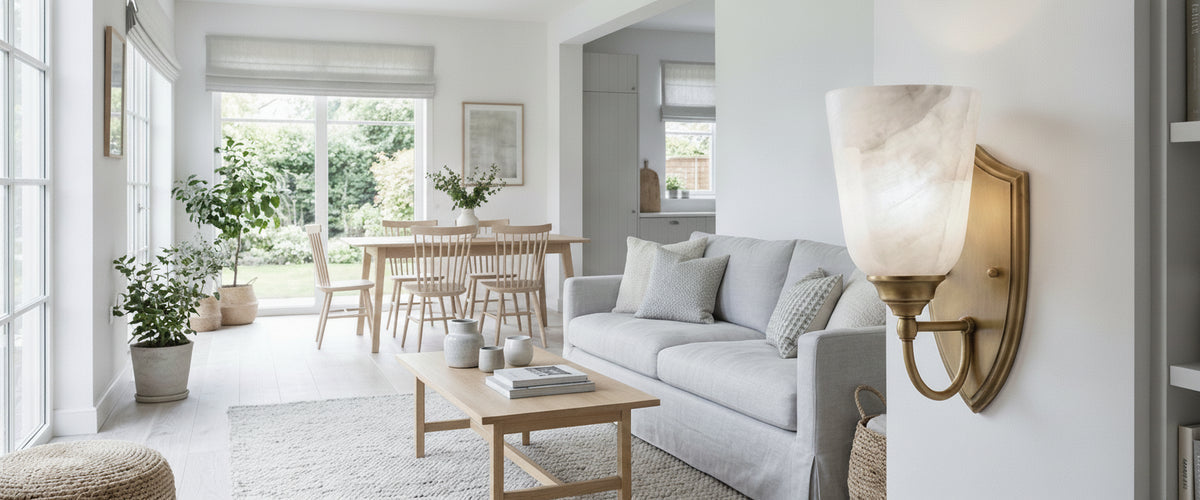

Most fittings sold as traditional wall lights are period costume. The silhouette is roughly right, the arm curves in the expected place, and then you look at the backplate and find a stamped disc with a visible seam, a hollow feel and a lacquer that will go patchy within two winters. Genuinely traditional wall lights give themselves away in the opposite direction: weight in the hand, tool marks where a hand finished the metal, glass or stone that varies slightly from one piece to the next.
That variation is the point. It is also the thing buyers most often mistake for a fault.

At a Glance: What Separates Good Traditional Wall Lights
- Backplate should feel solid, sit flat against imperfect plaster, and be proportioned to the arm rather than the fashion of the moment.
- Metal matters more than colour. Solid brass and copper age; plated steel simply wears through.
- Diffuser is where light quality is decided. Hand-blown glass, alabaster and onyx each soften a lamp very differently.
- Mounting height of roughly 1.6m to 1.7m (around 63 to 67 inches) suits most rooms, adjusted for ceiling height and eye line.
- Outdoors, you are buying an IP rating and a corrosion strategy as much as a design.
- Dimming should be specified with the lamp, not bolted on afterwards.

Classical Reproduction Versus Genuinely Traditional
Reproduction copies a picture. Traditional making copies a method. The difference shows up in places most product photography never reaches: the inside of a backplate, the join where an arm meets the body, the way a shade gallery holds glass without rattling.
Cast components have a certain density and a very slightly soft edge where the mould released. Pressed components have sharp, thin edges and often a faint ridge. Neither is automatically wrong, but a cast solid brass arm on a hand-spun backplate belongs to a different family of object than a folded steel bracket sprayed antique gold. Ask what is cast, what is spun, what is machined, and what is simply stamped.
Finishing is the second signal. A hand-applied patina moves across a surface unevenly, catching on raised detail and pooling in recesses, because that is what oxidation does. A sprayed antique finish is uniform, which is exactly why it looks flat under a warm lamp. Conservation departments describe historic metal surfaces in terms of layered corrosion products built up over decades, and reputable finishers imitate that logic rather than a single colour.
Third signal: serviceability. A traditional fitting was made in an era when things were repaired. If the lampholder can be replaced, the glass reordered and the arm re-tightened, someone designed it to last. Sealed assemblies with bonded shades are a modern convenience with a modern lifespan.
Aged Brass, Copper, Hand-Blown Glass and Alabaster: How Each Behaves Once Lit
The materials used in traditional wall lights do not simply hold a lamp. They edit it.
Solid and Unlacquered Brass
Unlacquered brass starts bright and gold, then dulls to a warmer honey tone as it oxidises. It takes fingerprints, particularly near switches, and it will develop a darker tide line around fixings. Buyers who want a fitting to look identical in five years should choose a lacquered or pre-aged finish. Buyers who want the fitting to look like it belongs to the house should leave it alone and let it move.
Copper
Copper shifts faster and further. Indoors it deepens to a russet brown; outdoors, exposed to rain and salt air, it heads towards green verdigris over years rather than months. A traditional copper wall light on a coastal property is a deliberate choice to let weather do the finishing. It looks considered on stone and render, and slightly odd on very new brickwork until the surrounding materials catch up.
Hand-Blown Glass
Hand-blown glass carries small bubbles and thickness variation, so the light it throws is faintly uneven. That is what makes a lit glass shade look alive rather than printed. Opal glass diffuses generously; clear or lightly seeded glass throws sharper patterns and demands a good-looking filament-style lamp, because the bulb becomes part of the design.
Alabaster, Marble and Onyx
Stone is where our own work sits. Alabaster is translucent enough to glow from within, and because the mineral structure scatters light rather than passing it straight through, the result is soft, warm and slightly golden with veining that reads as shadow. Onyx pushes further towards drama, with strong banding and amber tones. Marble is generally opaque and works as a body or backplate rather than a diffuser, throwing light up and down instead of through.
A stone sconce sits comfortably in a period room precisely because alabaster has been carved for lighting and architectural glazing for centuries; the Historic England record of medieval and post-medieval buildings is full of alabaster used for exactly its light-handling qualities. If you want traditional weight without the metal-heavy look, browse the alabaster lighting collection and compare a carved stone shade against a glass one at the same wattage. The stone will always read warmer at the same lumen output.
Backplate Proportion and Mounting Height, the Spec Detail Buyers Skip
We shipped a pair of alabaster sconces to a Georgian townhouse in Bath where the electrician had already chased the cables to a height taken from an American forum post. The fittings landed too high, the glow hit the cornice, and the room felt top-heavy. Re-chasing lime plaster is not a small job. Height gets decided early or it gets decided expensively.
Practical guidance: centre most traditional wall lights between 1.6m and 1.7m (around 63 to 67 inches) from finished floor level. Raise them slightly in rooms with ceilings above about 3m, and lower them in a snug or a low-ceilinged cottage bedroom so the light lands where people actually sit. Flanking a mirror or chimneypiece, work to the mirror, not the floor, and keep the pair symmetrical to the object rather than to the wall.
Backplate proportion is the other overlooked number. A backplate that is too small leaves a fitting looking pinned on; too large and it dominates a narrow pier. On a chimney breast between panelling, a taller oval or shield backplate holds its own. In a corridor with limited wall, a compact round plate keeps the fitting from reading as clutter. Also check projection. Anything protruding more than about 10cm (4 inches) into a circulation route will eventually be caught by a shoulder or a suitcase.
Hallway, Drawing Room and Study: Where Traditional Sconces Hold Authority
traditional wall sconce lighting earns its keep in rooms with vertical architecture to answer: panelling, dado rails, tall doorcases, chimney breasts.
Hallways and stairs. This is the strongest case for sconces wall lighting traditional in style, because a hall rarely needs a single bright source. A run of matched fittings at consistent height creates rhythm and makes a long corridor feel intentional. On a staircase, follow the pitch and keep the vertical spacing equal along the incline.
Drawing rooms. Pairs flanking a fireplace or a large mirror do more for atmosphere than any central pendant. Keep them dim and let table lamps carry the reading light. Alabaster shades work particularly well here because the stone body stays visibly luminous even at low output, so the fitting still looks lit when the room is at 20 per cent.
Studies and libraries. Directional brass picture lights and swing-arm sconces belong here. Aim for glare control; a shade that hides the lamp from a seated eye line is worth more than an extra 100 lumens.
Where they lose authority. Open-plan kitchen extensions with full-height glazing and minimal wall. Bathrooms where zone requirements limit placement. Rooms with heavy art hangs that leave no clean vertical space. In those cases, the same warmth is better delivered from a stone table lamp or a pendant, and the wider lighting collection is the easier starting point.
Traditional Outdoor Wall Lights: IP Ratings, Corrosion and Context
Outdoor traditional wall lights are a different brief with a similar silhouette. The design conversation shortens and the engineering conversation lengthens.
Start with ingress protection. The IP code is defined internationally by the IEC, and the second digit is the one that matters outdoors: IP44 handles splashing, IP54 handles heavier weather, IP65 handles direct jets and driven rain. Sheltered porch under a deep overhang: IP44 may be adequate. Exposed elevation, coastal site or anywhere wind drives rain sideways: specify higher and do not negotiate. On a gable or a sea-facing wall, a sealed fitting rated to that level, such as the Asker Outdoor Up/Down Wall Light in graphite, is the honest starting point, and its narrow up-and-down wash grazes stone or render in a way a single downlight cannot.
Corrosion is the second decision. Traditional exterior wall lights in solid brass or copper will patinate rather than fail. Where you want the weathering to be part of the design, a copper-bodied fitting such as the IP65 copper up-and-down wall light will move from bright metal to russet and eventually verdigris on the same timetable as the building around it. Galvanised and powder-coated steel look right on agricultural and estate buildings but depend entirely on coating integrity, so any drilled or scratched surface becomes a starting point for rust; if that vernacular is the one you are matching, a galvanised finish like the Mandal Outdoor LED Up/Down Wall Light reads more honestly than steel sprayed to imitate it. Stainless grades vary; 316 outperforms 304 near salt.
Fixings deserve the same scrutiny. Stainless screws in a brass fitting, stainless in copper, and a gasket that actually compresses. Check drainage too, because a lantern that collects water is a lantern that fails a lamp every winter. And whichever route you take with outdoor wall lights traditional in character, external circuits should be installed and tested by a qualified electrician working to current wiring regulations. This is not a weekend job.
Bulbs and Dimming
Warmth in traditional wall lights is decided by the lamp, not the marketing copy. For period interiors, 2400K to 2700K reads correctly; anything above 3000K makes aged brass look grey and alabaster look chalky. Choose lamps with a colour rendering index of 90 or above so timber, textiles and stone veining keep their depth.
Specify dimming as a system. Leading-edge dimmers designed for old filament loads frequently flicker or buzz with low-wattage LEDs, so pair LED lamps with a trailing-edge dimmer rated for the total load, and check the minimum load figure. A pair of 4W lamps on a dimmer with a 10W minimum will misbehave. Warm-dim lamps, which drop towards candle colour as they lower, suit stone shades particularly well.
The Questions Worth Pressing Any Supplier On
- What is the base metal, and is the finish plated, lacquered or hand-applied?
- Are the arm and backplate cast or pressed, and how thick is the backplate?
- Is the glass or stone shade replaceable, and can a single shade be reordered later?
- Which lampholder is fitted, and what is the maximum wattage and lamp length?
- For exterior fittings, what is the IP rating, the gasket material and the fixing specification?
- Is the fitting dimmable, and with which dimmer type?
- For natural stone, how much veining variation should be expected between two pieces in a pair?
- What is the lead time, and is the piece made to order or held?
Budget for traditional wall lights varies with material, scale, casting complexity, hand finishing and installation, so ask for a tailored quote against your actual specification rather than comparing headline figures across very different objects. A pair of hand-carved alabaster sconces and a pair of pressed steel lookalikes will never sit on the same line of a schedule.
Keeping Them Looking Right
Dust metal with a dry microfibre cloth and leave the patina alone unless you genuinely want it bright again. Alabaster and onyx should never meet vinegar, bleach or acidic proprietary cleaners; the stone is calcium-based and will etch. A barely damp cloth and an immediate dry buff is the whole routine. Check outdoor gaskets and fixings once a year, ideally in autumn before the weather turns.
Choose well once and traditional wall lights become part of the fabric of a house rather than a line item you replace. That is the standard we work to at Niori, where alabaster and natural-stone fittings are made to be lived with, repaired and passed on. Start with the room, the wall and the light you actually want, and the rest of the specification tends to follow.