
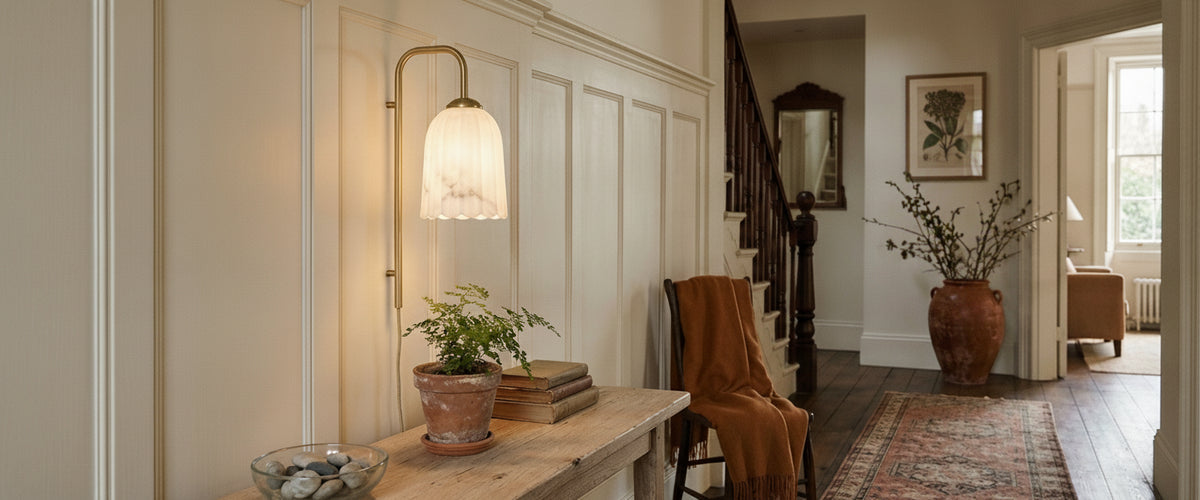

Most traditional wall lights fail in the evening, not in the showroom. In daylight a cast arm and a pleated shade look convincing enough. Switch them on in a Victorian hallway at nine o'clock and the weaker ones give themselves away: a hard white hotspot, a lacquer that glares like plastic, and a backplate colliding with a picture rail it was never designed to meet. Choosing well means judging a sconce by what it does to the wall once lit, which is exactly where alabaster, natural stone and honest metal finishes earn their place.

Key Takeaways
- Judge the lit effect first. A traditional sconce should throw a soft, shaped pattern on the wall, not a single bright spot.
- Finish changes after dark. Aged brass warms a room, antique bronze recedes, and polished nickel sparkles but can turn clinical under cool bulbs.
- Shade material sets the mood. Alabaster and onyx glow through the stone, opal glass gives an even wash, and fabric throws defined cones up and down.
- Placement follows architecture. Flank chimney breasts, mirrors and beds, and avoid fixing heights that collide with dado or picture rails.
- Talk to your electrician before you buy. Backplate size, wiring position and wall construction decide what will actually fit.

What Makes Traditional Wall Lights Read True in Person
A convincing period sconce is mostly about proportion and weight. The arm should feel related to the backplate, not bolted on from a different kit. The shade should sit low enough to hide the lamp from a standing eye line, which on most traditional wall lights means the bottom rim lands at or just below the bulb. Solid brass has a heft and a crispness at the joints that plated zinc never quite matches, and you can see the difference in how the edges catch light.
The shade is where reproductions fall down hardest. Hold an alabaster shade up to a window and the difference is obvious. Real stone shows its veining as a soft, uneven map, denser in some places and almost clear in others. A resin imitation glows perfectly evenly, and that uniformity is exactly what makes it read flat on a period wall. Natural material gives the light somewhere to wander.
Aged Brass, Antique Bronze, Polished Nickel: What Happens After Dark
Finishes behave very differently once traditional wall lights are the only light source in the room.
Aged Brass
Aged or unlacquered brass returns a honeyed, slightly broken reflection. Next to an alabaster shade it reads as one warm object rather than metal plus glass. Unlacquered brass is a living finish: it darkens with handling and air, which suits a Georgian drawing room and frustrates anyone who wants it to stay showroom bright. Dust with a dry, soft cloth and avoid abrasive polishes unless you genuinely want the shine back.
Antique Bronze
Bronze and dark bronze finishes almost disappear at night, so the shade becomes the whole fitting. That is useful on deep-coloured walls, in panelled studies and in rooms where you want the glow without the jewellery. On pale walls it can look heavier by day than you expect.
Polished Nickel
Nickel throws back bright pinpoints of the bulb and pairs naturally with white marble, cool-toned bathrooms and crisp painted joinery. Its risk is temperature. Under a 4000K lamp polished nickel looks surgical. Keep it to warm white and it reads Edwardian rather than clinical.
Shade Shape and Diffuser Material on a Period Wall
The pattern traditional wall lights paint on the wall matters as much as the fitting itself, because that pattern is what you see from across the room.
- Fabric empire and drum shades throw two defined cones, one up and one down, with a clear scalloped edge. On a plain plastered wall this looks classic. On busy wallpaper the edges can feel fussy.
- Opal glass gives an even, milky glow with little shadow. It is bright and practical, ideal for hallways and bathrooms, and very much of its era. In a hallway that needs that soft wash without stone's amber cast, a twin-shade fitting such as Antic 2 Light Opal Glass LED Wall Light, Gold is closer to the right design language than a single exposed bulb.
- Alabaster lets light pass through the stone, picking out veins and casting a warm, slightly amber tone. Glare is low, so it works at eye level beside a bed or a sofa.
- Onyx is more translucent and banded, with a richer honey colour. It reads more dramatic and suits dining rooms and bars.
- Marble is largely opaque, so it directs rather than diffuses. It is best used as a cap, backplate or reflector paired with an open top or bottom.
An upward wash is the period wall's best friend. It picks out the texture of lime plaster and draws the eye to cornicing. A downward-biased sconce is better for reading and for pooling light on a console. If you are comparing shade materials side by side, the alabaster lighting collection shows how wall lights, pendants and table lamps in the same stone relate, which helps when you want a room to feel consistent.
One care note: alabaster is soft and porous, sitting around 2 on the Mohs scale. Dust with a dry microfibre cloth, keep spray cleaners and water away from it, and do not fit an alabaster wall light inside a shower zone.
Where Traditional Wall Lights Reinforce Architecture, and Where They Fight the Room
Sconces work best when they answer something already in the room. Pairs either side of a chimney breast, a mirror over a console, or a bed headboard all give the eye a reason for the light to be there. In a long hallway, a rhythm of fittings roughly 2 to 2.5 metres (about 6.5 to 8 feet) apart follows the line of the walk and stops the far end falling into gloom.
They fight the room when the fixing height ignores the existing joinery. A common rule puts living room sconces at around 1.6 to 1.7 metres (about 5 feet 3 inches to 5 feet 7 inches) from the floor, but in a period room with a plate rail or low picture rail near that height, the rule is wrong. Drop below the rail or rise clearly above it. Sitting on the line looks like a mistake. Bedside sconces usually sit lower, so the shade covers the bulb from a seated position against the pillows. Where someone reads in bed every night, a fitting with its own directed reading light, such as Nivia LED Wall Light with Reading Light, Matt Black, saves a decorative shade from doing two jobs, though in a strictly period bedroom it will read as the quieter, more modern partner.
Before you commit to positions, draw a simple elevation with the dado, picture rail and window architraves marked. In rooms with working shutters, a sconce placed by eye can easily clip the shutter box when the shutters fold back, and shifting a pair 15 centimetres inward is often what makes a chimney breast look deliberate rather than crowded. Measure the whole wall, not just the gap.
Low ceilings are the other trap. Tall, upturned shades push a bright disc onto a ceiling at 2.3 metres and make it feel lower. Choose a compact shade or one with a closed top.
Pairing Traditional Sconces with Contemporary Fittings
Mixing eras works when one thread runs through everything. That thread can be a finish (aged brass on both the period sconces and a simple modern pendant), a material (alabaster in a traditional wall lights and a clean-lined ceiling fitting), or simply colour temperature. Let the contemporary pieces stay quiet in form so the traditional wall lights carry the detail. Where a modern wall light has to share a room with warm-metal period sconces, a plain cone such as Cira Cone Wall Light, Matt Black & Gold picks up the gold without competing for ornament.
Alabaster is a useful bridge here because stone has no fixed period. The same material sits comfortably on a fluted brass arm and in a plain geometric bowl. If you are building a scheme across several rooms, browsing the wider niori lighting range by material rather than by style is often quicker than trying to match shapes.
What confuses a scheme is three competing metals and three competing white temperatures in one sightline. Keep it to two finishes per room at most.
Bulbs and Dimming for Period Light
Use warm white lamps at around 2700K, or 2200K to 2400K for candle-style arms where you want a softer evening glow. Look for a colour rendering index of 90 or higher so paint colours and stone veining read accurately. Visible candle-style bulbs should be clear filament LEDs, while frosted lamps behind alabaster or opal glass prevent a visible hotspot. Put traditional wall lights on their own dimmable circuit and check the dimmer is rated for LED loads, otherwise you may get flicker or a hum at low levels.
Backplate Depth, Wiring Position and the Installation Conversation
Have this conversation with a qualified, registered electrician before you order, not after the fittings arrive. In England and Wales, a new circuit or any work in a bathroom is notifiable under Part P of the Building Regulations, and fixing into historic fabric raises its own questions.
- Backplate size. Will it cover the old fitting's holes, the existing back box and any patched plaster? A larger backplate often solves a redecorating problem.
- Projection. How far the fitting stands off the wall matters in narrow corridors and beside doors that swing.
- Cable entry. Most backplates expect the cable to arrive centrally. An offset supply may need rechasing.
- Wall construction. Lath and plaster, solid brick and stud partitions each need different fixings, and stone shades add weight.
- Consent. In a listed building, chasing walls or fixing into original panelling may need listed building consent from your local authority. The Society for the Protection of Ancient Buildings is a sensible place to read up on working with old walls.
- Bathrooms. Any fitting near a bath or basin needs the correct IP rating for its zone.
A Buyer's Checklist Before You Commit
- Have you seen the fitting lit, or at least a photo of its pattern on a wall?
- Does the finish suit your bulb temperature and wall colour after dark?
- Is the shade real stone, glass or fabric, and does that match the light you need?
- Have you measured against dado rails, picture rails, shutters and door swings?
- Does the backplate cover the existing box and old fixings?
- Is the circuit dimmable, and is the dimmer LED compatible?
- Has your electrician confirmed the wall can take the weight?
Budget depends on material, scale, finishing and installation complexity, so for larger schemes or hospitality projects it is worth requesting a tailored quote. Choose traditional wall lights for the light they make on the wall at night, and the rest of the decision tends to follow.