
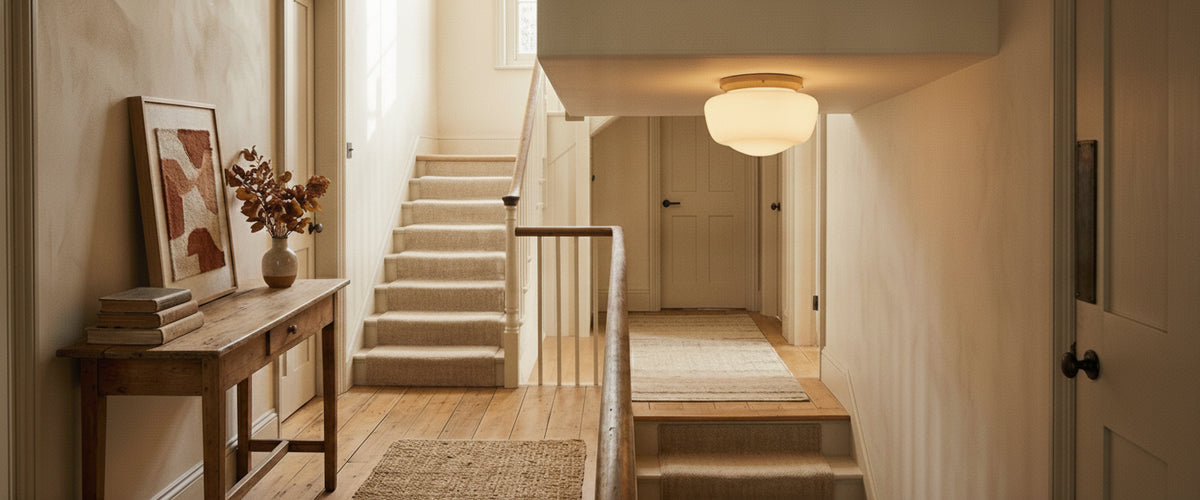

A flush mount has nowhere to hide. It sits tight against the ceiling, in full view from the doorway and from the stairs, lit from within. Get the proportion or the glass wrong and the room feels lower than it is. Get it right and a vintage flush mount does something no pendant can: it holds period character without stealing headroom, which is exactly why hallways, landings, and low-ceilinged bedrooms keep coming back to this fixture type.
The trouble is that "vintage" has become a finish rather than a set of decisions, and a vintage flush mount is where that shortcut shows fastest. Plenty of vintage ceiling lights fixtures on the market borrow the silhouette and skip everything that made the originals worth copying.

Quick Answer: What Makes a Vintage Flush Mount Work
Era cues over era costume. A convincing vintage flush mount uses honest glass or stone, real metal finishes, and hardware that matches the period being referenced.
Diameter follows the room, drop follows the ceiling. Under 8 ft (2.4 m), go fully flush. Between 8 and 9 ft (2.4 to 2.7 m), a semi-flush reads richer.
Warm, not yellow. 2400K to 2700K behind amber or opal glass; go cooler and the diffuser looks dirty.
Judge the cover material lit and unlit. Alabaster, opal glass, and seeded glass all behave differently once current runs through them.
Check the socket, the earth, and the canopy fixing. These are what fail first on both antiques and cheap reproductions.
A three-light heritage brass disc holds period character without eating into hallway headroom.

What "Vintage" Actually Signals in a Flush Mount
Strip away the marketing and vintage flush mount designs fall into a handful of recognizable families. Early electric fittings of the 1900s and 1910s tend toward exposed brass rods, small opal shades, and a slightly awkward mechanical look, because they were still borrowing the vocabulary of gasoliers. The 1920s and 1930s bring pressed and molded glass bowls with geometric ribbing, often in frosted or lightly amber glass. Mid-century flush fittings go simpler again: shallow domes, brushed metal collars, and diffusers designed to hide the bulb entirely.
Glass is the fastest tell. Pressed glass carries mold seams and a certain weight in the hand; blown opal glass has subtle thickness variation that makes the light bloom unevenly in a way machine-uniform acrylic never does. The Corning Museum of Glass has good background on how pressed glass was made and finished, and once you have seen the difference, printed "seeds" on the cover of a supposedly vintage flush mount are hard to unsee.
Finish is the second tell. Brass given a chemical patina develops depth at the edges where hands touch it. Sprayed antique-gold lacquer does the opposite: it wears through to flat base metal wherever the fitting catches traffic and cleaning. If you are buying a period-style vintage flush mount rather than a genuine antique, ask what the finish actually is. Solid brass, plated brass, and painted steel age on completely different timelines.
Ceiling Height and Diameter: The Proportion Rule
This is where most vintage flush mount purchases go wrong. The fitting is chosen for looks on a screen and arrives twice the visual weight the room can carry.
Start with diameter. Add the room's length and width in feet, then treat that number in inches as a sensible upper limit for the fixture's diameter. A 12 ft by 14 ft bedroom (3.7 m by 4.3 m) tolerates something in the region of 26 in (66 cm) across as a maximum, and usually looks better at 16 to 20 in (40 to 50 cm). Hallways are the exception: narrow spaces need a smaller diameter than the math suggests, or the fitting crowds the walls.
Then height. Under 8 ft (2.4 m) of ceiling, use a true vintage flush mount that sits directly against the plaster; in a narrow hallway at that height, a restrained three-light disc such as the Collier 3 Light Flush Ceiling Light in Heritage Brass keeps the period cues without eating into the corridor. Between 8 and 9 ft (2.4 to 2.7 m), a semi-flush with a short stem gives you shadow and dimension without dropping into head-strike range, and something like the Brinley 3 Light Semi-Flush in Brushed Brass sits in that band comfortably. Above 9 ft (2.7 m), a semi-flush starts to look stranded and a pendant or a small chandelier will serve the room better. One thing to check before you order: on a landing or above a stairwell, measure from the highest tread, not the floor below.
One client ordered a generously scaled alabaster semi-flush for an 8 ft hallway, then queried the drop before installation. They were right to. We swapped to the fully flush version of the same vintage flush mount and the corridor still reads spacious. A ten-minute conversation before shipping saved a slow and expensive return.
Rooms That Reward Period-Style Ceiling Lighting, and Rooms That Fight It
Entryways, hallways, and landings are the natural home for a vintage flush mount. These are transit spaces where a hanging fixture is a hazard and where a single warm glow does more for the mood of a house than any amount of recessed downlighting.
Bedrooms work well with a vintage flush mount, with one condition: the ceiling fitting should be ambient only, never the reading light. Pair it with a table lamp or a pair of wall lights and put it on a dimmer. Guest bathrooms and powder rooms take period fittings beautifully, though anything within reach of shower spray needs the correct moisture rating and a qualified electrician's sign-off.
Where it quietly fights you: over kitchen islands, where you need directional task light and a flush diffuser will not deliver it; in double-height great rooms, where the fixture disappears; and in very contemporary interiors with flat plaster ceilings and no other traditional detailing, where a heavily period vintage flush mount can look like a costume piece. If you want warmth without the period signal in those spaces, a plain alabaster disc reads calm and modern. It is worth browsing the wider niori lighting range before locking into a style, because the right answer is often a simpler shape in a better material.
Amber Warmth Versus Yellowed Glow: Getting the Bulb Right
Vintage ceiling light covers were designed around incandescent light. Swap in the wrong LED and the whole vintage flush mount looks tired.
For amber or lightly tinted glass, 2400K is usually the sweet spot; the glass is already adding warmth, so a warmer bulb keeps the tone honest rather than muddy. For opal white glass and for alabaster, 2700K holds true color without pushing into orange. Anything at 3000K or above behind the aged glass of a vintage flush mount makes the diffuser look grubby, and 4000K in a period fitting is simply wrong. Aim for CRI 90 or above so brass reads gold instead of brown.
Dimming matters more than wattage. Look for a bulb that warms as it dims, and confirm the driver and dimmer are compatible before install; mismatched pairings are the single most common cause of flicker in retrofitted vintage ceiling light fixtures. Where a fitting takes three or four bulbs, buy them from the same batch. Two different production runs of the same nominal 2700K lamp can sit visibly apart behind translucent glass. That matters most on multi-lamp fittings with individual shades. The Hollis 5 Light Semi-Flush in Heritage Brass with Opal Glass is a fair example of the format: five opal globes will expose any mismatch in color temperature instantly.
Where Alabaster Changes the Equation
Glass transmits light. Alabaster carries it. That difference is why so many buyers end up specifying stone for their vintage flush mount instead of glass.
Honed alabaster carries light rather than simply passing it, softening the hard edge of opal glass.
A honed alabaster disc glows from within, with veining that shifts as the light comes up and softens the hard edge you get from opal glass. It also flatters skin and wood, which is why we see alabaster vintage flush mounts so often in bedrooms and dining rooms. Each piece is quarried, so no two discs match, and the panels we ship are photographed lit as well as unlit for exactly that reason. Buyers who choose from an unlit image alone are working with half the information.
Stone does need respect. Calcite alabaster is soft and water-sensitive, so cleaning means a dry microfiber cloth and nothing else; the Natural Stone Institute's care guidance is a useful primer on why household sprays are a bad idea on porous stone. Keep it out of steam-heavy bathrooms unless the fitting is specified for it. Our alabaster lighting collection is the place to start if you want that warmth in a flush or semi-flush format.
Construction Details That Separate Craft from Costume
Pick a vintage flush mount up, or ask for close photography if you are buying remotely, and check the following:
Weight and wall thickness. Solid brass has heft. Thin plated steel rings hollow when tapped.
Socket quality. Ceramic or high-grade thermoplastic holders last; brittle plastic near a hot lamp will craze.
Cover fixing. Thumbscrews or a bayonet collar that engages cleanly beats a single central finial that cracks the glass when overtightened.
Canopy and mounting plate. A deep canopy with proper strap fixings gives an electrician room to work and hides an untidy junction box.
Finish continuity. Check the inside of the canopy. Manufacturers who cut corners finish only what you can see.
Stone or glass mounting. Alabaster and marble need a gasket or cushioned seat, never metal pressed straight onto stone.
Buyer's Checklist Before You Order
Measure ceiling height from the highest point people will stand, and decide flush or semi-flush from that number.
Calculate maximum diameter from room length plus width, then size down for corridors.
Confirm the material of the cover: pressed glass, opal glass, alabaster, or acrylic. Ask, if it is not stated.
Check bulb base, maximum wattage, and whether the fitting is dimmable as supplied.
Confirm the finish is solid or plated metal, and ask how it is expected to age.
Check moisture rating for bathrooms and covered outdoor porches.
Book a qualified electrician before delivery, not after. Ceiling boxes in older homes often need replacing to carry the load.
Ask about lead time and spare parts. A vintage flush mount worth buying is one whose glass or stone cover can be replaced in five years.
Budget for vintage ceiling lights varies widely with material, scale, engineering, and finishing, and stone fittings sit differently from glass because each piece is cut and matched by hand. If you are working to a defined figure for a whole house or a hospitality project, ask for a tailored quote rather than guessing from a category page.
One Last Thing About Period Fittings
Character comes from restraint. A hallway with one well-proportioned vintage flush mount, a warm dimmable bulb, and a finish that will look better in a decade beats a house full of fittings that all shout at once. Choose the vintage flush mount for the ceiling it lives on, then let the light do the period work.