
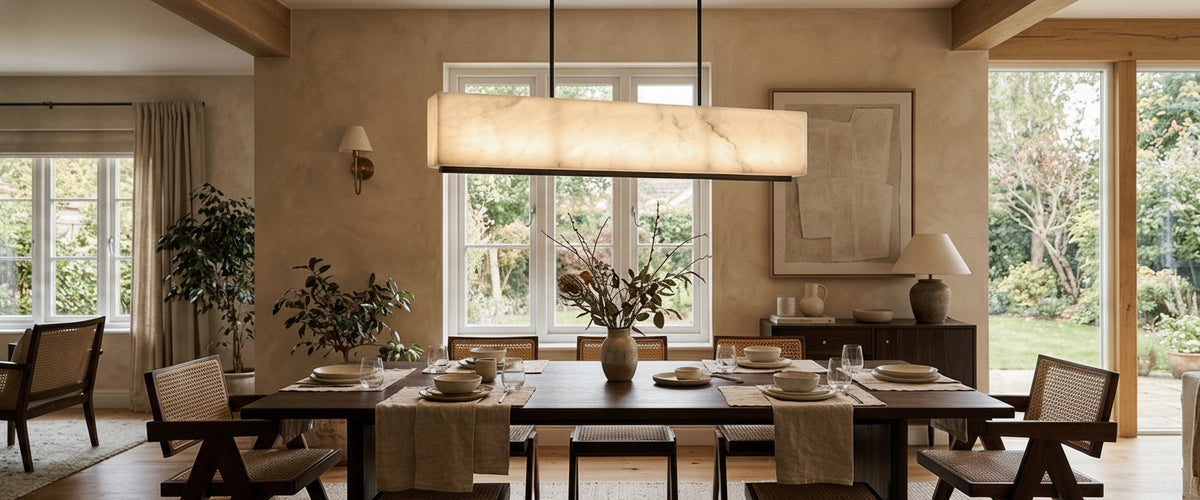

An industrial dining room photographs beautifully at eleven in the morning and falls apart at eight in the evening. Daylight does the heavy lifting for brick, blackened steel and reclaimed timber; artificial light has to work much harder, and most schemes fail at exactly the point they matter most. Get the lighting wrong and a room full of honest materials reads like a stripped-out unit waiting for a tenant. Get it right and the same surfaces turn soft, deep and welcoming. Alabaster and natural stone are unusually good at making that shift happen in an industrial dining room, because they warm light rather than merely emit it.

At a Glance: The Six Decisions That Matter
Contrast beats brightness. An industrial dining room needs pools of light, not an even wash.
Ceiling height sets the format. Below roughly 2.4m (8ft), think linear or low-profile; above 3m (10ft), a cluster or a chandelier earns its place.
Size up, not down. Most buyers choose a fixture that is too narrow and hang it too high.
Warm the metals. Raw iron and antique brass, or matte black and aged oak, hold warmth far better than chrome or nickel.
Dim to 2400K-2700K. Color temperature and a good dimmer rescue almost any fitting in an industrial dining room.
Add a diffuser. Alabaster, marble or onyx shades soften glare that bare bulbs create over a table.

Texture, Scale and Contrast: What Separates a Considered Scheme From an Under-Dressed One
The industrial look was borrowed from buildings that were never meant to be lived in. Factories used high-output fittings hung far apart because the goal was task visibility across a floor plate. Copy that logic into a domestic industrial dining room and you get a space that is technically well lit and emotionally flat.
What makes an industrial dining room feel resolved is layering: one strong gesture over the table, then two or three quieter sources at lower levels. Wall lights washing a brick return. A stone table lamp on a sideboard. Perhaps a floor lamp in the corner beyond the table, doing nothing except stopping the far wall from disappearing into gray. That secondary layer is where alabaster does its best work, because the material glows rather than glares. Gypsum alabaster is translucent enough that light travels through the stone itself, picking up the veining as it goes, which gives you a soft point of interest instead of a hard bright spot. Browsing an alabaster lighting range alongside your metalwork choices is the fastest way to see how much warmth a translucent shade adds back into a hard-surfaced room.
A translucent stone shade gives hard brick and steel something soft to answer to after dark.
Texture matters as much as light output. Brick, concrete and steel are all reflective in unhelpful ways; they bounce light without softening it. Stone, timber, leather and textile absorb and scatter. Seating carries more of that load than people expect: a dark matte leather seat such as the Caprelle Leather Dining Chair, Antique Ebony swallows light where a lacquered or molded shell would throw it straight back at the ceiling. An industrial dining room that is 90% hard surface needs at least one genuinely soft light source, or every conversation happens under what feels like a car park lamp.
Ceiling Height Thresholds: When a Cluster Is Honest and When a Linear Bar Is Smarter
Ceiling height is the single most useful constraint in an industrial dining room, because it removes half the catalogue before you start.
Under 2.4m (8ft)
Standard modern ceilings do not have room for drama below them. A single low-profile pendant or a slim linear fitting keeps the sightline across the table clear. Avoid multi-tier chandeliers entirely; they will hang in people's eyeline and make the room feel shorter than it is. A shallow alabaster disc pendant works well in a low industrial dining room because the light spreads sideways as well as down.
2.4m to 3m (8ft to 10ft)
This is where most UK conversions and new builds sit, and where a cluster of two or three pendants over a rectangular table starts to look deliberate rather than crowded. Most industrial dining rooms land in this band, so the spacing is worth getting right. Keep the pendants matched in form and vary nothing except perhaps height by a few centimeters. Mismatched clusters are a styling trend that ages badly.
Above 3m (10ft)
Warehouse conversions, barn conversions and double-height extensions can carry a chandelier or a substantial multi-arm fitting. Here the risk flips: buyers under-scale. A fixture that looked enormous in a showroom will shrink alarmingly under a 4m ceiling. If you are working with real volume, a stone or marble chandelier gives an industrial dining room mass without the visual heaviness of solid metal, since the light passing through the stone keeps the piece from reading as a dark block.
Table Size Versus Fixture Width, and the Mistake Everyone Makes in the Same Direction
Almost nobody buys a dining fixture that is too big for an industrial dining room. Nearly everyone buys one that is too small, then hangs it too high to compensate.
Scale and drop height do more for the scheme than lumens ever will.
The working rule: a single pendant or chandelier should span roughly half to two-thirds the width of the table. For a linear fitting over a rectangular table, aim for around two-thirds of the table length, leaving clear space at each end. Hang the bottom of the fixture around 75cm to 90cm (30in to 36in) above the tabletop. Higher than that and the light scatters into the room instead of pooling on the table; lower and tall guests will be talking around it.
Round tables are more forgiving of a single statement piece, and a centred pedestal form such as the Astvane Round Dining Table, Black fixes the drop point for you, which makes the half-to-two-thirds rule far easier to judge. Long rectangular tables in an industrial dining room usually want either a linear bar or a run of pendants spaced evenly, with the outer fittings sitting in from the table ends rather than aligned to them. If the table extends for guests, plan the lighting for the everyday configuration, not the Christmas one.
One more measurement worth taking before you order: the distance from the table edge to the nearest wall or circulation route. A wide fixture over a table that sits close to a walkway is fine at head height, but it changes how the room reads when you walk in. We had a client in a converted mill outside Leeds whose industrial dining room got a generously scaled alabaster pendant, then discovered the entrance sightline hit the fixture edge-on. Rotating the table 90 degrees solved it in an afternoon, but a floor plan sketch would have caught it sooner.
Finish Pairings That Hold Warmth After Dark
Metals behave differently at 2700K than they do in daylight, and this is where an industrial dining room is won or lost.
Raw iron with antique or unlacquered brass. The brass picks up warm light and reflects it back amber; the iron grounds it. This is the most reliable pairing for a dining setting.
Matte black with aged timber. Black absorbs rather than reflects, so pair it with a timber tone that carries the warmth instead. Oak, walnut and reclaimed pine all work; a mid-tone surface like the Astvane Dining Table, Walnut gives a black fixture something warm to sit above rather than dark on dark.
Blackened steel with white alabaster. High contrast, and the stone reads almost luminous against the dark frame. Good in tall industrial dining rooms.
Aged bronze with honey onyx or travertine. Softer, less graphic, better if your industrial scheme leans Mediterranean rather than Victorian factory.
Avoid polished chrome and brushed nickel in this palette. Both go slightly blue under warm light and fight the material story. If you already have chrome elsewhere, break the industrial dining room's finishes into zones rather than trying to match everything.
Dimming and Bulb Choice: The Rescue Tools for an Industrial Dining Room
A cage pendant with a cool-white LED at full output over a dinner table is a genuinely unpleasant thing. The same fitting on a proper dimmer, with a warm filament-style lamp behind a stone diffuser, is a different object entirely.
Specify 2400K to 2700K for dining. Look for a color rendering index of 90 or above, which keeps food, wine and skin tones looking correct rather than washed out. Choose dimmable lamps and check the driver compatibility; trailing-edge dimmers generally suit LED loads better than older leading-edge units, and mismatched pairings are the usual cause of flicker and buzz. Any change to fixed wiring or dimmer modules in a UK home should be carried out by a qualified electrician working to BS 7671 wiring regulations, not treated as a weekend job.
Where the fixture uses an alabaster or marble shade, you can usually run a lower output than you expect. Stone diffuses light across its whole surface, so the perceived brightness is higher than the lumen figure suggests. That is part of why an industrial dining room built around stone shades feels calm at low levels while a bare-bulb one feels dim and gloomy at the same setting.
What Hospitality Specification Does Differently
Restaurant lighting designers make three moves that translate straight into a home industrial dining room. First, they light the table, not the room; the ceiling plane is often left deliberately dark. Second, they build in a second, much lower layer for later in the evening, so the space changes character between the 7pm sitting and the 10pm one. Third, they choose fixtures that look good switched off, because a fitting hanging over a table is furniture as much as it is a light source.
That last point is where natural stone earns its cost. Alabaster, marble and onyx have presence in daylight; a plain glass or metal shade does not. If you are specifying for a venue as well as an industrial dining room at home, it is worth comparing the full lighting range across pendants, wall lights and table lamps rather than choosing a single hero piece and hoping the rest follows.
Your Industrial Dining Room Lighting Checklist
Measure ceiling height, table width and table length before you shortlist anything.
Confirm fixture width at half to two-thirds of table width; check the hanging drop is adjustable.
Plan at least two additional light layers: wall lights, a table lamp, or a floor lamp.
Lock your metal finish family early and stick to it across the room.
Specify 2400K-2700K, CRI 90+, fully dimmable lamps.
Check ceiling joist positions and fixture weight with your electrician before ordering a heavy stone piece.
Ask about lead times and any bespoke sizing rather than assuming stock dimensions will suit.
Caring for Stone Fittings in a Working Dining Room
A working industrial dining room produces airborne grease, and stone is porous. Dust alabaster and marble shades with a dry, soft, lint-free cloth every few weeks; a build-up of fine dust dulls translucency faster than anything else. Skip household sprays entirely. Gypsum alabaster is soft and slightly water-soluble, which is why museum conservators handle it so cautiously, as the Victoria and Albert Museum's guidance on caring for sculpture sets out. Acidic or abrasive cleaners will etch the surface permanently.
If a shade needs more than dusting, a barely damp cloth followed immediately by a dry one is the limit. Let the fitting cool first. And when a pendant sits directly over a table where candles burn regularly, expect to clean it more often; soot settles on the upper surface where nobody looks until the light output drops.
Budget for an industrial dining room fixture depends on material, scale, engineering, the complexity of the stonework and the installation itself, so the honest answer is to send your room dimensions and get a tailored quote rather than working from a number in your head. Niori specializes in alabaster and natural-stone lighting, and the studio is happy to talk through scale and drop heights before you commit; start with the main range and narrow from there.