
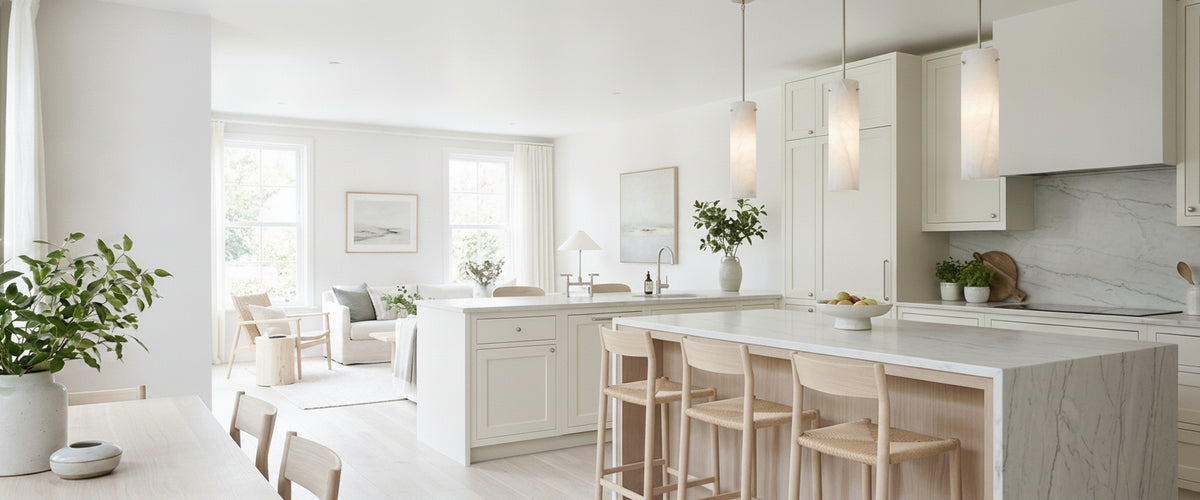

Under showroom halogens, a brushed nickel pendant and a polished chrome one look like siblings. Flip the switch at nine on a winter evening and they behave like strangers. Chrome throws back a hard, mirror-bright point of light that follows you around the room. Brushed nickel scatters the same light across thousands of microscopic grain lines, so the metal reads as a soft gray gleam rather than a flashpoint. That difference is the entire argument for the finish, and it is why so many kitchens that looked crisp in the design pack feel restless once they are actually lived in.
We deal with this question constantly at Niori. We build in alabaster, marble, onyx and natural stone, materials chosen precisely because they diffuse rather than reflect, and the metalwork we pair with them has to follow the same logic. A brushed nickel pendant is one of the few metal fixtures that agrees with stone instead of arguing with it.

Quick Answer: What Brushed Nickel Actually Does
Diffuses reflections. The directional grain breaks a light source into a broad sheen instead of a sharp highlight.
Reads cooler than brass, warmer than chrome. It sits at a neutral gray-silver that does not fight warm white bulbs.
Hides fingerprints and water spots far better than polished finishes, which matters over a sink or vanity.
Pairs best with diffusing shades: a brushed nickel pendant looks its best against frosted glass, opal, ribbed glass or alabaster. Clear glass tends to compete with it.
Ages slowly and subtly. Quality plating dulls gently; thin plating can flake at the edges within a few years.
Wants dimming. A brushed nickel pendant is at its best somewhere between 30 and 60 percent output.

Brushed Nickel Versus Polished Chrome Versus Satin: What Each Finish Does to Reflected Light
Chrome is a mirror, and that is the first thing to understand before you set it beside a brushed nickel pendant. Physically it has a near-specular surface, meaning incoming light bounces off at a predictable angle and keeps almost all of its intensity. That is fantastic when you want sparkle and terrible when you have recessed downlights a meter away, because every one of them appears as a second sun on the pendant body.
The body of a brushed nickel pendant is machined or hand-abraded in one direction, creating fine parallel scratches. Light hitting that surface breaks into a wide fan. The result is a finish with depth and movement that never produces a hot spot. Hold a sample under a bare bulb and rotate it: the sheen travels along the grain like light on brushed silk.
Satin nickel sits closer to a uniform matte. It is smoother than brushed, without the visible directional grain, and reads flatter and slightly softer. Choose satin for very minimal schemes where you want the metal to almost disappear; choose a brushed nickel pendant when you want the fixture to carry a bit of texture and presence. Where a room needs the fixture to soften the ceiling line rather than announce itself, a drum form in satin nickel such as the Cendral Fretwork Drum Pendant is closer to the right design language than a grained, sculptural body. Be aware that the finish name is doing less work than the plating beneath it: two fixtures both labeled brushed nickel can age very differently depending on the base metal underneath.
Shade Pairings That Complement Brushed Nickel, and the Ones That Neutralise It
A frosted glass pendant light is the natural partner. Frosting scatters light inside the shade so the glass glows evenly instead of showing the filament, and that even glow is exactly what a brushed nickel pendant wants: a broad, soft source rather than a point. The two materials do the same job in different ways, and together they produce light with almost no glare.
Clear glass is the risky pairing for a brushed nickel pendant. It puts a naked bulb next to a metal that has been engineered to avoid harsh reflection, and the eye goes straight to the filament. If you love the look of clear glass, keep the bulb low-output and dimmed, or specify a shade with a lightly etched interior.
Opal glass is a heavier diffuser than standard frosting; it can look slightly milky and blank when off, but at night it is the most forgiving option in a room with dark cabinetry. Ribbed and reeded glass adds vertical rhythm that echoes the grain of the metal, which is a quietly effective combination in narrow spaces like a hallway or a run over a kitchen peninsula. On a linear fixture like the Marnova 5 Light Pendant with Ribbed Glass Shades, that ribbing carries the full length of a peninsula in one gesture, and the same logic holds when you specify a brushed nickel pendant rather than aged brass.
Alabaster is the pairing we return to. Because light passes through the stone rather than bouncing off it, an alabaster shade produces a warm, cloudy interior glow with visible veining. Set against the frame of a brushed nickel pendant, the cool neutral metal keeps the honeyed stone from tipping into anything sentimental. If you want to see how that plays out across pendants, wall lights and chandeliers, the alabaster lighting collection is the fastest way to compare shade densities side by side.
Cord Length, Ceiling Height, and the Proportions the Finish Rewards
A brushed nickel pendant forgives fingerprints. It does not forgive bad hanging heights.
Because the finish is quiet, the fixture has to earn attention through shape and position instead. Over an island, aim for roughly 30 to 36 inches (76 to 91 cm) between the countertop and the bottom of the shade. Over a dining table, 28 to 34 inches (71 to 86 cm) keeps sightlines clear across the table. In a stairwell or double-height entry, the lowest point of the fixture should clear the floor by at least 7 feet (2.1 m).
Scale matters more with a diffused finish than a shiny one. A polished pendant reads visually larger than it is because the reflections extend it; a brushed nickel pendant reads at its true size. Buyers routinely order one size down and then wish they had not. For an island, a rough working rule is that the combined width of your pendants should sit around one-third to one-half the island's length, with even spacing and equal end margins. On a long island, three small shades often read as scattered where one wide multi-light fixture such as the Amalise 8 Light Pendant in bright nickel holds the proportion in a single span, and that span logic holds whichever nickel finish you settle on.
On ceiling height: rod-suspended fixtures hold their position and stay level, which suits high ceilings and open-plan spaces where air movement is real. Cable and cord suspensions allow easier adjustment but can twist. Ask for the rod extension options on your brushed nickel pendant before you order, not after.
Why Filament Bulbs and Frosted LEDs Respond So Differently Against Brushed Metal
A vintage-style filament bulb is a collection of tiny, intensely bright lines. Against a brushed nickel pendant, those lines multiply along the grain into a soft streak of light, which can be lovely in a bar area or a snug. Against clear glass with no diffusion, the same bulb produces glare that sits right in your eyeline at a kitchen island.
Frosted LEDs behave the opposite way. The diffusing coating turns the emitter into a broad glowing surface, so the reflection across a brushed nickel pendant becomes a wide, gentle band. This is the safer default for task areas.
Three specification points to get right:
Color temperature: 2700K for living and dining, 3000K for kitchens and bathrooms where you want a little more crispness. Push past 3500K and a brushed nickel pendant starts to look clinical.
Color rendering: CRI 90 or above. Low-CRI light flattens the subtle warm-gray tone in the nickel and makes stone shades look dull.
Dimming: specify a driver and dimmer that are confirmed compatible. Warm-dim LEDs, which drop toward 2200K as they lower, flatter both nickel and alabaster.
Kitchens and Bathrooms Where a Brushed Nickel Pendant Holds Authority After Dark
Kitchens are where the finish proves itself. One project we supplied ran four pendants over an 11 foot (3.3 m) island beneath a bank of downlights. The client had originally specified polished chrome and swapped to brushed nickel pendants after seeing both under the same lamps in the studio. The reason was simple: with chrome, each fixture carried three visible reflections of the ceiling lights and the room never settled at night.
Bathrooms are the other stronghold. Hard water spots are the enemy of polished metal, and brushed nickel hides them until you actually clean. Flanking a mirror with a pair of brushed nickel pendants at roughly eye height gives far better facial lighting than a single overhead fitting, because the light arrives from both sides rather than casting downward shadows. Any fixture near a shower or bath must carry the correct IP rating for its zone and be installed by a qualified electrician; this is not a DIY area.
Elsewhere, a single brushed nickel pendant works hard in a stairwell, over a bedside table where a lamp would eat surface space, or in a dressing area. One client hung one over a reading chair instead of using a floor lamp, which freed the corner entirely. If you are still weighing fixture types, browsing the wider lighting range alongside pendants usually clarifies whether the room really wants suspension or a wall light.
Patina, Cleaning, and What Changes Over the Long Run
A brushed nickel pendant plated over solid brass ages slowly. The sheen softens, the high points around handling areas warm very slightly, and after a decade the fixture looks lived-in rather than worn. Thin plating over pot metal or aluminium is a different story: it can lift at the seams, blister near heat, or develop dull patches that cannot be polished out.
Cleaning rules are short. Dry microfiber first. If you need more, use a barely damp cloth with a drop of mild detergent, wipe along the grain, then dry immediately. No ammonia, no abrasive creams, no all-purpose sprays. The Canadian Conservation Institute's guidance on caring for metal objects is a sensible reference on why aggressive cleaners do more harm than good on plated surfaces (canada.ca/conservation-institute).
For the glass, dust monthly and wash properly twice a year. Frosted and acid-etched surfaces hold grease more readily than polished glass because the texture gives it somewhere to sit; the Corning Museum of Glass has a good primer on how etched and frosted surfaces are made and why they behave that way (cmog.org).
The Buyer's Checklist Before You Order
Confirm the base metal beneath the plating, not just the finish name.
Check whether the finish is brushed, satin or a lacquered imitation. Lacquer yellows.
Measure ceiling height and confirm the rod or cord extension range covers it.
Count your downlights. More than four within six feet (2 m) of the fixture strongly favors a brushed nickel pendant or another diffused finish.
Choose the shade type before the bulb, then match the bulb to the shade.
Confirm dimmer compatibility with the specific driver.
For bathrooms, confirm the IP rating for the zone the fixture sits in.
Order a finish sample if the project mixes metals; brushed nickel and brushed stainless are not the same gray.
Ask about replacement glass availability before you buy, not after a shade breaks.
Book the electrician before delivery so heavy fixtures are not sitting in a hallway for weeks.
Where Stone Changes the Calculation
If the appeal of a brushed nickel pendant is softness, alabaster takes that further. Glass diffuses light; stone carries it. Hold a thin alabaster panel to the light and you see cloudy amber depth, mineral veining and a glow that shifts as you move around it. No frosted glass light pendant can quite replicate it, because the effect comes from the internal structure of the stone itself.
That said, pendant lighting in frosted glass has real advantages: it is lighter, easier to hang from standard ceiling boxes, more consistent between units, and simpler to replace. Alabaster is heavier, each piece is unique, and the mounting needs proper support. Many of our clients use both in one home, with stone in the rooms that matter most and a frosted glass shade on a brushed nickel pendant where the practical case wins.
One last studio observation. When people ask us to compare finishes, we stop describing them and dim the lights instead. At full output, everything looks confident. At 40 percent, chrome goes cold, brass goes orange, and a brushed nickel pendant holds its neutral gray and lets the shade do the talking. That is the moment most people decide.