
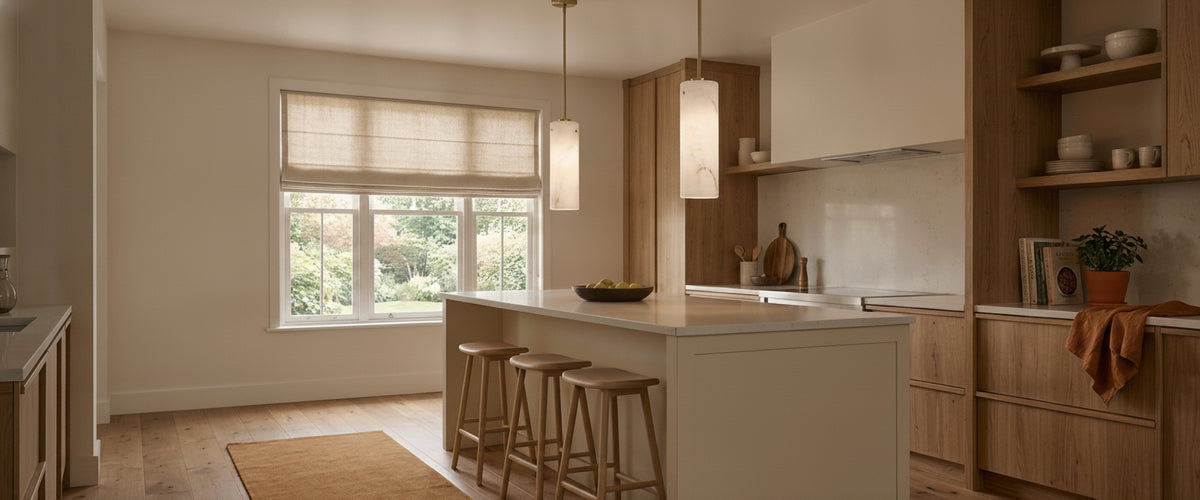

Brass takes the blame for a lot of schemes it did not ruin. Usually the metal was fine and the decision around it was wrong: the wrong sheen against a cool gray wall, a 2200K filament lamp turning warm alloy into something closer to mustard, or an unlacquered finish installed by someone who never wanted it to age. A brushed brass light is one of the most forgiving fittings in lighting, but only once you understand what the brushed surface is actually doing to the light bouncing off it.

Quick Answer: What a Brushed Brass Light Does Well
It scatters instead of mirrors. The fine directional grain breaks up reflections, so you get a low, even sheen rather than hard highlights.
It hides fingerprints and water spots far better than polished brass, which matters on switch-height wall lights and kitchen pendants.
It sits well next to translucent stone. A brushed brass light and an alabaster shade share the same soft, non-glossy handling of light.
It needs the right bulb. Warm brass plus an over-warm lamp reads yellow. Aim around 2700K and dim, rather than dropping to 2200K.
Lacquered or unlacquered is a permanent decision. Choose based on whether you want the finish to stay put or darken over the years.

Brushed Versus Polished Brass: How Texture Changes Reflected Light
Polished brass behaves like a curved mirror. Every light source in the room shows up on it as a bright point, which is why polished fittings look so lively in a hallway with a window at one end and so restless in a small bedroom. The metal on a brushed brass light has been abraded in one direction, leaving microscopic parallel grooves that spread each reflection into a soft streak. The surface still glows, but it glows as a broad band rather than a hotspot.
That single difference explains most of the outcomes people report. A brushed brass light photographs cooler than it looks in person, because the diffused reflection loses some of the warm saturation that polished surfaces carry. Designers who pick a finish from a phone photo and then see the fitting in a north-facing room in February are often surprised by how quiet it looks. Ask for a physical sample and look at it at the actual time of day the room gets used.
Brass is a copper and zinc alloy, and the ratio of those two metals sets the base color before any finishing happens. Higher copper content pushes the tone rosier; more zinc pulls it toward a paler, almost champagne yellow. The Copper Development Association covers the alloy families in useful detail if you want to understand why two brushed brass lights, both described the same way on the box, can look like different metals side by side.
Rooms Where a Brushed Brass Light Sings, and Rooms Where It Reads Flat
A brushed brass light earns its keep in rooms with layered light and some visual texture: kitchens with timber or stone worktops, dining rooms with fabric and rugs, snugs, panelled studies, and hallways where a fitting is seen at eye level. It also works hard in bathrooms, where the brushed grain shrugs off the water marks that would make a polished finish look neglected within a week.
Where it disappoints is in flat, cool, low-contrast rooms. A brushed brass light on a plain white ceiling in a room painted brilliant white, with gray porcelain underfoot and no warm materials anywhere, has nothing to reflect and nothing to respond to. The metal turns beige. If your palette is genuinely cool and minimal, either commit to a brighter polished finish that provides its own contrast, or let the fitting body recede and put the interest in the shade instead. This is where a stone shade does the work: an alabaster diffuser gives the eye something to look at even when the metal is behaving modestly. The alabaster lighting collection is a useful place to see how brass hardware reads when the shade carries the scheme.
Reading Brushed Brass Against Plaster, Stone, Timber and Dark Paint
Take the pairings one at a time rather than assuming a brushed brass light goes with everything.
Polished Plaster and Limewash
Excellent. Both surfaces are matte and slightly irregular, so neither competes. The chalky depth of limewash flatters the low sheen of a brushed brass light, and wall fittings throwing light up a plaster wall pick up the same soft gradient the metal has.
Marble, Onyx and Alabaster
The strongest pairing in our experience. Warm-veined stone shares brass's undertone, and translucent stone lit from within casts a honeyed glow that the brushed grain catches without glaring. Be careful with cool gray-veined marbles; a brushed brass light against a blue-gray Carrara can look slightly orphaned unless there is warm timber or fabric elsewhere in the room to bridge the gap.
Timber
Oak, walnut and ash all work, but they work differently. Pale oak and a brushed brass light produce a light, Scandinavian-leaning result. Walnut and brass gets richer and heavier, and suits dining and library spaces. Avoid orange-toned varnished pine, which fights the brass for the same slot on the color wheel.
Dark Paint
Deep greens, inky blues and near-blacks are where a brushed brass light looks most expensive, because the surrounding darkness restores the contrast the brushed grain gives away. A brass wall fitting on a dark green wall reads as a genuine glow rather than a smudge.
Lacquered or Unlacquered: Answer This Before You Order
Most brushed brass light fittings sold today carry a clear lacquer that seals the metal and keeps the finish looking as it did on delivery. Unlacquered brass is left bare and will oxidize, darkening unevenly with handling and humidity. Neither is superior; they are different commitments.
A hospitality client fitting out a private dining room asked us specifically for living, unlacquered brass on the wall fittings and then rang three months later concerned that the two lights nearest the kitchen pass had darkened faster than the rest. That was the finish working exactly as intended. Warm, humid air accelerates the reaction. If uneven aging will bother you or your client, specify lacquered and be done with it. If you want the fitting to record the life of the room, go unlacquered and brief everyone involved, including the cleaning team, before anyone reaches for a proprietary metal polish.
One practical note: a lacquered brushed brass light must never be cleaned with abrasive cream or acidic polish. Those products are designed to remove tarnish from bare metal and will cut straight through the lacquer, leaving patches that cannot be blended back. A dry microfiber cloth is almost always enough.
Pendant, Wall Light or Table Lamp: How Fixture Type Shifts the Finish
The same finish behaves differently depending on where the fitting sits and how close you get to it.
Pendants. Seen from below and often from a distance, so the brushed grain reads as overall tone rather than texture. Scale matters more than finish here. Over an island, plan for the fitting base to sit roughly 75 to 90cm (30 to 35in) above the worktop so it lights the surface without blocking sightlines. On a long island or a generous dining table, a single wide disc such as the Gemini Brushed Brass Pendant Light 2700K 61cm holds the space better than a cluster of small shades that fragment the reflection.
Wall lights. The most demanding application. They are viewed at close range and at eye level, so the quality of the brushing is visible. Look for a consistent, directional grain rather than a swirled or patchy one. This is also where fingerprints would show on a polished finish, which is why brushed brass lights dominate the category. Outdoors the same logic applies with weathering added, so a sealed fitting such as the Eamon Outdoor Up/Down Wall Light IP54 is the sensible way to carry the finish from a hallway out to a porch or garden wall.
Table and floor lamps. Handled daily. A brushed brass light on a bedside table takes contact from hands, jewelry and books, so lacquer quality and the hardness of the underlying alloy both count. Brass bases also add welcome weight, which keeps a tall alabaster shade stable.
Flush and semi-flush ceiling lights. Brass rims and trims work well in halls and landings with restricted ceiling height, where a pendant would be in the way. Where the ceiling is low but the floor area is not, a broad shallow fitting like the Gemini Brushed Brass Flush Ceiling Light 61cm spreads light across the plaster instead of concentrating it in one bright patch. It is worth comparing fixture types side by side in the wider lighting collection before settling on a format.
Bulb Colour Temperature and Brushed Brass
This is where most brushed brass lighting schemes go wrong. Brass already carries a yellow-gold bias, so every degree of warmth in the lamp compounds it. Filament-style bulbs marketed at 2200K look charming on their own but turn brass fittings distinctly sallow, particularly against white walls. A brushed brass light paired with 2700K and a good dimmer gives you the same cozy result at low output without the color cast baked in.
Also check the color rendering index. A lamp at CRI 90 or above keeps the copper undertone in the metal honest and stops warm stone shades looking muddy; cheap lamps in the CRI 80 range flatten both. Correlated color temperature is a standardized measure, defined and maintained by the International Commission on Illumination, so the numbers on the box are comparable across manufacturers even when the light quality is not.
If you are mixing 4000K downlights with warmer decorative fittings, keep the two layers on separate circuits. Cool general light with warm brass accents can work for kitchens and utility spaces, but only when you can turn the cool layer off in the evening. With an integrated LED the temperature is fixed at the point of order, so a cooler brushed brass light such as the Gemini Brushed Brass Flush Ceiling Light 4000K 61cm belongs in a utility room, boot room or task-led kitchen rather than a bedroom where the brass is meant to read warm.
A Buyer's Checklist Before You Order
Request a physical finish sample and view it in the room, at the hour the room is actually used.
Confirm whether the brass is lacquered or unlacquered, and whether the interior of a shade or reflector is finished to the same standard.
Check that every brushed brass light in one room comes from the same supplier or the same production run; tone varies between batches.
Decide on color temperature before you buy, not after, and buy all lamps for a room together.
Confirm dimmer compatibility with the specific LED lamps you plan to use.
For bathrooms and outdoor use, check the IP rating against the zone the fitting will occupy.
Have every hardwired fitting installed by a qualified electrician; in the UK that means someone competent to work to the current wiring regulations.
Ask for a tailored quote rather than assuming a price. Cost depends on the alloy, the scale, the complexity of the metalwork, whether stone is hand-selected and hand-finished, and what the installation involves.
Caring for Brushed Brass and Alabaster Together
Mixed-material fittings need mixed-material care, and the stone sets the rules. Alabaster is a gypsum stone and is soluble in water, so a damp cloth that would be fine on the brass can leave a permanent dull patch on the shade. Dust the stone dry with a soft brush or a clean lint-free cloth, and keep any cleaning product well away from it. On the metal of a brushed brass light, wipe along the direction of the grain, never across it, so you do not introduce cross-scratches into the surface.
Switch the fitting off and let it cool before cleaning, and support any stone element from underneath rather than pulling on it. If an unlacquered brushed brass light develops tarnish you dislike after several years, a specialist can re-brush and re-lacquer it, which is one of the quiet advantages of solid metal over plated finishes.
Get these decisions right and a brushed brass light stops being a trend item and becomes structural to the scheme: a warm, low-glare metal that holds its own next to natural stone for decades. At Niori we build alabaster and natural-stone lighting around exactly that relationship, and the full range is on the Niori homepage.