
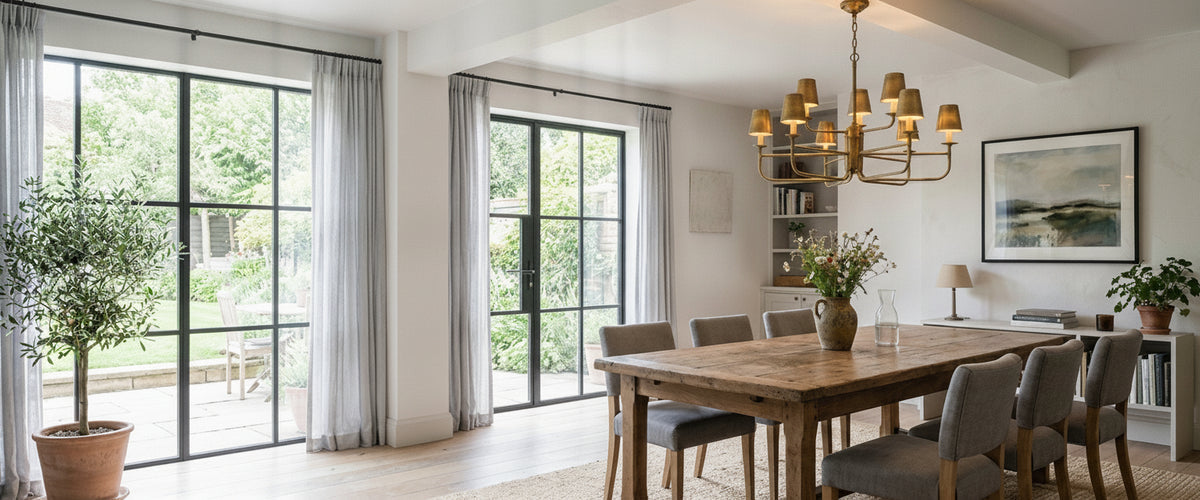

Most brass chandeliers go wrong for one of two reasons: the finish fights the light already in the room, or the frame is the wrong size for the ceiling it hangs from. An antique brass chandeliers is less forgiving than a painted or nickel fitting on both counts, because aged brass absorbs light rather than bouncing it back. Get the proportion and the lamp right and it settles into a room like it has always been there. Get them wrong and it reads like a fitting somebody inherited and never replaced.

At a Glance: What Actually Decides the Result
- Finish: antique brass is darkened and warm; polished brass is mirror-bright; brushed brass is matte and modern; living brass changes over years.
- Scale: aged finishes read visually heavier, so an antique brass chandelier usually needs a slightly smaller diameter than a brushed-brass equivalent in the same room.
- Bulb: clear candle filament lamps at roughly 2200K to 2700K make patina glow. Cold frosted lamps flatten it to grey-brown.
- Backdrop: aged brass needs mid to deep wall colours, warm timber or stone. It disappears against cool grey and bright white.
- Care: establish whether the finish is lacquered before you touch it with any polish.

Antique Brass Versus Brushed, Polished and Living Brass
These four finishes are sold as if they were shades of the same colour. Under light they behave nothing alike. Polished brass is specular: it throws hard highlights, doubles every lamp in the room as a reflection, and looks brilliant in a dining room at night and slightly frantic at midday. Brushed brass scatters light in one direction, giving a soft satin sheen that sits comfortably alongside matte black, plaster and pale stone. It is the safe modern choice.
Antique brass is chemically darkened, then relieved on high points so edges and curves catch light while recesses stay deep. That contrast is the whole appeal. It means a brass antique chandeliers reads as three-dimensional even when switched off, and it means the fitting needs light landing on it from somewhere, whether that is the lamps within the fixture, a nearby wall light or daylight from a window.
Living brass, sometimes called unlacquered or raw brass, arrives bright and oxidises on its own schedule. Fingerprints show. Humidity accelerates it. A bathroom fitting in living brass will look considerably older after eighteen months than the same piece in a dry hallway. Some clients love that; others come back frustrated. If you want a stable, predictable dark warmth from day one, an antique brass chandelier is what you should be specifying.
The Period References an Antique Brass Chandelier Carries
Aged brass borrows from a long line of things: Georgian and Regency candle chandeliers, Dutch bell-arm fittings, 1920s hotel bars, mid-century Italian sputniks, 1970s restaurant lighting. That is a lot of history for one object to carry, and it is why the same fitting can look scholarly in one house and like a themed pub in another.
The trick is to let the room supply one period reference and no more. A Victorian terrace with original cornicing already has its story. Drop a heavily scrolled vintage brass chandelier underneath it and you have doubled down. Choose a cleaner arm profile instead and the fitting reads as a considered addition. Conversely, in a new-build kitchen extension with a flat plastered ceiling, a more ornate antique brass chandelier gives the room the age it does not have. Metalwork historians at the Victoria and Albert Museum note how brass alloy composition and surface treatment shifted with manufacturing technology across these centuries, which is partly why period-inspired castings look convincing today while machine-perfect ones can feel thin. Their guidance on caring for metalwork is a useful primer if you are also living with older brass pieces.
Arm Count and Scale: Vintage Frames Play by Different Rules
The usual rule of thumb (add the room's length and width in feet, and use that figure in inches as your diameter) is a starting point for sizing an antique brass chandelier, not an answer. It was written for pale, open fittings. Aged brass has visual weight. As a working adjustment we suggest taking that number down by roughly ten per cent for a dark antiqued finish, and adding to it for a slim brushed or alabaster fitting.
Arm count matters more than most buyers expect. A 5-light frame with generous spacing reads elegant; an 8-light frame at the same diameter reads dense and formal. Where a six-seater table needs presence without density, a frame such as the Zelda 5 Light Chandelier in Vintage Brass holds the space more comfortably than a wider eight-arm alternative at the same diameter. In a dining room, count arms against seats: five or six arms over a six-seater, eight over an eight to ten seater. Over a kitchen island or a long refectory table, a brass linear chandelier almost always beats a round one, because the light distribution matches the worktop rather than pooling in the centre and leaving the ends dim.
Drop height: aim for the base of the fixture to sit roughly 76cm to 90cm (30 to 35 inches) above a dining table, and add around 7.5cm (3 inches) for every 30cm (1 foot) of ceiling above the standard 2.4m (8 feet). In a stairwell, the lowest point should clear the highest tread by a comfortable margin and be visible from the entrance below, which is where a multi-tier antique brass chandelier earns its keep.
The Bulb Decides Whether the Patina Glows or Dulls
This is the single most common mistake we see with an antique brass chandelier, and it costs nothing to fix. Aged brass has almost no reflectance in the blue end of the spectrum. Put a 4000K frosted LED candle in it and the finish turns muddy grey-brown; the relief work vanishes; the whole fixture looks tired. Put a clear filament LED at 2200K to 2400K in the same frame and the metal comes alive, because the warm output is exactly the wavelength band that darkened brass throws back.
Practical guidance for a retro brass chandelier:
- Clear candle filament LEDs for exposed-lamp frames. The visible filament is part of the composition.
- Colour temperature 2200K to 2700K. Anything above 3000K undermines the finish.
- CRI 90 or above so timber, textiles and stone alongside it hold their colour.
- Dim to around 10 per cent for dining. Aged brass at low output is where the finish looks best.
- Match every lamp in the fitting. Mixed batches of LED candles produce visibly different tints, and on an eight-arm frame you will notice.
Use a trailing-edge dimmer rated for LED loads and confirm compatibility before ordering, particularly with retrofit filament lamps. Any hardwiring should be done by a qualified electrician.
Wall Colour, Ceiling Height and Flooring That Make Brass Read Deliberate
Aged brass needs contrast to define its silhouette and warmth to justify its colour. Deep greens, ink blues, oxblood, warm clay and dark plaster shades all work, because the fitting draws itself against them cleanly. Bright white walls with cool undertones are the hardest backdrop for an antique brass chandelier; the metal looks orange and slightly cheap, and the light it throws seems yellow rather than warm.
Flooring pulls the scheme together from below. Oak, walnut, terracotta, sisal, aged limestone and travertine all echo the tone. Grey porcelain and cool-toned engineered planks fight it. If your floor is cool and your walls are pale, a brushed brass fitting or an alabaster piece with brass detailing will sit far more comfortably than a heavily antiqued frame; browse the range on our lighting collection to compare how the two finishes behave against different backgrounds.
Ceiling height sets the ceiling on ornament. Below 2.4m (8 feet), keep arms compact and the drop short, or move to a semi-flush aged brass fitting. Above 3m (10 feet), you have room for tiered frames and a genuine sense of occasion.
Rooms Where Antique Brass Earns Its Place
Dining rooms are the natural home. Candle-style arms at low dim, warm walls, a timber table; nothing else does that job as well. Entrance halls and stairwells come second, especially in period properties where the fitting is seen from two levels. Snugs, libraries and panelled studies take aged brass easily because the palette is already warm and layered.
Bedrooms work if the antique brass chandelier is paired with soft materials and a low-output lamp. Last winter we shipped the eight-light Equinoxe Chandelier in Antique Brass and Amber Glass to a Georgian townhouse in Bath, where the client had already stripped back to the original ceiling rose. The fitting was heavier than her interior designer initially wanted; on site, with the walls in a deep olive and the lamps dimmed to a fraction of their output, it was the only thing in the room anyone talked about.
Where it fights: cool-toned minimalist kitchens, bathrooms with polished chrome brassware, and open-plan spaces with large expanses of glass and pale stone. In those rooms, brass at full ornament looks like a visitor. That is often the moment clients move to alabaster, where the stone itself carries the warmth and brass appears only as a slim structural element.
Where Alabaster Changes the Calculation
Niori works primarily in alabaster and natural stone, and the honest comparison is this: a vintage brass chandelier throws light outward from visible lamps, while an alabaster fitting glows from within. Stone diffuses light through its own thickness, so the veining reads as a soft internal map and the output is even rather than sparkling. Over a long island or a boardroom table where you want length of light without glare, a piece such as the Aurevia 14 Light Linear Alabaster Chandelier in Brushed Brass is closer to the right design language than an exposed-lamp frame. An antique brass chandelier with filament lamps suits a room where you want atmosphere and accept some sparkle.
Plenty of projects use both, and they sit together well as long as the brass tone is consistent across the room. If you are weighing the two, the alabaster lighting collection shows how brass detailing behaves against stone rather than against air.
How to Clean a Brass Chandelier Without Ruining It
Before anything else, find out whether the finish is lacquered. Most contemporary antique brass chandeliers are lacquered to hold the patina in place. Polish will cut straight through that coating and leave bright patches you cannot blend back. The Smithsonian's conservation guidance on caring for metal objects is clear that abrasive cleaners and commercial polishes should be a last resort, not routine maintenance.
- Switch off at the wall and let the lamps cool completely.
- Dust dry with a soft lint-free cloth or a clean makeup brush for detailed castings. Do this every few weeks and you may never need anything stronger.
- For grime, use a barely damp cloth with a drop of pH-neutral soap, then dry immediately. Moisture left in crevices is what causes the finish to go patchy.
- Never use vinegar, lemon, ketchup remedies, wire wool or all-purpose spray cleaner. Spray also travels into lampholders.
- Polishing applies only to unlacquered brass. Use a proprietary brass polish sparingly on a cloth, work in small sections, buff, and accept that you are removing patina in the process. If you want the aged look, polish less, not more.
- Alabaster and stone elements get a dry soft brush only. No water, no solvents, no proprietary polish. Stone is porous and will mark.
Buyer's Checklist Before You Order
- Measured room dimensions, ceiling height and the exact table or island length the fitting will sit over.
- Wall colour and flooring tone confirmed, not assumed. Order a sample if the finish is borderline.
- Arm count chosen against seat count, not against the photograph.
- Lacquered or unlacquered confirmed in writing, so care is not a guess later.
- Dimmer type checked against the lamps you intend to fit.
- Fixture weight and ceiling fixing reviewed by a qualified electrician, especially on lath and plaster.
- Rod, chain or cable drop specified for your ceiling height rather than the default supplied length.
- Budget discussed openly. Cost depends on scale, arm count, hand-finishing, glass or stone components and installation complexity, so ask for a tailored quote rather than working from a headline figure.
So Are Brass Chandeliers Out of Style?
No, though the version that dominated the early 2000s is. What has changed is the finish: heavily lacquered high-shine gold has given way to antique, burnished and brushed tones with more depth and less glare. Brass has run continuously through interiors for three hundred years and shows no sign of leaving. Choose an antique brass chandelier because it fits your palette and the light you want, not because a feed told you to. If you would rather see the wider range of stone and metal fittings side by side, start on the Niori homepage and work from the room you are actually lighting.