
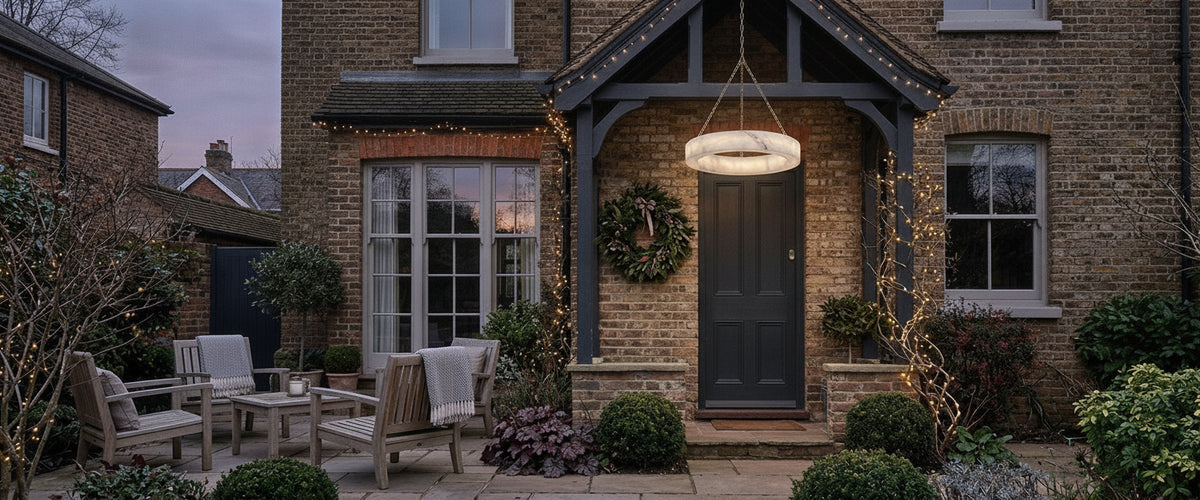

Most outdoor festive displays peak on the night they go up. By the third week of December the same house looks tired: a sagging net over the hedge, a string that has half-died on the porch, and three competing shades of white fighting across one facade. The problem with most christmas outdoor lights is rarely the bulbs themselves. It is the absence of a plan. At Niori we spend our working lives thinking about how light leaves a surface and lands in a room, and the same principles apply to a front garden in December.

Quick Answer: What Makes an Outdoor Scheme Work
- Pick one white. Warm white (around 2200K to 2700K) flatters brick, stone and render, and matches the glow from your windows.
- Use fewer light types. Two, at most three, across the whole frontage.
- Match power to position. Mains for the roofline and large trees, battery operated outdoor lights for doors and planters, solar only where there is real daylight.
- Check the rating. IP44 is the minimum for outdoor sets; IP65 or higher for anything near the ground or exposed to driving rain.
- Light the interior too. A warm lamp in a front window does more for kerb appeal than another hundred LEDs.

Why Christmas Outdoor Lights Peak on Day One
Displays tend to get built additively. One set goes on the tree, a second set of a different make goes round the door, and a bargain net goes over the box hedge. Each looks fine alone. Together they produce a patchwork of colour temperatures, flash patterns and brightness levels that the eye reads as clutter.
Weather finishes the job. British Decembers are wet rather than frozen, and cheap connectors let in water long before the lights themselves fail. The first sign is usually a section that flickers after rain, then goes dark. Buying fewer, better Christmas outdoor lights and placing them with intent is what keeps a facade looking considered into January.
String, Icicle, Net and Rope: What Each Light Type Does to a Facade
Most Christmas outdoor lights come in one of four formats, and each changes how a facade reads.
String lights are the most versatile. Wrapped tightly around a trunk and main branches they sculpt a tree; draped loosely they look like an afterthought. Tight spacing reads as a line, wide spacing as a scatter.
Icicle lights trace a horizontal edge and add depth below it. On a long Victorian terrace frontage or a deep eaves line they give structure. On a low bungalow roofline they can crowd the windows, so keep the drops short.
Net lights give fast, even coverage over hedges and shrubs. They flatten form, though, which is why a clipped box ball can end up looking like a glowing blanket. Use them on informal hedging, not on topiary you are proud of.
Rope lights produce a continuous line with no visible points. They suit path edges, steps and handrails, where you want guidance rather than sparkle. On a period house they can feel commercial, so we tend to keep them low and out of the sightline from the street.
Warm White or Colour: Which Palette Ages Better Across a British December
Colour has its place, particularly for families with young children, but warm white Christmas outdoor lights wear better over a long season. Grey skies and short days make cool white LEDs look clinical, almost blue against wet stone or London stock brick. Warm white sits closer to candlelight and firelight, and it pairs with the amber glow coming from inside the house.
The same holds from the inside looking out. Stand beside a lit alabaster pendant or table lamp at dusk, and anything outside the window lit in cool white immediately looks wrong next to the stone's honeyed glow. The eye wants one family of warmth. If you do want colour, confine it to a single element (one tree, one wreath) rather than mixing it across the whole frontage.
Mains, Battery or Solar: Which Power Source Belongs Where
Christmas outdoor lights can run from the mains, batteries or the sun. Each power source has a natural home, and most disappointment comes from forcing one into the wrong job.
Mains Power
Best for rooflines, large trees and anything you want bright for five or six hours a night. Choose low-voltage sets with the transformer kept indoors or in a weatherproof enclosure, and plug into an RCD-protected socket. If you want a permanent outdoor socket or a switched supply to the front of the house, use a qualified electrician; in the UK, a registered contractor can certify the work.
Battery Operated Outdoor Lights
Yes, you can use battery lights outdoors, provided the battery box itself is rated for outdoor use. battery operated outdoor lights are ideal for the front door, window boxes, planters and a wreath, anywhere a cable would be awkward. Look for a built-in timer (typically six hours on, eighteen off) so the batteries last the season. Keep the battery box tucked under foliage or a sill, facing down so rain runs off it. If a set uses button cells, store spares well out of reach; the Child Accident Prevention Trust is clear about the risks to small children.
Solar
Solar is the weakest option for Christmas in Britain. With around eight hours of daylight, much of it overcast, panels rarely charge fully. North-facing front gardens are close to hopeless. Keep solar for a south-facing back garden, and treat it as a bonus rather than the backbone of the scheme.
IP Ratings and Cable Quality: The Specs That Decide How Long It Lasts
The IP (ingress protection) rating tells you how well a fitting keeps out dust and water. The second digit matters most outdoors. IP44 resists splashing and is the practical minimum. IP65 resists low-pressure jets of water and is what you want for lights at ground level, on exposed walls or near downpipes.
Cable is where cheaper Christmas outdoor lights give themselves away. Thin PVC cable stiffens in the cold and cracks at the bends; rubber cable stays flexible and survives being coiled and uncoiled for several seasons. Check the connectors too. Screw-sealed joints with rubber gaskets outlast push-fit plugs, and every connection should be off the ground and angled so water drains away.
Placement Logic That Reads as a Scheme, Not an Accident
Rooflines
Run lights along one continuous edge, the gutter or the eaves, not both. Use proper gutter clips rather than nails or staples, and work from a secure ladder with someone footing it. If the roofline is high or awkward, hire a professional.
Trees
Choose one hero tree visible from the street and light it properly, rather than lighting every shrub a little. Wrap from the base upward, following the main limbs. A small tree in a pot either side of the door creates symmetry that immediately looks planned.
Paths
Paths need guidance, not glare. Low, even light every metre or so (about three feet) along one side is enough. Rope lights or small stake lights work; avoid anything that shines directly into the eyes of someone walking up to the door.
Window Frames
Outlining sash windows with string lights is traditional, but it often competes with what is inside. Consider framing only the front door and letting the windows glow on their own.
Let the House Glow from Inside
Picture a Georgian townhouse with a pair of alabaster table lamps set in the ground-floor sash windows. Instead of stringing the whole facade, the owner stops at a wreath, a lit bay tree either side of the door, and the lamps. From the street, the translucent stone throws a soft amber rectangle into each window, and the house looks more festive with less on the outside.
This is the most underrated move in outdoor Christmas lighting. Natural stone diffuses light rather than pointing it, so a lamp or pendant visible from outside reads as warmth, not glare. If you are rethinking the front rooms anyway, the alabaster lighting collection is worth browsing for pieces that earn their place all year, then do double duty every December.
Before You Buy: A Practical Checklist
- Measure each run (roofline, tree height, path length) in metres and add 10 per cent for bends and drops.
- Choose one colour temperature and buy every set from the same range where possible.
- Confirm the IP rating on the lights, the connectors and the transformer or battery box separately.
- Map where your outdoor sockets are. If there are none, plan battery sets or speak to an electrician.
- Prefer sets with timers and rubber cable.
- Decide on a hero element (a tree, the door, the roofline) and keep the rest quieter.
- Check the view from the street at dusk before adding anything more.
Packing Away So It Works Next Year
Dry your Christmas outdoor lights indoors before storing. Coil cables loosely around a piece of card rather than knotting them, remove batteries from battery boxes to prevent leakage, and label each set by location. Next December, the scheme goes back up in an afternoon, and it looks deliberate from the first night to the last.