
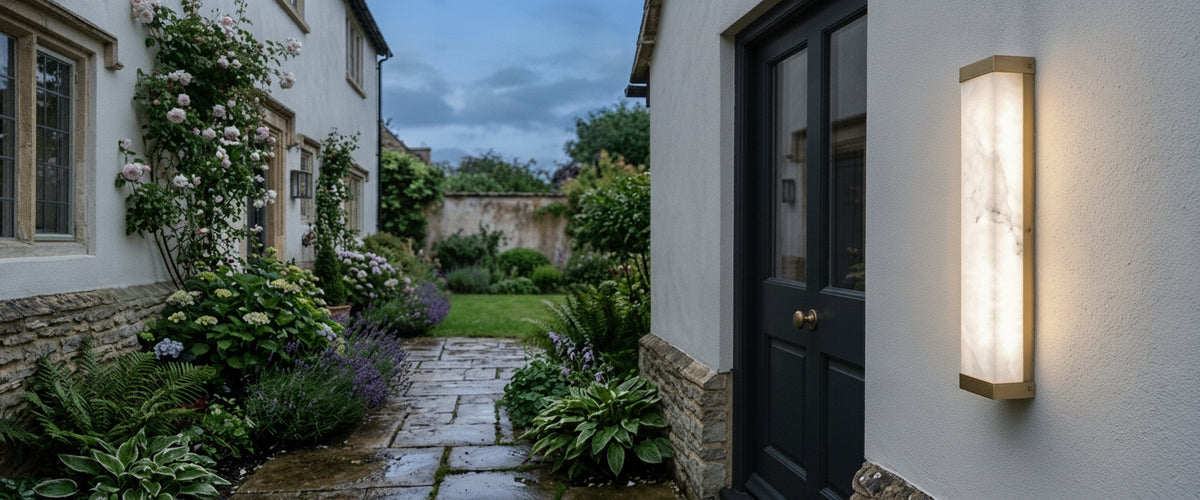

Most modern outdoor wall lights look sharp on the day they go up and tired by the following March. The usual causes are a finish that could not cope with months of rain, a fitting too small for the door it frames, and a cable that had to be forced in from the wrong direction. Search for modern outdoor wall lighting and you will find thousands of near-identical cylinders and cubes. What separates them is mostly invisible in a product photo. This buying guide covers the details that decide whether a fitting still looks deliberate after its first wet winter.

At a Glance
- Narrow by function first: are you lighting a door, washing a wall, marking a path or picking out a gate? Style comes second.
- Match the beam to the facade: textured brick and stone suit grazing up-and-down light. Smooth render suits soft diffusion.
- Finish matters more than shape: ask about pretreatment and coating spec on aluminium, especially within a few miles of the coast.
- Size up, not down: a fitting beside a front door should usually be roughly a quarter to a third of the door's height.
- Confirm cable entry before ordering: rear or bottom entry, and whether the fitting can be mounted only one way up.

Modern Outdoor Wall Lights Cover More Ground Than the Search Suggests
"Modern" in the outdoor category covers everything from a 10cm (4in) matt black puck to a tall up-and-down column. It also includes lantern shapes stripped back to a frame of glass and metal. Treating all of these as one category is how people end up with a fitting that suits the house in a mood board and does nothing useful at the door.
The fastest way to narrow the field is to name the job. A front door needs light on faces and the keyhole, so you want downward or diffused light at roughly head height. A long garden wall needs a wash, so you want an up-and-down beam that draws two lines of light across the masonry. A side return needs safe footing and little else, so a low, shielded fitting will do. Once you have named the job, you can cut a shortlist of a hundred modern outdoor wall lights down to about a dozen. Then filter by finish and IP rating. IP44 is the sensible floor for a sheltered porch. IP65 is the better choice for an exposed elevation or anywhere a hose might reach. Leave the shape until last.
Wall Colour, Facade Material and Mounting Height
Treat these three as one decision, because each changes how the others behave. A dark modern outdoor wall light on red brick almost disappears by day, which many people want. The same fitting on white render reads as a hard graphic mark, so its proportions need to be right. On pale render a slim white or stone-coloured body can vanish entirely. That works well if you care about the light and not the object.
Facade material changes what the light does. Rough brick, flint and natural stone reward grazing light: a beam mounted close to the wall picks out every course and joint. Render is far less forgiving. Graze it and every patch, trowel mark and hairline crack shows up at night. On a rendered house we usually steer people towards wider beams or diffused fittings that put a gentle pool on the wall without raking across it.
For mounting height beside a door, a good starting point is around 1.6 to 1.8m (5ft 3in to 5ft 11in) to the centre of the fitting. Alternatively, line the top of the fitting up with the top of the door frame. Go lower and the light shines into visitors' eyes. Go much higher and faces fall into shadow, particularly under a porch canopy.
Powder Coat Versus Anodised Aluminium: What a Wet Winter Reveals
Most modern outdoor wall fittings are aluminium, and the finish is where cheap and well-made versions part company. You will not see the difference in the first month. You will see it after a season of driving rain, freezing nights and salt spray carried on the wind.
Powder coat is a polymer layer baked onto the metal. It comes in almost any colour and gives that flat, velvety matt black people want. Its weakness is adhesion. If the aluminium was not properly pretreated, a chip at an edge or screw hole lets moisture creep underneath. The result is filiform corrosion: thin, worm-like blisters that spread under the paint. Coating schemes certified to standards such as Qualicoat set requirements for pretreatment and film thickness, and coastal-grade variants exist for good reason. If a supplier cannot tell you anything about the coating spec, treat that as an answer in itself.
Anodised aluminium works differently. The protective oxide layer is grown from the metal itself, so there is nothing to peel or blister. The trade-offs are a narrower colour range (silvers, bronzes, champagnes and blacks) and scratches that are hard to touch up. Anodised finishes also need an occasional rinse in salty or polluted air, otherwise deposits can dull the surface.
The pattern we hear about most often from coastal homeowners is a powder-coated fitting blistering at its corners within a couple of years, while an anodised fitting on the same wall still looks much as it did on day one. Choose powder coat for colour and anodised for longevity in harsh air, and ask about pretreatment either way.
Uplighting, Downlighting and Full Diffusion on a British Facade
Downlighting suits entrances, steps and anywhere you need to see where you are putting your feet. It is also the most neighbour-friendly choice, because the light stays on the ground and out of the sky and bedroom windows.
Up-and-down beams belong on wide, textured elevations: brick terraces, stone cottages and long garden walls. Spaced evenly, they give a strong architectural rhythm. Think carefully before using pure uplighting. Light thrown into the sky is wasted energy, and under eaves it lights up cobwebs.
Full diffusion comes from opal glass globes and frosted boxes, and it is the outdoor cousin of the soft glow alabaster gives indoors. It suits rendered walls, covered porches and courtyard dining areas where you want ambience rather than a beam. For warmth, choose 2700K or 3000K. Anything cooler makes a British facade look like a car park on a damp night.
Scale Against Doors, Window Reveals and Gate Posts
Undersizing is the most common mistake we see with modern outdoor wall lights. A fitting looks big in the hand and small on a wall viewed from the pavement. For a pair either side of a standard front door, aim for each fitting to be roughly a quarter of the door's height. For a single fitting, aim nearer a third.
Window reveals catch people out. Mount a fitting too close to a deep reveal and half its light disappears into the recess, while the body looks crammed against the opening. Leave at least 10 to 15cm (4 to 6in) between the fitting and the edge of the reveal. On gate posts, the backplate should never be wider than the face of the post. Centre the fitting and keep it a little below the cap so the post still reads as a post.
Cable Entry: Confirm It Before Purchase, Not During Installation
This is the detail almost nobody checks, and it causes the most trouble on installation day. Some modern outdoor wall fittings take the cable through the backplate from a box recessed in the wall. Others expect a surface cable rising from below through a gland. If your existing supply emerges 8cm off-centre and the backplate is only 10cm wide, you have a problem. So does a fitting that can only be mounted with its gland facing up, because an upward-facing entry collects water.
Before ordering, photograph where the cable comes out, measure its position, and check that against the fitting's backplate and its permitted mounting orientations. Have the work done by a qualified electrician. Outdoor electrics combine water and mains voltage, and adding a new circuit is notifiable under Part P of the Building Regulations in England. A drip loop in the cable and a properly sealed gland cost almost nothing extra and head off the most common cause of water ingress.
Where Alabaster and Natural Stone Fit In
We are an alabaster and natural-stone lighting brand, so here is a straight answer: alabaster does not belong on an exposed exterior wall. It is a form of gypsum, soft and slightly soluble, and rain will etch and cloud it over time. Its place is just inside the threshold. Think of a glazed porch, an orangery, or a hallway where the glow is visible through a fanlight. Pairing a crisp modern outdoor wall fitting outside with warm stone just inside is one of the most satisfying arrival sequences you can design. Our alabaster lighting collection is the place to look for that interior half of the pairing.
Scale matters on the inside of the door too. In a narrow hallway where the wall beside the fanlight is only a little wider than the fitting, a compact piece such as the Selvara LED Small Alabaster Wall Light in Brushed Brass gives that visible glow without crowding the opening the way a large double fitting would.
Echo the metals across the threshold to tie the two together. Brushed brass inside pairs well with bronze anodised outside, and where a glazed porch has the wall space for something more generous, the Selvara LED Medium Alabaster Wall Light in Brushed Brass carries that warm metal and stone pairing at a scale that still reads from the front path. Matt black outside suits darker veined stone within. If the hallway calls for a cleaner, more graphic line to continue a black exterior scheme indoors, a cone-shaped interior fitting like the Astra 2 Light Cone Wall Light in Matt Black is closer to the right design language than a decorative lantern. If you are planning a whole scheme, the full niori lighting range makes it easier to keep finishes consistent from the front step to the dining room.
Buyer's Checklist Before You Order
- Name the job: door, wall wash, path or gate.
- Check the IP rating against how exposed the wall is (IP44 sheltered, IP65 exposed).
- Ask for the coating spec and pretreatment on powder-coated aluminium, especially near the coast.
- Choose the beam for the facade: grazing for texture, diffusion for render.
- Size the fitting at roughly a quarter to a third of door height.
- Measure cable position and confirm entry direction and mounting orientation.
- Pick 2700K to 3000K, and check driver compatibility if you plan to dim.
- Book a qualified electrician, and ask for a drip loop and sealed gland.
Get those right and picking a modern outdoor wall light comes down to taste: a cylinder, a cube or a slim lantern. That is the decision you wanted to make in the first place.