
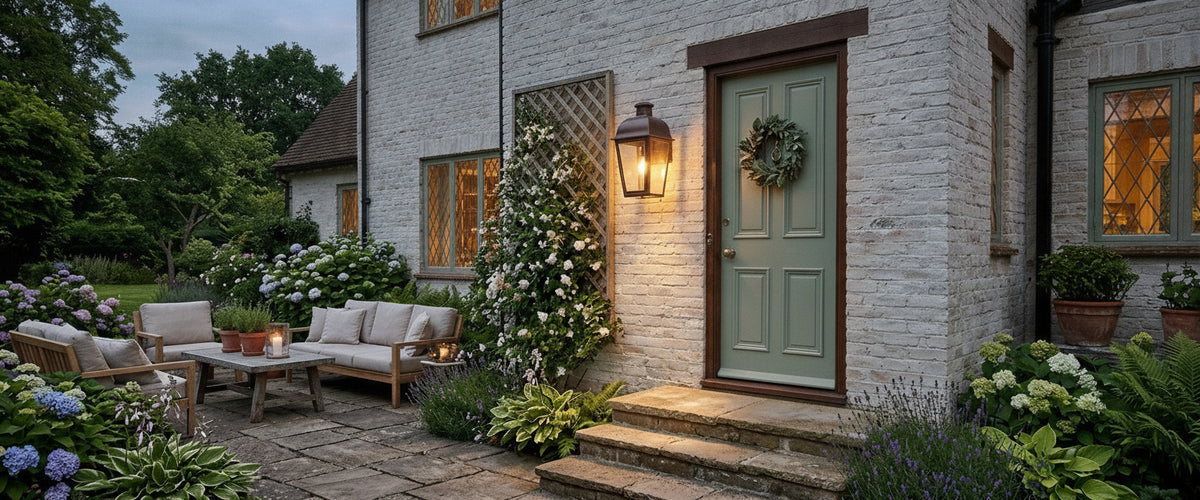

A copper outdoor wall light is one of the few fittings on your house that changes colour without asking permission. Bright salmon-pink on delivery, chocolate brown within a season, and eventually, if the conditions allow, the blue-green of an old church roof. Some buyers love every stage of that. Others ring us a year later asking why their porch light looks 'dirty'. The difference is almost always a decision made at checkout, before anyone thought about the finish, the wall it would sit on, or the bulb going inside.
At a glance
- Live (unlacquered) copper darkens within months and can turn green over years. Choose it if you want the facade to age with the house.
- Lacquered copper holds its warm tone longer, but the coating eventually wears and weathers unevenly.
- Copper-effect finishes are a coating over another metal. They look copper on day one and do not develop a true patina.
- IP44 is the sensible minimum for a sheltered wall; IP65 for exposed, coastal or north-facing elevations.
- 2700K suits bright and brown copper; consider 3000K once the green arrives.
- All outdoor wiring belongs with a qualified electrician.

Live Copper or Lacquered Copper: Which One Turns Green?
Live copper is bare metal. Rain, air and pollution start working on it the day it goes up. The first change is quick: the bright pink fades to a darker bronze within weeks, then to a deep brown that many people think of as the 'proper' copper colour. Green comes much later, and only on surfaces that stay damp long enough for the chemistry to build up.
Lacquered copper has a clear protective coat that seals the surface away from moisture. Done well, it keeps that warm, polished tone for years. The catch is how lacquer fails. UV and frost break it down unevenly, so you get a bright patch beside a dark patch, usually on the top of the fitting where weather hits hardest. Fixing it means stripping and relacquering, which is a job most people never get round to.
Then there is a third category, which matters when you are reading listings. Many lights sold as copper outdoor wall fittings carry a copper-effect finish: a painted or plated surface over aluminium or steel. That is a perfectly reasonable choice if you want a consistent warm tone with very little upkeep, but it will never patinate. If a chip appears, you will see silver or grey underneath. Ask what the body is made of before you buy. If a steady tone matters more to you than an evolving one, a copper-effect fitting such as the Outdoor Adjustable Wall Light GU10, Copper Effect IP65 is the more honest match for that brief than live metal you would then have to fight to keep bright.

How Copper Weathers Next to Brass and Steel on a UK Exterior
On a typical UK house, with steady rain, mild winters and not much sun, live copper tends to settle into its brown phase within the first year. The green layer takes far longer. According to the Copper Development Association's architectural finishes guidance, natural patina can take anywhere from several years to a couple of decades depending on climate, and it forms faster in marine and urban air than in dry, clean rural air. A copper outdoor wall light on a sheltered porch may stay brown almost indefinitely.
Coastal walls show the opposite. A copper outdoor wall light facing the sea across open ground can start to show green along its top edges far sooner than the same fitting in an inland garden. Salt spray speeds everything up.
Unlacquered brass behaves more gently. It dulls to a soft honey-brown and can pick up odd dark or greenish spots, but rarely develops an even verdigris. Steel splits into two camps. Stainless steel stays grey and largely stable. Powder-coated mild steel looks crisp until the coating chips, at which point rust can bleed down the wall. Copper's strength is that its weathering is protective: the patina shields the metal underneath rather than eating into it.
One thing copper does that brass and steel rarely do: it stains what sits below it. Rainwater running off live copper can leave green streaks on pale render, limestone and Bath stone. If your copper outdoor wall light is going above light-coloured masonry, mount it with a small drip clearance or accept that the wall will tell the story too.
IP Ratings, Back-Plate Sealing and the Details That Decide Longevity
On any copper outdoor wall light, the metal rarely fails first. The seal does. An IP rating tells you how well the fitting resists dust and water: the first digit covers solids, the second water. IP44 handles splashing from any direction and suits a covered porch or a wall under deep eaves. IP65 is jet-resistant and dust-tight, which is what we would specify for an exposed gable, a coastal property or a north-facing wall that never quite dries out. On an open elevation where you also want to wash the brick or stone above and below the fitting, an IP65 up-down design like the Outdoor Up Down Wall Light IP65, Copper GU10 puts the protection where the weather actually lands, rather than relying on a sheltered position.
The rating only holds if the fitting is installed the way it was tested. Points worth raising with your electrician:
- Back-plate gasket: make sure it sits flat on the wall. Rough brick or textured render may need a flat mounting block so the gasket can seal.
- Sealant bead: run it along the top and sides, leaving the bottom open so any condensation can drain.
- Cable entry: use the supplied gland and seal unused knockouts. Water follows cable.
- Orientation: up-down fittings and adjustable spot heads often have a correct way up. Check before fixing.
- Mounting height: roughly 1.7 to 1.8 m (about 5.5 to 6 feet) beside a door keeps the light at face level without glaring into eyes.
Outdoor circuits need RCD protection, and in England and Wales some outdoor electrical work falls under the building regulations. The government's Approved Document P guidance sets out the rules. Always use a qualified, registered electrician; this is not a weekend DIY job, however simple the bracket looks.
Where a Copper Outdoor Wall Light Sits Naturally, and Where It Competes
Copper is a warm metal, and it reads best against materials that are either warm and muted or cool enough to make it the accent.
- Victorian and Edwardian red brick: aged, dark copper looks right at home. New bright copper against orange brick can feel like too much of one colour; lacquered pieces suit softer, older brick better.
- Cotswold and Bath stone: honey stone and brown copper are a natural pairing. Watch the run-off staining mentioned above.
- Slate, granite and dark grey render: copper becomes the focal point here, and the eventual green looks deliberate against cool stone.
- Crisp white render and new-build modern: this is where copper competes. A lone copper fitting on a stark white wall can look applied rather than designed. Repeat the metal elsewhere (a door handle, a house number, guttering) so it belongs to a scheme.
- Timber cladding: larch and cedar silver over time, and weathered copper ages along a similar path. A good match if you are happy for both to mellow together.
Bulb Color Temperature for a Surface That Keeps Changing
A copper outdoor wall light reflects warm light back at you, so the bulb matters more than it does with a matt black fitting. When the metal is fresh or brown, 2700K draws out its depth and keeps the threshold welcoming. Go much cooler and bright copper starts to look flat and slightly cheap.
Green patina changes the brief. Very warm light falling on verdigris can turn it a muddy olive, so 3000K often shows the colour more truthfully. Seasons shift things too. In winter, wet copper reads darker and the walls around it look heavier, so a dimmable lamp lets you bring the output up on grim evenings and down in summer when there is still light in the sky. Many outdoor wall fittings take a standard GU10 lamp, which makes changing colour temperature as the finish ages an easy swap; for a single doorway, a straightforward fitting such as the Outdoor Wall Light GU10, Copper IP65 keeps that flexibility without the extra output of a twin-beam design. Keep the output modest; a front door rarely needs to be floodlit, and low, warm light is kinder to neighbours and nocturnal wildlife.
Clean, Treat or Leave Alone: Caring for Copper Outdoors
Clean twice a year regardless of finish: brush off cobwebs, wipe the glass or lens with warm water and a drop of washing-up liquid, and check the gasket hasn't perished. Isolate the power first.
Treat only if you want to slow the change. A thin coat of microcrystalline wax on live copper holds it in the brown stage longer and needs renewing roughly once a year. On lacquered copper, use only a soft cloth; abrasive pads and metal polish cut straight through the coating.
Leave alone once green has begun to form, if that is the look you chose. Scrubbing patina off a copper outdoor wall light restarts the clock and usually leaves it blotchy. The patina is doing its job, protecting the metal beneath.
Buyer Checklist Before You Order
- Decide whether you want your copper outdoor wall light to change colour. That settles live, lacquered or copper-effect.
- Confirm what the body is made of, not just the finish name.
- Match the IP rating to the wall's exposure, not the catalogue average.
- Check the wall colour below the light for staining risk.
- Choose fitting style by task: up-down for facade wash, adjustable heads for steps and house numbers, a lantern-style fitting for a softer doorway.
- Pick a lamp type you can buy easily and in more than one colour temperature.
- Book a qualified electrician before the fitting arrives.
If you are planning the whole scheme rather than one fitting, our lighting collection shows how warm metals can carry from outside to in.
Where Alabaster Fits In (and Where It Does Not)
A question we hear often at Niori: can an alabaster wall light go outside? Our advice is no. Alabaster is a soft, porous stone that dislikes water and frost, and even a covered porch sees enough damp to mark it. Keep it just inside the door instead. The best thresholds we have seen pair a weathered copper outdoor wall light by the step with an alabaster wall light or pendant in the hall beyond; the copper's warmth outside hands over to the stone's soft, diffused glow the moment the door opens. Brass detailing on the interior pieces ties the two together. You can see the range of forms in our alabaster lighting collection.