
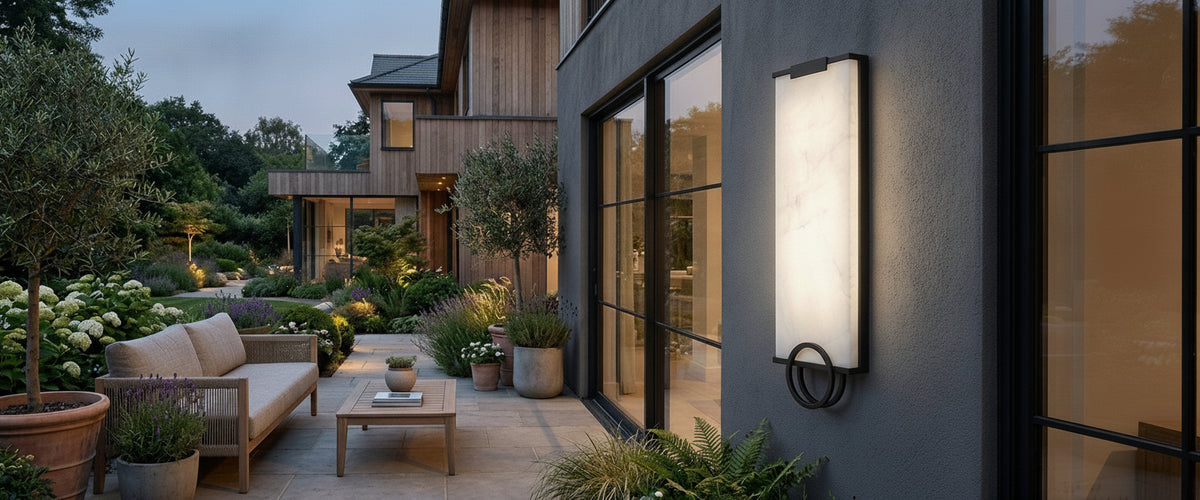

Black is the safest finish on a British front elevation and the easiest one to get wrong. Black outdoor wall lights read as quiet hardware in daylight, sitting back against brick and render instead of drawing the eye, and then at dusk they either frame the house beautifully or blind everyone walking up the path. The finish is the simple decision. Mounting height, beam direction, IP rating and color temperature are where projects come apart, and they are the reason two houses on the same street can fit near-identical black outdoor wall lights and get completely different results.

Key Takeaways
Black works hardest against warm-toned surfaces such as red brick, honey stone and painted timber, where black outdoor wall lights give a crisp outline without adding another color.
IP44 is the minimum for a sheltered wall; open elevations want IP54 or better, and coastal sites IP65 with a marine-grade powder coat.
Mount around 1.9m to 2.1m (6ft 3in to 7ft) to the center of the fitting so the light source sits above standing eye level.
2700K is the right color temperature for warm materials and for matching the glow of alabaster lighting seen through a hallway window.
Scale black outdoor wall lights to the door and the bay, not to the catalog photo. Undersized fittings look like an afterthought.

How Black Performs Against Brick, Render, Painted Timber and Stone
Matte black behaves like an outline. On red or multi-stock brick it draws a clean edge against a busy, mottled surface, which is why black outdoor wall lights became the default on Victorian and Edwardian terraces. The mortar joints already break the wall into a grid, so a rectangular black fitting settles into that rhythm rather than fighting it.
White or off-white render is the highest-contrast backdrop you can pick. Every fixing plate edge, every screw head and every drip mark shows. Choose a fitting with a concealed mounting plate and a clean back box, and be honest about how often the wall is repainted. On gray render, black outdoor wall lights almost vanish in daylight and only announce themselves at night, which suits contemporary extensions.
Painted timber cladding wants a lighter touch. Black hardware on black-stained larch or a dark shiplap facade disappears entirely, so the light itself becomes the visual element. That can be excellent, but it means the beam shape has to do all the work. On natural stone, especially limestone and sandstone, black outdoor wall lights read as ironmongery in the old sense. They sit comfortably with cast metal rainwater goods and dark window frames. Conservation practice on historic masonry is consistent and worth respecting before anyone drills: take fixings into the mortar joints wherever possible, never into the face of the stone, so the wall can be made good later.
What British Weather Actually Demands From IP Ratings and Powder Coat
An IP rating is two digits: solids first, water second. IP44 protects against splashing water from any direction and is fine under a deep porch or a sheltered side return. On an open elevation, IP54 adds proper dust protection, but it is the second digit that decides how black outdoor wall lights cope with weather, and rain in this country rarely falls straight down. Where the wall takes driven rain head on, the jet-rated seal of IP65 is the safer specification. For coastal black outdoor wall lighting, salt is the primary enemy rather than water. Salt-laden air attacks the coating first, then the fixings, then the gasket.
Powder coat quality matters more than the shade of black. A thin coating over untreated aluminium will bloom and lift within a few winters. Look for marine-grade or seaside-rated finishes on 316 stainless fixings, and check whether the manufacturer states a corrosion class. Two small habits extend the life of any black outdoor wall light: wash the housing with clean water twice a year to remove salt and pollution, and check that the drainage weep hole at the base is clear. A blocked weep hole turns a well-rated fitting into a small aquarium.
Adding a new exterior circuit is notifiable work under Part P of the Building Regulations in England and Wales. Use a qualified electrician for the connection and the earthing, and make sure the cable entry into the black outdoor wall light is sealed with the correct gland rather than a smear of silicone.
Mounting Height and Beam Direction: The Glare Trap
The single most common fault on dark facades is a fitting mounted too low. Black outdoor wall lights conceal the housing so well that the eye has nothing to read except the light source, and a bare aperture at 1.5m (5ft) is a direct hit on the retina of every arriving guest. Set the center of the fitting between 1.9m and 2.1m (6ft 3in and 7ft), which puts the emitter above standing eye level for almost everyone.
Up-and-down black outdoor wall lights need more thought than they usually get. The upward beam should have a wall above it to graze; place one under a soffit and the light stops dead in a bright disc that looks like a mistake. The downward beam should land on the ground within a meter or so of the wall, washing the surface rather than shooting across the path. Where there is open brick or render above the mounting point and enough exposure to justify a higher seal, something like the Eamon Outdoor Up/Down Wall Light in black, IP54 gives you the twin beam without a bare aperture at eye level. If you want the path lit, that is a separate job for bollards or spike lights.
Recessed lenses, honeycomb louvers and deep cowls all cut glare at source. The Institution of Lighting Professionals publishes guidance on reducing obtrusive light, and the principles apply just as much to black outdoor wall lights on a semi-detached in Reading as to a commercial car park: aim light down, keep it on the property, and use the lowest output that does the job. Neighbours notice spill long before they notice the fitting.
Why 2700K Matters More in a Black Fitting Than Anywhere Else
Color temperature is unforgiving inside the dark housing of black outdoor wall lights. There is no reflected warmth from the fixture to soften the output, so a 4000K lamp reads clinical and slightly blue against brick, and it makes black powder coat look gray and cheap. At 2700K the beam warms the mortar, flatters sandstone, and sits closer to the light spilling from the windows.
That last point is the one designers care about. If the hall behind the front door is lit by alabaster wall lights or a stone pendant at 2700K, and the exterior fittings run at 4000K, the threshold looks like two different buildings stitched together. It is one of the questions we are asked most often, and the fix is usually nothing more than swapping the lamps in the black outdoor wall lights outside. Our alabaster lighting collection is built around that warm, diffused quality, and matching it outside costs nothing but a moment of attention at the specification stage.
Alabaster itself belongs indoors. It is a soft, porous gypsum stone that reacts badly to moisture and frost, so it should never be specified for an exterior wall. The exterior job goes to powder-coated metal and toughened glass; the stone does its work the moment you step inside.
Silhouette and Profile: Getting the Scale Right
Fixtures that look wrong on a facade are usually the right style at the wrong size. A slim cylinder that photographs beautifully in a studio can look like a doorbell beside a wide Georgian door surround. As a rough working rule, a flanking pair of black outdoor wall lights has to read as deliberate hardware from the pavement: on a standard door that means at least 20cm of visible height, and a tall or wide surround will carry considerably more.
Cylinders are the clearest illustration of why the same design needs to be bought in the right size. On a narrow pier, a side return or a low garden wall, the compact Atom Black Outdoor Wall Light, 10cm stays in proportion, while the same form at 20cm is the version that holds its own either side of a front door or across a wide render panel. Ordering the small one for a big elevation is the most common way a good fitting ends up looking cheap.
Profile depth is the other overlooked dimension. A deep fitting on a narrow pier between two windows creates a shadow all day and catches every gust. Shallow rectangular and half-cylinder profiles handle tight piers far better. On wide render panels you can afford more projection and a stronger silhouette. Lantern shapes suit traditional porches and stone thresholds; sharp geometric black outdoor wall lights suit render, dark cladding and flat-roof extensions. If you are still weighing the options, browsing the full niori lighting range side by side is the fastest way to see how profile changes the read of a fitting.
The Placement Errors That Repeat Most Often on UK Front Elevations
Same street, same mistakes, year after year. Most black outdoor wall lights fail on placement rather than product, so run through these before the electrician arrives.
Centering the fitting on the door instead of the visitor. A single light directly above a door flattens faces and throws the doorstep into shadow. A pair either side, or one offset to the handle side, is far kinder.
Fitting where the cable already is. Convenience beats composition almost every time, and it shows. Decide the position first, then run the cable.
Over-lighting the number. Two watts of well-aimed light will make a house number legible from the pavement. Twenty watts turns the porch into a forecourt.
Mismatched blacks. Textured matte, satin and gloss black all sit differently next to black uPVC or painted timber. Ask for a sample or a close-up of the finish before committing to a pair of black outdoor wall lights.
PIR sensors aimed at the road. A motion sensor that triggers on passing cars becomes a nuisance within a week. Angle the sensor across the approach path and use the sensitivity adjuster.
Forgetting the back door. Rear elevations get more use in summer and usually more weather. Match the family of fittings even if the sizes differ.
A Quick Checklist Before You Order
Confirm exposure for your black outdoor wall lights: sheltered porch (IP44), open elevation (IP54 to IP65), coastal (IP65 plus marine-grade coating).
Mark the mounting center at 1.9m to 2.1m (6ft 3in to 7ft) and stand at the gate to check for glare.
Choose 2700K and check that any dimming or smart control is compatible with the driver.
Hold a paper template of the fitting outline against the wall before drilling.
Check the lamp is replaceable, or that the integrated LED module can be serviced.
Plan fixings into mortar joints on brick and historic stone.
Book a qualified electrician for the connection, earthing and testing.
Diarize a twice-yearly wash-down and a check of the gasket and weep hole.
Where Niori Fits
Niori is an alabaster and natural-stone lighting brand, and our reputation is built on the way light behaves when it passes through stone. That same instinct shapes how we advise on exterior schemes: warm, controlled, aimed at surfaces rather than eyes. Black outdoor wall lights are the hardware that gets you to the door; the alabaster and marble pieces take over once you are through it. Get the color temperature consistent across that threshold and the whole house reads as one considered scheme. If you would like help specifying a full scheme, from black outdoor wall lights to the pendants and wall lights inside, talk to the Niori studio and we will work through the elevation with you.