
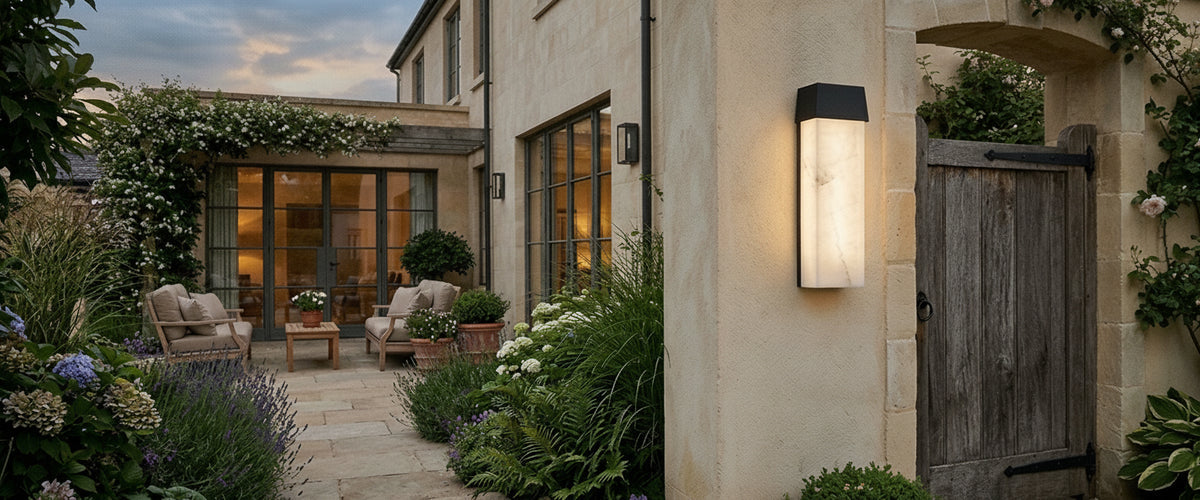

Most outdoor wall lights are bought from a photograph taken on a dry afternoon, against a freshly painted wall, with no rain or salt in sight. That is why so many of them look tired by their second winter. The best modern outdoor wall lights are chosen the other way round: from the facade, the weather it faces, and the way light falls on it after dark. The trend of the season comes last, if at all.

At a Glance
- Let the facade lead. Brick, render, stone and timber cladding each want a different shape, finish and light spread.
- Check the IP rating first. IP44 is the floor for a sheltered porch; exposed walls and anything near the ground deserve IP65.
- Match colour temperature to the wall. Warm 2200K to 2700K flatters brick; white render often reads cleaner at 2700K to 3000K.
- Mount for sightlines, not symmetry alone. Beside a door, the light source usually sits around 5.5 to 6 ft (1.7 to 1.8 m) from the ground.
- Keep alabaster indoors. Carry its warmth through the threshold with brass, glass and stone tones outside.
- Ask about fixings, gaskets and lamp type. These decide lifespan more than the finish does.

Why the Best Modern Outdoor Lighting Starts at the Facade
"Modern" covers almost everything sold for exterior walls now: slim up-and-down cylinders, flat discs, cubes, cage lanterns with clear glass, minimal brass hoods. Search for the best modern outdoor wall lights and you get all of them at once, which tells you very little about which one belongs on your house.
The facade narrows it fast. A Victorian red-brick terrace has deep mortar joints and texture that a grazing up-and-down light will pick out beautifully. Put the same fitting on smooth white render and it draws two hard bright stripes that make every patch and hairline crack visible. Render tends to suit softer, wider diffusion: an opal glass globe or a hooded fitting that washes the wall gently. Pale limestone or Cotswold-type stone sits somewhere between the two, and often looks best with a warm, narrow downlight that lets the texture do the talking.
Scale matters too. A useful rule beside a front door is a fitting roughly one quarter to one third of the door height. Smaller looks apologetic from the street; larger starts to dominate the elevation.
What British Weather Does That Product Shots Never Show
Britain rarely destroys outdoor lights in one dramatic storm. It wears them down. Driving rain from the south-west pushes water into any gap in a back plate. Freeze-thaw cycles open up the masonry around fixings. Coastal air carries salt surprisingly far inland, and it pits cheap metal finishes within a season.
Finish is where this shows first, and where even the best modern outdoor designs can let you down. Thin powder coating on aluminium chalks and fades on a south-facing wall. Solid brass, by contrast, darkens and patinates; some owners love this, others want it lacquered or occasionally waxed. Near the sea, look for marine-grade (316) stainless steel or solid brass and avoid plated mild steel entirely.
Weight is the quieter issue. A solid brass or stone-detailed fitting is heavy, and soft Victorian brick or a render-over-insulation system will not hold it on a pair of plastic plugs. A familiar failure is a pair of heavy porch lanterns that has to be reinstalled within a year because the render cracked around the original fixings. The fittings are fine; the wall behind them was never assessed.
And a frank note on our own material. Alabaster is a form of gypsum, a soft mineral that is slightly soluble in water. That is exactly why it glows so warmly indoors and exactly why it has no place on an exposed exterior wall. When designers ask whether an alabaster wall light can go on a covered porch, our answer is almost always no: damp air and temperature swings will cloud and roughen the surface over time.
Colour Temperature on Render Versus Brick
Few buyers expect bulb colour to change the look of a house as much as it does. Daylight hides the difference. After dark, it is the whole story, and even the best modern outdoor fitting looks wrong under the wrong lamp.
Red and brown brick absorb a lot of light and lean warm already. A 2200K to 2700K lamp deepens them into a rich, honeyed glow. Go to 4000K and the same brick turns flat and slightly grey, like a car park wall.
White or cream render reflects far more light, so warm lamps can push it toward a yellowish cream that looks dated. Many render facades read more crisply at 2700K to 3000K, with a lower lumen output than you would use on brick because the wall bounces so much back. If your render is painted a warm off-white, test 2700K first.
Natural stone usually sits happiest at 2700K. Whatever the wall, keep every exterior fitting at the same colour temperature. Mixed whites across one elevation look like a repair job.
Placement: Wall Heights, Gate Piers, Soffits and Sightlines
Think about where people actually look. Arriving at a front door, the eye goes to the lock, the step and the face of whoever opens it. Lights either side of the door at roughly 5.5 to 6 ft (1.7 to 1.8 m) to the light source help with all three. A single light on the latch side is often enough on a narrow terrace frontage.
- Gate piers: Pier-top lanterns or low wall lights mark the entrance from the street. Keep them modest in output; they are wayfinding, not floodlighting.
- Soffits and canopies: Small recessed downlights in a porch soffit light the step without any glare at eye level, and pair well with a decorative wall light by the door.
- Garden walls and side returns: Lower fittings, around 2 to 3 ft (0.6 to 0.9 m), guide a path without lighting the neighbours' bedrooms.
- Back elevations: Light the edges of a terrace rather than the middle of the house, so the garden still reads at night.
Glare and light spill are worth taking seriously, particularly in rural areas and conservation villages. The Institution of Lighting Professionals publishes guidance on reducing obtrusive light that is a useful reference for downward-facing, shielded fittings.
Carrying an Interior Finish Through the Threshold
This is where most schemes either come together or quietly fall apart. A glazed front door or a wall of garden doors means the inside and outside lights are seen together. If the hall has a warm alabaster pendant and the porch has a cold steel cylinder, the eye feels the mismatch before it can name it.
The answer is not to force the interior material outside. Echo it instead. A honed alabaster pendant in the hallway, or a pair of alabaster wall lights in a garden room, can be answered on the exterior by solid brass hoods, clear or opal glass, and warm 2700K lamps. You keep the colour of the light consistent and let the materials change at the threshold, which is what a good architect would do with flooring.
If you are planning both sides at once, browse the alabaster lighting collection for the interior pieces first, then choose exterior fittings whose metal and lamp colour sit comfortably beside them.
The Specification Details That Decide Longevity
The best modern outdoor fittings are rarely distinguished by their silhouette. They are distinguished by small details that most listings bury at the bottom of a data sheet, if they mention them at all.
- IP rating: The second digit is water protection. IP44 handles splashes; IP65 handles jets of water from any direction.
- Gaskets and back-plate seal: Silicone gaskets age far better than foam. Ask whether the back plate seals to the wall or relies on sealant.
- Diffuser material: Glass stays clear for decades. Cheaper polycarbonate can yellow and haze under UV.
- Fixings: Stainless screws as standard, and a fixing guide that covers brick, render and stone.
- Lamp type: A replaceable lamp means a fifteen-year-old fitting can still work. Integrated LED modules can be efficient but are hard to replace if they fail.
- IK rating: Worth checking for low fittings, gate piers and hospitality projects where impact is likely.
- Cable entry and drainage: Rear cable entry keeps the wall tidy; weep holes stop water pooling inside.
Installation is not a weekend job. Outdoor circuits in the UK need RCD protection and may be notifiable work, so always use a qualified electrician who can certify the installation.
A Buyer's Checklist Before You Order
Work through these in order and the shortlist of best modern outdoor lights for your home usually shrinks to two or three.
- Photograph the facade at dusk and note the wall material and colour.
- Decide the exposure: sheltered porch, open wall, coastal or ground-level.
- Set a minimum IP rating from that exposure.
- Choose one colour temperature for the whole elevation.
- Measure the door height and size the fitting to roughly a quarter to a third of it.
- Confirm the wall can take the weight, and with what fixings.
- Check gasket, diffuser and lamp details on the specification sheet.
- Look through the glazing: will the exterior light sit comfortably with the interior pieces?
Budget depends on material, scale, engineering, finish and installation, so it is worth asking for a tailored quote once you know the facade and exposure. For the interior side of the threshold, the wider niori lighting range covers pendants, chandeliers, wall lights and lamps in alabaster, marble and onyx. Choose the outside with the same care, and the two will read as one house rather than two catalogues.