
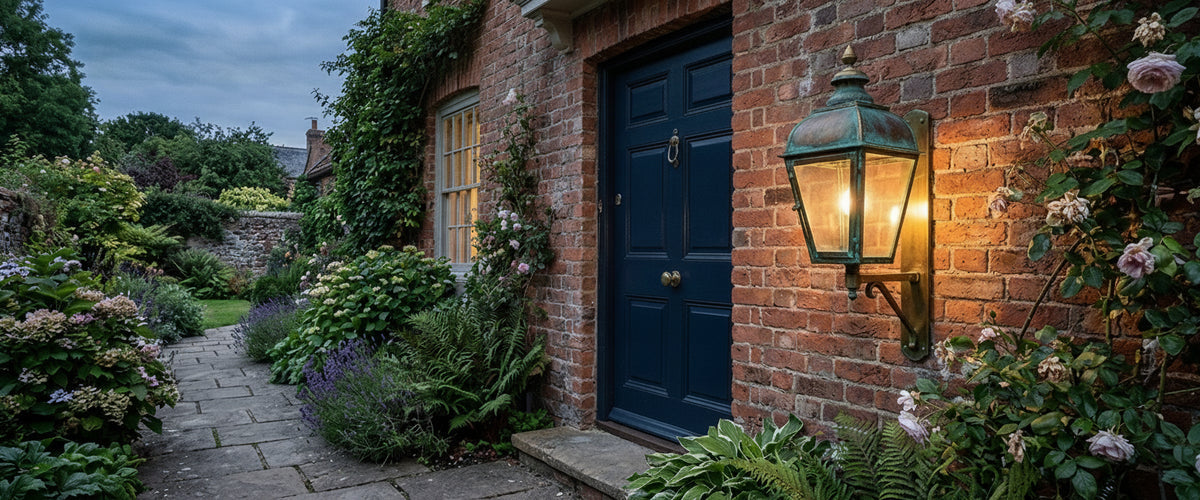

The antique brass lantern you fit by the front door this spring will not look the same by next winter. That is the appeal of antique brass outdoor lighting, and also the reason some buyers end up disappointed. The finish keeps reacting to rain, sun, salt and the particular microclimate of each wall. Choose and place it well and the patina deepens into something that looks as if it has always belonged to the house. Choose it badly and it reads as neglect within two seasons.

Quick Answer: What to Know Before You Buy
- Antique brass outdoor finishes keep ageing. The factory colour is a starting point.
- Orientation matters. North walls stay damp and darken unevenly. South walls bake lacquer and fade it.
- Lacquered finishes hold their colour until the coating fails. Unlacquered finishes change steadily but never peel.
- Scale up. Brick and stone facades swallow small fittings, especially in dark finishes.
- Confirm the fixing before ordering. Cable entry, back-plate depth and fixings should suit your wall, and a qualified electrician should do the installation.

How Antique Brass Outdoor Fittings Actually Age
Most antique brass is a chemically darkened finish applied over solid or plated brass, then often sealed. Outdoors, moisture and pollutants carry on the darkening process the factory started. Copper in the alloy oxidises to warm brown first; with persistent damp it can move towards the green-grey of verdigris, particularly in crevices and around screw heads. Cheaper fittings may use thin plating or a brass-effect coating over steel or aluminium, which wears through rather than patinating, so check what sits under the finish. Historic England's technical conservation guidance covers how metals weather on historic buildings, and the same chemistry applies to a lantern by your door.
North and south walls tell very different stories. A north-facing wall rarely dries fully between October and April. Fittings there darken faster and less evenly, with green bloom collecting in the lower seams where water sits. A south-facing wall gets the opposite treatment: UV and heat cycling break down lacquer, so a sealed antique brass outdoor lantern on a sunny elevation tends to fade to a dull, slightly milky bronze before the coating starts to lift. East and west walls sit between the two, although west elevations take the brunt of prevailing rain across much of Britain.
Coastal properties speed everything up. Salt air can turn the seaward face of an unlacquered lantern a deep chocolate brown within a year, while the sheltered side still shows gold at the edges. Some owners love that two-tone character. Others do not, so decide which camp you are in before anything goes on the wall.
Lacquered or Unlacquered: Choose Your Maintenance Commitment
This one decision governs how much attention an antique brass outdoor fitting will need over the next decade.
Lacquered Antique Brass
A clear lacquer freezes the colour you bought. That suits buyers who want the lantern to match a sample or a set of interior fittings exactly. The trade-off is how it fails. Lacquer rarely gives way evenly; it breaks down at welds, sharp edges and any scratch from installation, and moisture creeps underneath. You end up with bright patches next to dark ones, and the only real fix is stripping the whole fitting and refinishing it. Inspect a lacquered lantern closely on arrival and again after fitting, because a tiny chip at a corner or seam is where the trouble starts.
Unlacquered (Living) Antique Brass
An unlacquered finish has nothing to peel. It darkens steadily, and evenly in a sheltered spot, and a light coat of microcrystalline wax once or twice a year slows the change without stopping it. If you want an old-house look, this is usually the honest choice. It is also the more forgiving option on a north wall, where lacquer tends to fail first.
Rule of thumb: if matching matters more than character, choose lacquer and inspect it every spring. If character matters more, go unlacquered and accept that the fitting will drift.
Fixture Formats That Carry the Finish on a British Facade
Antique brass is a mid-to-dark tone, and against red brick or weathered stone it loses contrast quickly. Formats with some depth and structure carry it better than flat ones.
- Box and coach lanterns. The frame gives the patina edges to collect on, and clear or seeded glass lets the lamp show through. This is the classic choice for flanking a front door.
- Bracket lanterns. Projecting from the wall casts a shadow behind, which lifts the fitting visually off the brick.
- Flush bulkheads and small cylinders. These shrink on a period facade. They work for side passages and utility doors, but look underpowered beside a principal entrance.
- Mixed finishes. Black frames with brass detailing keep the warmth of brass while giving the silhouette more definition against pale render. Where an all-brass lantern would blur into the wall, a black-and-brass piece such as the Buckley 1 Light Outdoor Wall Lantern keeps a crisp outline while the brass picks up the warmth.
On scale, a single lantern beside a standard front door generally wants to be around a third of the door's height. A pair flanking the door can come down to roughly a quarter each. If you are torn between two sizes for an antique brass outdoor lantern, choose the larger; distance and dark brick both make fittings read smaller than they look in the box.
Placement That Flatters the Patina
Where you mount the fitting decides whether the ageing looks intentional. A lantern tucked under a porch canopy or deep eave weathers slowly and evenly, which tends to look deliberate. One mounted directly in the path of a drip line or a leaking gutter collects streaks and blotches, and that reads as neglect.
Watch what sits below the fitting, too. Copper-rich runoff can leave green-brown staining on pale limestone, Portland stone or light render. On a stone facade, mount antique brass outdoor fittings where rain runs past them rather than over them, or accept a small stain below over time. Brick is more forgiving, though fresh pointing in lime mortar will still pick up marks.
Bulb choice matters more than people expect. A warm lamp around 2700K draws out the gold and amber in an antique brass outdoor finish. A cool 4000K lamp flattens it to grey-brown and makes even a new fitting look tired. If the lantern is on a dimmer or smart timer, check the LED lamp is rated as dimmable and suitable for enclosed fittings, since sealed lanterns trap heat.
Why Alabaster Stays Indoors
Customers sometimes ask whether they can carry our alabaster pieces out to a covered terrace. We advise against it. Alabaster is a soft, slightly water-soluble stone, and damp air will slowly cloud and pit the surface. The better move is to let the brass outside set up the warmth you meet once through the door. In a hallway that needs a soft, diffused glow at a modest scale, a compact piece such as the Selvara LED Small Alabaster Wall Light carries the brass tone indoors without any risk from weather.
Matching Brass Outside and In, Without Over-Coordinating
Lanterns, knocker, letterplate and house numbers all in exactly the same lacquered antique brass can look like a catalogue page. Aim for the same family rather than a perfect match. An unlacquered lantern that darkens beside polished door furniture that you buff back regularly gives you two tones of one metal, which looks considered.
Inside, the thread can carry on more quietly. Antique brass switch plates and sockets in the hallway pick up the exterior tone without shouting about it; a square-edged plate with a black insert, like the 13A 2 Gang Switched Socket in Antique Brass, echoes the black-and-brass contrast of a mixed-finish lantern by the door. Brass detailing on stone fittings ties the two together. If you want to see how brass trims sit against translucent stone, our alabaster lighting collection pairs warm metal bases and brackets with alabaster shades. Keep one dominant metal per space and let everything else sit in a supporting role.
Cable Entry, Mounting Depth and Fixings for Brick or Stone
This is where outdoor orders most often go wrong, usually because the fitting arrives and the existing cable sits in the wrong place.
- Cable entry position. Confirm whether the fitting takes cable from the rear, top or bottom, and that it lines up with your existing feed. Rear entry hides the cable but needs the feed to emerge exactly behind the back plate.
- Back-plate depth. Measure the space available for connections. Shallow back plates can be tight for outdoor cable and a junction connector, and an outdoor-rated back box may be needed.
- IP rating. IP44 is the usual minimum for a wall light under shelter. Exposed elevations, especially west-facing or coastal walls, warrant IP65.
- Fixings. Use stainless steel or brass screws. Plated steel fixings rust and streak down both the fitting and the wall.
- Brick versus mortar. On older homes with soft brick or lime mortar, your installer may prefer fixing into the brick face or using resin anchors. On stone, keep holes back from arrises so the edge does not spall.
- Qualified installation. Outdoor lighting must be fitted by a qualified electrician. New outdoor circuits may be notifiable under Part P of the Building Regulations in England and Wales, and Electrical Safety First publishes clear guidance on using registered installers.
Before You Order: A Buyer's Checklist
- Note which way the wall faces and how exposed it is to prevailing rain or sea air.
- Decide whether you want the colour fixed (lacquered) or changing (unlacquered).
- Measure the door height and choose a lantern scaled to it, rounding up.
- Check what sits below the fitting: pale stone, render or brick.
- Confirm cable entry position, back-plate depth and IP rating against your wall.
- Plan warm 2700K lamps, and check they are dimmable if you want dimming.
- Look at your door furniture and hallway hardware and pick one dominant metal.
- Book a qualified electrician before the fitting arrives.
Antique brass outdoor lighting rewards buyers who think about the wall before the lantern. Once the outside is settled, niori s wider lighting range carries the same warm palette through the hallway and living spaces, where alabaster and natural stone take over from brass as the main source of glow.