
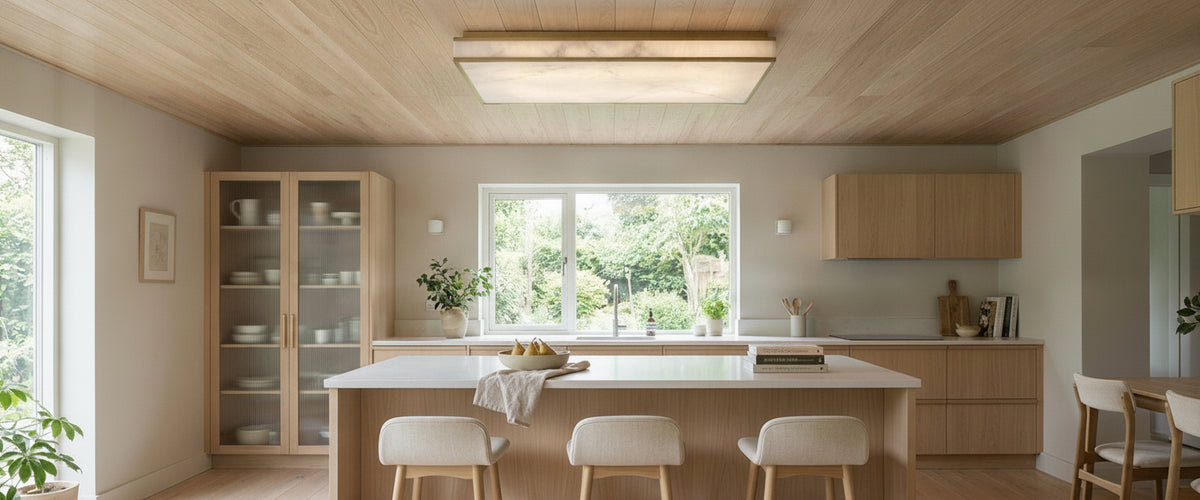

Wood overhead is the quickest way to warm a room and the quickest way to make it feel like the inside of a wardrobe. Both outcomes are common. Wooden ceiling lights, timber-clad ceilings and fans with wood blades all absorb far more light than most buyers expect, so the gap between a fitting that glows and one that sits there doing very little comes down to a few decisions made before the bulb goes in.
Quick answer
Pale woods such as ash, maple and birch bounce light back into the room. Walnut and dark-stained oak soak it up.
Solid wood does not transmit light. A wooden shade throws light down and out of its openings, so the ceiling above it will read darker.
Pair wooden ceiling lights with a pale ceiling or a translucent material (alabaster, onyx, opal glass) if you want any ambient glow.
Use warm 2700K bulbs with good color rendering (CRI 90+) and plan dimming from the start.
Most UK sizing errors involve hanging a pendant too low in a standard 7 ft 10 in (2.4 m) room or choosing a diameter that is too small for a tall Victorian ceiling.

How Grain, Species and Finish Shape the Light
Wood is opaque, and that single fact governs everything. A wooden shade cannot glow the way an alabaster bowl does; it can only reflect light off its inner surface and push it through slats, perforations or the open bottom. What it does to that reflected light depends on three things.
Species and color. Light woods reflect a large share of the light that hits them, while dark heartwoods absorb most of it. The Wood Handbook from the US Forest Products Laboratory also notes that wood surfaces change color under light exposure over time, so a pale shade will mellow towards honey and a dark one will often lighten slightly. Expect your fitting to look a little different in two years.
Grain. Open-grained species such as oak and ash scatter light into a soft texture across the inner surface. Tight, even grain gives a cleaner, more uniform reflection. Neither is better; they simply read differently when the lamp is on.
Finish. A matte oil keeps the reflection soft. A lacquer or polished finish adds hotspots and can show the bulb as a bright smudge inside the shade. For a wooden pendant you will look up into, matte nearly always wins.

Light Wood versus Dark Stain under the Same 2700K Bulb
Hang two identical drum pendants side by side, one in raw ash and one in smoked walnut, both with the same 2700K filament bulb, and the difference is stark. The ash reads as warm and generous; the light pools on the table and creeps up the walls. The walnut behaves like a spotlight. The table below is lit, but the room around it falls away, and the shade itself becomes a dark silhouette against the ceiling.
Same bulb, same drum, different species: the ash spreads light into the room while the walnut keeps it on the table.
That is the trade-off with dark wooden ceiling lights. They create drama and focus, which suits a dining table or a bar counter, but they will not light a room on their own. Pale wood gives you a little ambient bounce for free. If you love walnut, plan for wall lights or lamps to carry the rest of the room.
Where Wooden Ceiling Lights Earn Their Place
Wood overhead works best where you want warmth and a slightly lowered, intimate feel:
Kitchen-diners and dining rooms. A pendant or row of pendants over a table puts the light exactly where it is needed, and the wood ties in with furniture and worktops.
Barn conversions and beamed cottages. Timber fittings belong with exposed oak, but beware of stacking dark on dark.
Bedrooms. A pale wooden flush fitting gives a calm, low-glare overhead light.
Hospitality. Restaurants and hotel bars use dark wood pendants for pools of light that keep tables private.
Where it fights the room: low ceilings below about 7 ft 6 in (2.3 m), where a chunky timber pendant reads as a heavy block at eye level, and very tall double-height spaces, where a modest wooden shade disappears into the volume. Barn conversions show the second problem clearly. Under an oak-clad roof rising to almost 20 ft (6 m), walnut pendants vanish against the dark boards. The better approach is to keep one walnut pendant low over the island and add a large alabaster chandelier at the apex, where the translucent stone gives off a glow the beams can catch. Where a timber roof needs a high-level light source that glows rather than reflects, pieces from the alabaster lighting range are closer to the right design language than another wooden shade.
Under a tall timber roof, keep the wood low and let translucent stone carry the glow higher up.
Ceiling Fans with Wood Elements
A light wood ceiling fan, or any fan with timber blades, brings decisions a static lighting fitting never does. Movement changes how the light behaves, and the hardware adds weight and vibration.
Strobing. If the light kit sits above the blades, moving wood will chop the light into a flicker. Choose fans with the light below the blade line, or light the room another way.
Blade clearance. Most fan makers specify at least 7 ft 6 in (2.3 m) from floor to blade, which rules out fans in many UK rooms with standard ceilings.
Fixing. A fan needs a ceiling fixing rated for its weight and dynamic load, especially in old lath and plaster. Have a qualified electrician assess the joist and fit it.
Finish matching. Pale oak or bleached blades suit a white ceiling. Dark blades on a timber ceiling tend to disappear, which can be the point or the problem.
Bulbs, Dimming and Ceiling Color
These three variables decide whether wood glows or just deadens the room.
Bulbs. Wooden ceiling lights reward warm color temperatures. 2700K brings out the amber in oak and the red in cherry; 3000K is acceptable in kitchens; anything cooler makes timber look gray and tired. Choose a CRI of 90 or above so the grain reads true. Frosted or opal bulbs reduce the glare you get from looking up into an open-bottomed shade.
Dimming. A dark wood pendant at full brightness can create harsh contrast between the lit table and the dark room. Dimmed, it becomes atmospheric. Pair dimmable LED bulbs with a compatible trailing-edge dimmer, and check compatibility before installation rather than after the flicker starts.
Ceiling color. This is the variable most often ignored. Lighting guidance from the Society of Light and Lighting at CIBSE generally favors high-reflectance ceilings for comfortable interiors, because a pale ceiling turns upward spill into soft ambient light. A white or warm off-white ceiling above wooden ceiling lights gives them a backdrop to work against. Under a dark timber ceiling, every fitting has to work twice as hard, which is where translucent materials earn their keep. Alabaster and onyx transmit light through the body of the shade, so they glow even when nothing above them reflects. When you come to layer those translucent shades with wall lights and lamps at lower levels, the wider lighting collection makes it easier to compare scale and finish side by side.
Sizing for UK Ceilings: The Drop and Diameter Mistakes
Most buyers of wooden ceiling lights make these mistakes exactly once.
Hanging too low in a standard room. Many new-build and post-war homes have ceilings around 7 ft 10 in (2.4 m). Over a walkway, keep at least 7 ft (2.1 m) clear beneath the fitting. In these rooms a flush or semi-flush fitting is often the honest answer.
Hanging too high over a table. Pendants over a dining table usually sit 28 to 34 in (70 to 85 cm) above the tabletop. Higher, and the light spreads thin and glares into eyes across the table.
Undersizing in period homes. Victorian and Edwardian rooms with 9 to 11 ft (2.7 to 3.4 m) ceilings swallow small shades. A useful starting point: add the room's length and width in feet, and use that number in inches as the shade diameter. A 14 by 16 ft room suggests roughly a 30 in (76 cm) fitting.
Forgetting weight. Solid timber and natural stone are heavy. Confirm the ceiling fixing can carry the fitting, and use a qualified electrician for installation.
Buyer Checklist Before You Order
Measure ceiling height, table height and room footprint before shortlisting.
Decide whether the fitting must light the room or simply mark a zone. Dark wood marks; pale wood and stone light.
Check your ceiling color. Dark ceilings call for translucent shades or extra lighting at lower levels.
Choose 2700K, CRI 90+ dimmable bulbs and a compatible dimmer.
For fans, confirm blade clearance and light position.
Confirm fixing strength for heavy wood or stone fittings, and book a qualified electrician.
For larger or bespoke pieces, budget depends on material, scale, engineering, installation and finishing, so request a tailored quote.
Wood and stone make better partners than most people expect. At Niori we work in alabaster and natural stone, and some of our favorite rooms pair a timber ceiling or a wooden pendant with stone that glows from within. Get the bulb, the ceiling and the drop right, and wooden ceiling lights stop swallowing light and start giving the room their warmth.