
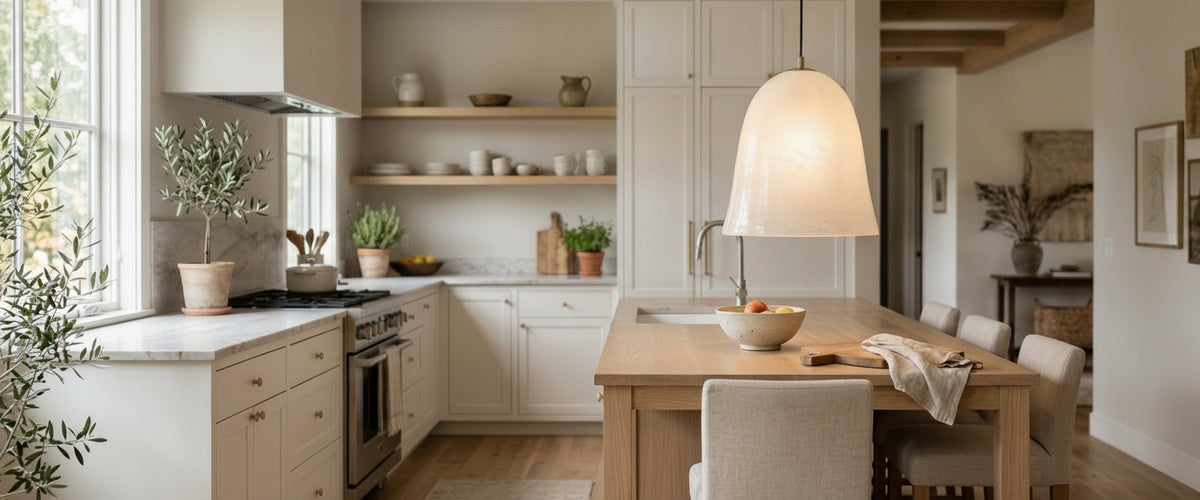

Switch on a moulded glass pendant and a hand-blown one side by side, and the difference shows within seconds. The moulded shade glows evenly. The hand-blown shade glows unevenly in places, with a faint ripple, a soft bright spot where the wall thins and a few pinprick bubbles catching the filament. Hand blown glass carries the record of breath, heat and a maker's hand in its walls, and every one of those marks changes how light leaves the shade. Once you know what to look for, you can judge a piece from a product photo, pick the right bulb for it and decide whether a chip is worth repairing.

Key Takeaways
- Hand blown glass diffuses light unevenly by nature. Thickness and bubbles create gentle variation that moulded glass smooths away.
- 2700K suits amber, smoked and opal glass; 3000K keeps clear and pale-tinted glass crisp.
- Look for a pontil mark and no seam lines when judging authenticity from photographs.
- Mould-blown is still hand-blown, but machine-pressed glass sold as "artisan" is not.
- Small rim chips can often be ground and polished; cracks mean replacement.

What Glassblowing Does That a Mould Cannot
A glassblower gathers molten glass on the end of a hollow pipe, breathes into it to form a bubble and then shapes it with gravity, wooden blocks, wet newspaper and steel jacks while turning it constantly. The glass cools as it moves, so each area firms up at a slightly different moment. The result is a wall that is never perfectly uniform. It is thicker where the gather sat longest and thinner where the bubble stretched.
Pressed and machine-blown glass works the other way. Molten glass is forced against a precision steel mould, so the wall thickness is set by the tool, not by a person. That gives consistency, which is exactly what you want in a part such as Horatio Junior & Merchant Bulkhead Replacement Prismatic Glass, where the cover has to seat precisely in an existing fitting and the prismatic pattern does the job of spreading light. The same precision suits high-volume fittings, but it removes the small optical irregularities that make hand blown glass worth paying attention to. You cannot press a ripple into glass and get the same result, because the ripple in a blown shade is a change in thickness, not a texture on the surface.
Air, Thickness and Colour: How Each Changes the Light
Trapped Air
Tiny bubbles, which glassmakers call seeds, are trapped when air is folded into the gather. Each seed acts as a minute lens. Under a clear filament bulb they throw small sparkles across the shade; under an opal or frosted finish they disappear into the overall glow. That makes the finish a real design decision: where a room needs a soft, even glow over a table rather than sparkle, an opal globe such as the Mika Opal Glass Globe Pendant Light, Gold is closer to the right design language, while clear blown glass suits spaces where you want the material itself to be seen. A shade with a scattering of seeds reads livelier than one with none. Large or clustered bubbles near the rim are another matter, because they can weaken the edge.
Uneven Wall Thickness
This is the variable that does most of the work. Light loses intensity and picks up colour as it passes through thicker glass, so a hand-blown globe will often show a slightly brighter band around its widest point and a deeper tone near the neck. Alabaster behaves the same way, which is why the two materials sit so comfortably together: a thin section of stone glows honey-white while a thicker vein holds back. If you already own pieces from our alabaster lighting range, a hand blown glass pendant in amber or smoke will echo that layered glow rather than fight it.
Colour Variation
Coloured glass gets its tint from metal oxides mixed into the batch, and in small-batch furnaces the concentration shifts slightly from pot to pot. Last winter we supplied a pair of smoked hand-blown pendants for a kitchen island in a Harrogate townhouse. The client rang a week later, worried that one looked a touch darker. It did, by perhaps a shade. Hung 75cm (about 30in) apart over the worktop, nobody else ever noticed, and she now points it out to guests as proof they were made by hand. If you need two shades to match exactly for a symmetrical scheme, say so before ordering, so the maker can pick the closest pair from a batch.
2700K or 3000K for Hand Blown Glass Shades
Colour temperature interacts with tinted glass more than most buyers expect. Amber, smoke and opal glass already lean warm, so a 2700K bulb deepens them into something close to candlelight. That is the right choice for living rooms, bedrooms, dining tables and hotel bars, where you want the shade itself to glow rather than the room to look bright.
A 3000K bulb sharpens things. Clear and very pale glass looks cleaner and more precise, seeds sparkle more distinctly and the colour of food and fabric stays truer. We tend to suggest 3000K for kitchens, bathrooms and hallways with clear or lightly tinted shades. Avoid going cooler than that: at 4000K, amber glass turns muddy and opal glass starts to look clinical.
Two further points matter. First, choose a dimmable bulb and a compatible dimmer, because hand-blown shades look their best at 40 to 70 per cent output. Second, with clear glass the bulb is part of the design. A decorative filament or globe lamp looks deliberate; a standard frosted lamp seen through clear glass looks like an afterthought.
How to Spot Genuine Hand Blown Glass From Photographs
Buying online means judging glass from images, and good photography gives a lot away. Here is what we look for when assessing a supplier's samples.
- The pontil mark. When a piece is transferred from the blowpipe to a solid rod called a pontil, a small scar is left where it was attached. On lighting it usually sits at the base of a globe or around the fitter opening, either as a rough circle or ground and polished into a shallow dimple. The Corning Museum of Glass dictionary is a useful reference for this and other glassmaking terms.
- No vertical seam lines. Pressed and two-part moulded glass often shows a faint raised line running top to bottom where the mould halves met. Zoom in on the profile shot. A genuinely free-blown shade has none.
- Visible wall variation when lit. A product photo of the lit shade should show slightly brighter and darker zones. Perfectly even illumination across a large globe is a hint of machine production.
- Slight asymmetry. Hold a ruler to the screen. A hand-blown globe is rarely a perfect circle, and the neck may sit a millimetre or two off centre.
- Seeds and gentle cord lines. Faint swirls or streaks inside the glass are normal in hand work and rarely seen in pressed pieces.
If a retailer only shows heavily retouched studio images on white, ask for an unedited photo of the lit shade. A confident maker will send one.
Hand-Blown or Mould-Assisted? Reading the Artisan Label
This is where the language gets slippery. There are three broad methods, and only two of them involve a person blowing glass.
- Free-blown: shaped entirely by breath, tools and gravity. The most variation and usually the most expensive to produce, because every piece takes skilled time.
- Mould-blown: still blown by mouth, but into a wooden or metal mould that sets the outer shape. Optic and ribbed shades are usually made this way. It is legitimate hand blown glass, with good consistency for matching sets, though walls are more even and pontil marks are often ground away.
- Machine-blown or pressed: no glassblower involved. Sometimes finished by hand, which is how "hand-finished" or "artisan" ends up on the label.
The honest test is to ask the seller directly: was a person blowing into this piece, and was it shaped free or in a mould? A specific answer is a good sign. A vague one about "traditional craftsmanship" usually means option three.
Before You Buy: A Practical Checklist
- Decide whether you want variation or matching. Free-blown for character, mould-blown for symmetrical pairs and runs over an island or bar.
- Check the fitter opening size and the weight. Thick hand-blown shades can be heavier than they look, so confirm your ceiling fixing can take the load.
- Match colour temperature to tint: 2700K for amber, smoke and opal; 3000K for clear and pale glass.
- Confirm the maximum bulb wattage and that the bulb is dimmable.
- Ask for a lit, unretouched photograph.
- Have pendants and wall lights installed by a qualified electrician, particularly in bathrooms, where IP ratings apply.
For budget, expect hand-blown pieces to vary with size, colour, method, wall thickness and the brass or metal detailing around them. A tailored quote is the only reliable figure. If you are planning a mixed scheme with glass pendants over a dining table and alabaster wall lights around it, browsing the wider lighting collection helps you balance finishes before you commit. Where you would rather carry glass onto the walls as well, a twin-shade opal fitting such as the Antic 2 Light Opal Glass LED Wall Light, Gold keeps the light soft at eye level, so it supports a statement pendant instead of competing with it.
Cleaning, Handling and What to Do When a Shade Chips
Hand blown glass is tougher than it looks in daily use and fragile in a few specific moments. Most damage we see happens during installation or cleaning, not while the shade is hanging.
- Always let the bulb and shade cool fully before touching. Cold water on warm glass can cause thermal shock and cracking.
- Dust weekly with a dry microfibre cloth. For grease, especially in kitchens, use lukewarm water with a drop of mild washing-up liquid, then dry immediately to avoid water marks.
- Never use abrasive pads or ammonia-heavy sprays on frosted, acid-etched or lustred finishes.
- Remove the shade to clean it properly if it detaches, and lay it on a folded towel, never directly on stone worktops.
- Hold the shade by its body, not its neck. The neck is often the thinnest point.
If a shade does chip, the decision comes down to where and how deep. A small flake on the rim or around the fitter collar can usually be ground and polished smooth by a glass restorer, leaving a slightly altered edge that most people never spot. You can search the Conservation Register for accredited glass conservators across the UK. A chip hidden by the gallery or canopy is often best left alone. A crack is different. Any crack that runs from a chip, however short, can spread with heating and cooling cycles, so the shade should be replaced, not refitted.
Accepting a minor mark is reasonable, and with hand blown glass it is also in keeping with the piece. That sits close to how we think about alabaster at Niori: natural material ages, carries small marks and keeps its warmth. Choose glass the same way, for the light it gives and the way it lives in a room, and the occasional imperfection becomes part of its history.