
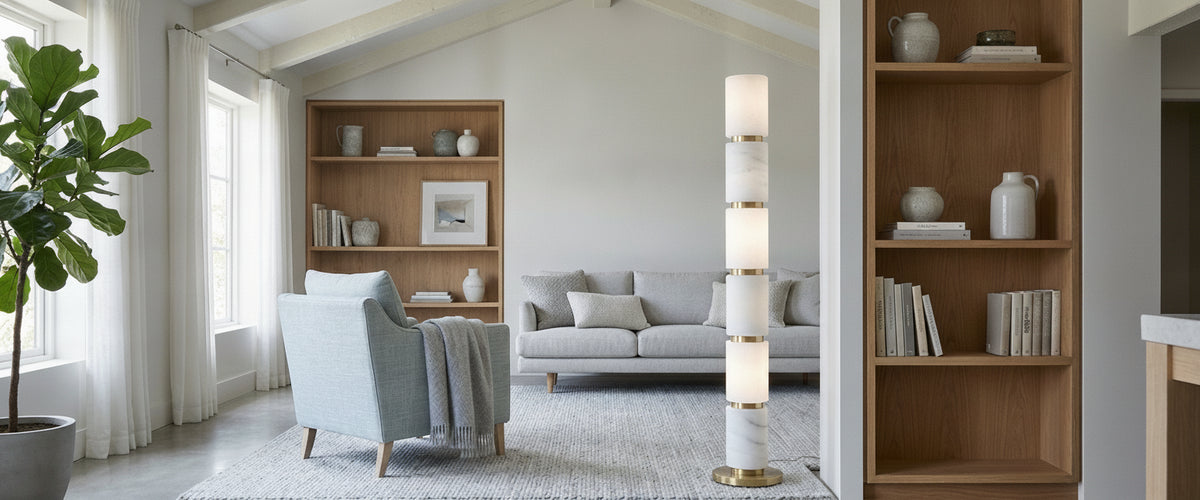

Switch off the photograph in your head. An alabaster totem floor lamps looks one way in a studio shot and quite another at nine o'clock on a February evening, when it is the only light in the room and every vein in the stone suddenly has something to say. That gap between the picture and the glowing object is where most buyers get caught out, and it is the part we spend the most time explaining when clients ring the Niori studio.
A totem lamp stacks stone vertically, either as separate drums, spheres and discs or as one tall carved column. The form is sculptural when unlit and becomes a column of graded light once the bulb is on. Getting that second state right depends on the stone, the bulb and the room far more than on the silhouette alone.

Quick Answer: Choosing an Alabaster Totem Floor Lamp
- Stacked totems give banded, rhythmic light with darker joints. Carved columns glow more evenly from top to bottom.
- Thinner stone transmits more light and more colour. Thicker stone reads cooler, milkier and calmer.
- Use a warm white LED around 2700K at a lower output than you would put behind linen or glass.
- The totem shape works best as a standalone object with breathing room, not wedged between sofa and bookcase.
- Ask for photographs of your actual piece, lit, before it ships.

Stacked Versus Carved: How the Totem Form Moves Light Through Stone
A stacked totem is built from individual turned or cut pieces threaded over a central rod or tube. Light leaves each section separately, so you get a gentle pulse up the lamp. It is bright through the body of each drum and dimmer at the seams, where metal spacers or the stone's own rim block it. Brass spacers between sections add a fine gold line when lit, which is one reason designers like them in panelled or period rooms.
A carved column is hollowed from a single block, or from two halves joined lengthways. Light spreads more continuously, and the effect is closer to a standing lantern than a stack of glowing beads. The trade-off is weight and fragility at the base. One long piece of soft stone carries more risk in transit and on uneven floors, which is worth knowing if your house has old, sloping boards.
Neither version of an alabaster totem floor lamp is better. Stacked forms suit rooms that already have rhythm, such as beams, panelling or open shelving. Carved columns sit well in plainer, plastered spaces where one calm vertical glow is the point.
Veining, Thickness and Colour: What a Product Photograph Cannot Show You
Alabaster used in lighting is a fine-grained form of gypsum, a soft mineral that has been carved into lamps and vessels for millennia precisely because it lets light pass through. That translucency is uneven by nature. Two sections of the same alabaster totem floor lamp, cut from one block, can glow quite differently.
Three things change what you see when the lamp is on:
- Wall thickness. A few millimetres of difference can turn a soft honey glow into a pale, almost grey one.
- Veining density. Veins that look like delicate pencil lines when unlit can read as bold amber or dark brown bands once backlit.
- Base tone. A white alabaster floor lamp is rarely pure white when lit. Expect cream to warm ivory, depending on the stone and the bulb.
We learned this the hard way with a client in a Georgian townhouse in Bath who chose a heavily veined totem from a daytime photograph. Lit, one middle section showed a dark diagonal band that she felt cut the lamp in two. We now photograph every stone piece switched on, against a neutral wall, before dispatch, and we encourage buyers to ask any supplier for the same.
Alabaster Against Frosted Glass and Linen, Once the Bulb Is On
Frosted glass spreads light evenly and predictably. It is consistent from lamp to lamp, and it can look slightly clinical in a living room after dark. Linen and other fabric shades soften light well and throw a defined pool down onto the floor, but the shade itself reads as a flat surface.
Alabaster does something neither material manages: it holds light inside its depth. The surface glows, and the veining gives the glow a sense of structure. An alabaster floor lamp shades also cuts more light than glass or linen of similar size, so the lamp works as a mood source rather than a reading light. If you want to read beside it, plan a second source or choose a design with an exposed downward element. An adjustable head on a heavy stone foot, as on the Nala Adjustable Floor Lamp with Marble Base, Matt Black & Gold, can handle the reading beside the sofa. The marble keeps a quiet link to the stone, and the alabaster is left to carry the mood.
For anyone comparing materials across a room scheme, it helps to look through the alabaster lighting collection next to fabric and glass designs. That way you can see how pendants and wall lights in the same stone might echo a floor lamp across the space. Where a totem stands at one end of a room, a wall fitting in the same stone, such as the Selvara LED Large Alabaster Double Wall Light, Brushed Brass, repeats that veined glow at eye level. Its brushed brass also picks up the spacers on a stacked design.
Why the Right Wattage Is Lower Than You Expect
Buyers often assume dense stone needs a bright bulb to get light through. The opposite tends to be true. A high-output bulb inside an alabaster totem floor lamp creates a hot spot: a bright patch at the bulb's height with dimmer stone above and below. It also flattens the veining, which is the reason you bought stone in the first place.
Our general guidance:
- Choose a warm white LED around 2700K. Cooler colour temperatures make alabaster look grey.
- Start lower in output than you would for a fabric shade and step up only if the room needs it.
- Opal or frosted bulbs diffuse better than clear filament styles, which can show as a bright point through thinner stone.
- Fit a compatible dimmer where possible. Alabaster looks its best at around half output.
- Check the maximum wattage marked on the lamp and never exceed it, even with LED.
LEDs also run cooler than old incandescent bulbs, which matters for a soft stone that dislikes heat and humidity swings.
Where the Totem Silhouette Earns Its Place, and Where It Becomes Noise
An alabaster totem floor lamp is a statement shape. Give it a job and some space.
Where It Works
- Empty corners of a living room, where it lifts a dark area and reads as sculpture by day.
- Either side of a fireplace or wide window, used as a pair, in rooms with enough width for both to stand clear.
- Hotel lobbies, restaurant entrances and lounge bars, where a column of warm light draws people through a space.
- Bedrooms with high ceilings, beside a chair rather than the bed, as an evening light.
Where It Struggles
- Next to a busy gallery wall or patterned wallpaper, where the stacked rhythm competes.
- In tight walkways, where the lamp gets knocked and soft stone chips.
- Beside a sofa as the main reading light. It will disappoint.
- In rooms already full of round, stacked or bobbled forms. One totem is a feature. Three totem-like objects is clutter.
A London architect we supplied for a loft project put two carved totems at the far end of a long open-plan room and nothing else at floor level. It worked because the rest of the scheme was quiet. If your room is already busy, a simpler outline may serve you better. A plain matt dome such as the Tessa Dome Floor Lamp, Matt White gives a calm downward pool without competing with pattern. The wider lighting range also has column designs that keep the vertical line without the stacked rhythm.
Questions to Ask a Supplier Before You Commit
Stone lamps are heavy, fragile in transit and often awkward to return. Ask these before you pay for an alabaster totem floor lamp:
- Can I see my actual piece lit? Not a stock image. Your stone, switched on.
- Is the stone genuine alabaster, or resin or composite? Both exist. Only one ages like stone.
- Is the base weighted, and how is the column fixed? Tall stone needs a stable footing.
- What bulb type and maximum wattage is it rated for? Is it dimmable?
- How is it packed and insured for shipping? Individually crated sections travel better.
- Can individual sections be replaced if one breaks? With stacked totems this can save the lamp.
- What is the returns position for natural-stone variation? Get it in writing.
Budget depends on stone grade, scale, how many sections are carved, the metalwork and the finishing. For larger or matched pairs, especially for hospitality projects, request a tailored quote rather than comparing headline figures.
Living With Alabaster: Care in Brief
Alabaster sits at around 2 on the Mohs hardness scale, which is soft enough to scratch with a fingernail, and gypsum is slightly water soluble. Dust with a dry, soft brush or microfibre cloth. Avoid water, sprays and polish. Keep the lamp out of bathrooms, steamy kitchens and direct sun through glass. When moving it, lift it by the base, never by the stone sections.
Treated this way, an alabaster totem floor lamp keeps its glow for decades. Most of the faults we see come from a dropped section or a damp room, not from age.