
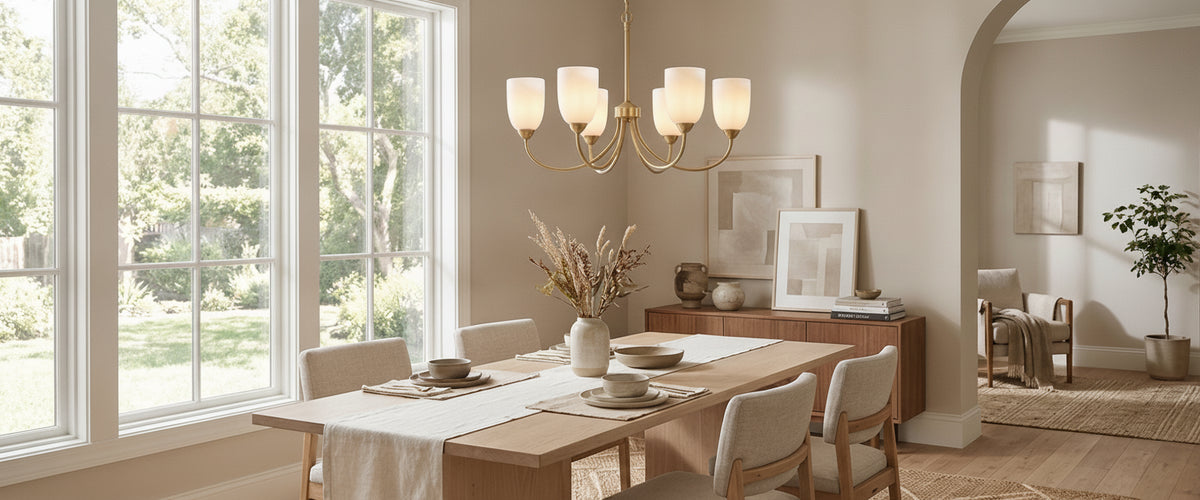

Search for a modern glass chandelier and you will find very different objects under the same three words. There is the hand-blown Murano sculpture, the cluster of production bubble globes, and the steel ring hung with crystal fringe. There is also the branching brass frame tipped with smoked shades. All of them hang from the ceiling. Once the switch goes on, they do very different things to a room.
At Niori we are best known for alabaster and natural-stone lighting, where the material itself diffuses the light into a soft, even glow. Glass follows other rules. Depending on how it was made, it can pass light straight through, bend it, bounce it back into the room, or put the bulb on full display. Know which of those a modern glass chandelier does before you buy it. That is the difference between a fixture that sets the mood of a dining room and one that glares at you across the table.
Quick answer
Clear blown or ball glass shows the bulb, so the bulb becomes part of the design.
Opal or frosted glass diffuses the light and behaves most like alabaster.
Smoked and amber glass absorb some output, so plan for brighter bulbs or extra light sources in the room.
Size by the room: add the room's length and width in feet. The total gives a sensible diameter in inches.
Weight and fixing matter more with glass than almost any other material. Always use a qualified electrician.

Why One Search Term Covers Such Different Fixtures
Whether a site files it as a "glass chandelier modern" or a "glass modern chandeliers", the same label covers at least four families. Each one behaves differently overhead.
Art glass: individually blown pieces, often Venetian in technique.
Globe and bubble clusters: many glass spheres grouped on a canopy or frame.
Branching fixtures: a metal frame that carries shades or globes at the tips.
Fringe and crystal: faceted drops that work by refraction rather than diffusion.
The distinction matters because each family places light in a different part of the room. A branching frame throws light outward and sideways. A dense bubble cluster concentrates it in one bright mass. Crystal fringe scatters pinpoints across the walls. Choose by silhouette alone and you can end up with the right shape and the wrong light.

Blown, Molded or Ball Glass: How Each Handles the Light
Blown Glass
Mouth-blown glass is never perfectly even. Walls thicken and thin, tiny seeds of air get trapped, and the surface carries a faint ripple. Those imperfections are useful, because they break up the light source and soften its edges. A Murano glass chandelier modern in shape but traditional in technique takes this furthest. The island's glassmakers have refined colored and layered glass over centuries, and the Museo del Vetro on Murano is the best place to see that lineage. Even a blown glass chandelier modern enough for a minimal loft will show slight variation between pieces. That variation is the point.
Molded Glass
Molded or pressed glass is consistent from piece to piece, which suits rows of pendants and hospitality projects where twelve fixtures have to match. Ribbed or fluted molding turns a point of light into vertical lines. Smooth molded glass behaves much like a clear globe. It is usually thicker and heavier than blown glass of the same size, so check the weight early.
Ball and Bubble Glass
A modern glass bubble chandelier and any glass ball chandelier modern in its lines both put the light source on show rather than hiding it. Clear spheres act like lenses. Look up and you see the bulb, slightly magnified, with a bright halo where the glass curves away. When those globes are spread across a branching frame rather than bunched together, as on the Galaxy 12 Light Branching Chandelier in Black & Brass with Clear Glass Globes, each bulb reads as its own point of light, so the bulb you choose becomes part of the design. A bubble glass modern chandelier sometimes layers smaller spheres inside or around larger ones. That multiplies the reflections and makes the fixture sparkle more, but it does not make the light any softer. If you want the globe form with gentler light, choose opal glass. Of all the glass options, opal comes closest to the even glow of carved alabaster.
Spread across a branching frame, clear globes turn each bulb into its own point of light.
Scale and Drop Length for a Modern Glass Chandelier
A modern glass chandelier that is too small does not fill the space. It hangs there looking like an afterthought. Start with the room-size rule: a 14 by 16 ft room (about 4.3 by 4.9 m) suits a fixture of roughly 30 in (76 cm) across. Over a dining table, aim for a diameter between half and two-thirds of the table's width, and hang the bottom of the fixture 30 to 36 in (76 to 91 cm) above the tabletop.
In walkways and halls, keep at least 7 ft (2.1 m) of clearance beneath the lowest glass element. Height matters more for glass than for metal, because a knock that only scuffs brass can crack a globe. For double-height stairwells, allow roughly 2.5 to 3 in of fixture height for every foot of ceiling height. Fixtures in tall spaces usually need to be larger than people expect. When you are comparing silhouettes across the wider niori lighting range, judge each one against the room's measurements rather than how it looks in a product photo.
Where a Glass Chandelier Competes With Its Own Reflection
Glass is reflective, and so is a lot of modern architecture. Picture a Georgian townhouse that opens into a fully glazed rear extension. After dark, a clear-globe modern glass chandelier over the kitchen table can reappear three times: in the glazing, in a polished concrete floor, and in a mirrored backsplash. In daylight the room looks calm. At night it looks as though four chandeliers are competing for attention. Switch the globes to opal glass and the reflections settle into a single soft shape.
Opal glass keeps reflections in glazing and polished floors down to a single soft shape.
Be cautious with walls of glazing, large mirrors, high-gloss lacquer and polished marble floors. A clear or crystal-fringe modern glass chandelier works best where the surfaces are matte: limewashed plaster, textured stone, timber and linen. Those surfaces absorb stray sparkle instead of repeating it. In very reflective rooms, pair one glass centerpiece with diffused alabaster wall lights at eye level. The wall lights carry the ambient glow, so the chandelier can sparkle without having to light the whole room. Our alabaster lighting collection is built around exactly that kind of soft, glare-free layer.
Bulbs and Color Temperature Inside Clear, Opal and Smoked Glass
The bulb's specification stays the same whatever glass surrounds it in a modern glass chandelier. What changes is how much of the bulb you see and what color the light becomes on its way out.
Clear glass: the bulb is on show, so its shape matters. Filament-style LEDs at 2200 to 2700K look intentional. Bare corn-style LEDs never do.
Opal glass: diffuses the source, so bulb shape matters less. A 2700K lamp gives a warm, even glow.
Smoked glass: absorbs a share of the output and mutes the light slightly. Next to a clear-globe fixture with identical bulbs, a smoked-glass branching fixture such as the Tree 6 Light Branching Chandelier in Matt Black with Smoked Glass will look noticeably dimmer. Choose higher-lumen lamps, or accept that the fixture is atmosphere rather than task light.
Amber glass: warms everything. A 2700K bulb behind amber reads closer to candlelight.
Whatever the glass, choose LEDs with a color rendering index (CRI) of 90 or above, so that food, skin and timber look right. Pair them with a compatible trailing-edge dimmer. The Society of Light and Lighting publishes useful guidance on glare and color quality for anyone specifying at project scale. Some fixtures have no replaceable bulb at all: on an integrated-LED ring design such as the Blossom 8 Light LED Glass Ring Chandelier in Gold, the light source is built into the fixture, so confirm the color temperature and dimming compatibility before you order.
Construction Details to Check Before Anything Heavy Goes Overhead
Glass is heavier than it looks, and a cluster of thick globes adds up quickly. Before you buy, ask for or check the following:
Total weight in pounds (kilograms), including the glass, so your electrician can choose the right fixing.
Ceiling fixing: heavier pieces should fix to a joist or a dedicated bracket, never to drywall alone.
How the glass is held: threaded collars or gallery screws with protective gaskets are better than friction fits.
Suspension: adjustable cable or chain, plus enough length for your ceiling height.
Replacement parts: whether spare globes or shades are available if one breaks.
Bathroom use: the IP rating, if the fixture is going anywhere near a bathroom.
All installation and wiring should be carried out by a qualified electrician, who can check the circuit, the dimmer compatibility and the load on the ceiling.
Modern Glass Chandelier Buying Checklist
Decide what the light is for: ambient glow, sparkle, or a focal point over a table.
Match the glass to that job. Choose opal for glow, clear or crystal for sparkle, and smoked or amber for mood.
Measure the room and the table, then size the diameter and drop.
Count the reflective surfaces in the room, and look at them after dark.
Choose bulbs for the glass: filament styles behind clear glass, higher lumens behind smoked glass, and CRI 90+ throughout.
Confirm the weight, the fixing method and the availability of spare parts.
For bespoke or project-scale pieces, ask for a tailored quote. Budget depends on material, scale, engineering, finishing and installation, so a quote is the only reliable figure.
The best modern glass chandelier is bought for the light it makes. The shape it cuts against the ceiling comes second. Decide what you want the light to do first, then choose the glass that does it. If you are still weighing glass against stone, Niori's alabaster and natural-stone lighting is a useful point of comparison.