
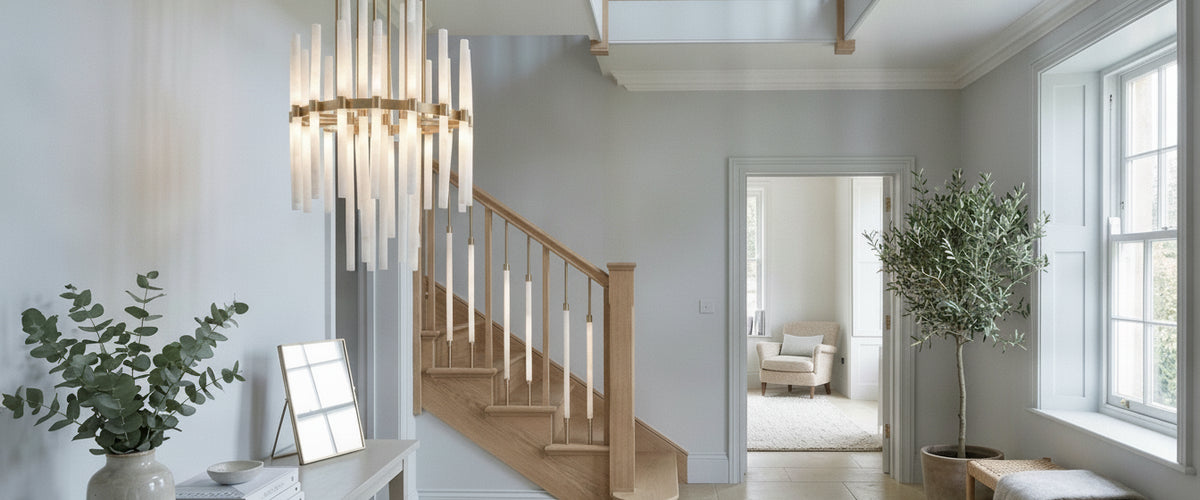

Hang an alabaster cluster chandeliers in the right room and the ceiling seems to dissolve into a loose constellation of warm, glowing stone. Hang the same fixture a foot too low, or against the wrong wall, and it reads as a tangle of drops nobody quite planned. The difference is rarely the chandelier. It is almost always placement, and placement decisions are easiest to get right before anything is wired.

Key Takeaways
- Clusters scatter light from many points, so they flatter rooms with height and volume and struggle in low, tight ones.
- Around 2.6 metres (8 ft 6 in) of ceiling height is where a full cluster starts to float rather than crowd, unless it hangs over a table.
- Dining rooms and double-height halls are the natural homes for the format. Bedrooms usually are not.
- A calm backdrop makes a spindle form look composed rather than chaotic.
- Stone grade, thickness and finish shape the glow more than the bulb does, so choose the stone first.

How a Cluster Scatters Light Differently from a Single Shade
A single alabaster bowl or drum works like one large, soft lantern. Light gathers inside the stone and leaves it as a broad, even wash, with a clear downward pool beneath. Your eye reads one source and the room organises itself around it.
A cluster breaks that source into many. Each alabaster element, whether a sphere, a cylinder or a slim spindle, glows at a slightly different height and distance from you. The result is layered light: brighter cores close to the eye, dimmer stones further back, and overlapping shadows on the walls that soften one another. It feels closer to candlelight than to a ceiling fitting. That is the appeal, and it is also why the format needs room. Every individual glow wants a little air around it.
Because alabaster diffuses rather than directs, a cluster also throws less light straight down than its lamp count suggests. Plan task light separately if the room needs it. Wall lights or a pair of table lamps will do far more for reading than another three drops.
Ceiling Height and Span for an Alabaster Cluster Chandelier
These are working thresholds we use when advising clients, not building rules, but they hold up well in real rooms.
- Below 2.4 metres (7 ft 10 in): a full cluster almost always crowds. Look at a flush or semi-flush alabaster ceiling light instead, or a compact three-light pendant over a table only.
- 2.4 to 2.6 metres (7 ft 10 in to 8 ft 6 in): workable over a dining or kitchen table, where nobody walks beneath it. Keep the drop shallow.
- 2.6 to 3 metres (8 ft 6 in to 9 ft 10 in): the comfortable zone for most period living and dining rooms. A medium cluster floats here.
- Above 3 metres (9 ft 10 in), and in stairwells: this is where larger ten-light formats earn their scale. A piece the size of the Selvara 10 Light Alabaster Cluster Chandelier in brushed brass needs this kind of volume to read as a constellation rather than a crowd.
Anywhere people walk beneath it, keep the lowest stone at least 2.1 metres (6 ft 11 in) from the floor. Over a dining table, aim for roughly 75 to 85 centimetres (30 to 33 in) between tabletop and the lowest element. For span, a cluster about half to two-thirds the width of the table looks deliberate, and leaving a clear margin to the table edge stops elbows and heads meeting stone.
One lesson from the studio: measure the canopy-to-lowest-stone height, not just the overall drop. Clusters with staggered spindles often have a lowest point well below the visual centre of the piece, and that hidden extra length is what catches people out.
Dining Rooms versus Double-Height Halls: Where the Cluster Logic Holds
The Dining Room
The dining table is the cluster's best friend. It anchors the piece, keeps people from walking underneath, and gives the scattered glow a surface to land on. Faces around the table catch light from several angles at once, which is far kinder than a single downlight. Set the fixture on a dimmer and you can run it bright for clearing up and low for dinner, where alabaster's warm amber tone does most of the atmosphere work.
Centre it on the table, not the room. If the two differ, the table wins every time, and a qualified electrician can reposition the ceiling point or add a discreet swag hook.
The Double-Height Hall
In a tall entrance or stairwell, an alabaster cluster chandelier solves a problem single pendants cannot: it fills vertical space. Seen from the front door, the landing and the stairs, a cluster looks different from each level, which keeps the void from feeling empty. In a Georgian townhouse stairwell, for example, hanging a ten-light cluster so its lowest stone sits level with the landing handrail changes everything. From upstairs, the glow sits at eye height; from the hall, it hangs like a lantern well above head height. That single alignment decision does more for the space than any choice of finish.
Heavier fixtures in high voids also need proper support. Under BS 7671, the IET Wiring Regulations, the fixing must carry the luminaire's weight, so have a qualified electrician confirm the ceiling structure and install it. This is not a DIY job.
Why the Bedroom Is Usually the Wrong Room for a Spindle Alabaster Cluster Chandelier
A spindle alabaster cluster chandeliers is a vertical, scattered form, built to be seen side-on and from below at a distance. A bedroom gives it neither. You look at a bedroom ceiling while lying flat, which means you see the underside of every spindle and, often, the bright ends of the light sources. What glowed softly from across a dining room becomes a cluster of hot spots directly above your pillow.
Height is the other problem. Many UK bedrooms sit around 2.4 metres, which pushes the fixture close to head height beside wardrobes and doors. And bedrooms rarely have a focal surface like a table to anchor the form. If you love the look, try a single alabaster pendant beside each bed or alabaster wall lights either side of the headboard. A twin-shade fitting such as the Velaris 2 Light Double Alabaster Wall Light keeps the stone near eye level, where it glows across the room rather than down onto the pillow. You keep the stone and lose the glare.
The Backdrop a Spindle Form Needs
Spindles are busy by nature. Ten or a dozen slim stones at staggered heights already contain plenty of visual information, so the room behind them needs to be calm for the composition to read as intentional.
- Plain or softly textured walls such as limewash, polished plaster or painted panelling let the shadows from each spindle show. Bold patterned wallpaper fights them.
- One cluster per sightline. Two clusters, or a cluster beside a row of spotlights, confuse the eye.
- A clear anchor below: a table, a round rug, a stair void. A cluster hovering over an empty floor looks lost.
- Warm, matt surfaces pick up alabaster's amber tones. High-gloss white ceilings can bounce glare back down.
Brass detailing helps too. A brushed brass canopy and rods read as a frame, tying the stones into one object. Look through the alabaster lighting collection with your room's backdrop in mind and you will see how differently the same stone reads against brass, bronze or a lighter finish.
Stone Grade and Finish: The Glow Is Decided Before the Bulb
Alabaster is a fine-grained form of gypsum, as the British Geological Survey describes in its mineral resources work, and its translucency varies with grade and thickness. Those two factors set the character of the light long before you pick a lamp.
- Purer, paler grades glow milky and even, closer to cream. Good for calm, minimal rooms.
- Heavily veined stone shows its markings when lit, with darker drifts and amber streaks. Beautiful, but busier, so pair it with an even quieter backdrop.
- Thinner walls pass more light and look brighter; thicker sections look richer and more amber.
- Honed finishes look soft and chalky when off. Polished finishes catch reflections and appear slightly glassier by day.
In an alabaster cluster chandelier, that variation multiplies. Each piece of natural stone is different, so no two spindles will glow identically, and we treat that as part of the material rather than a flaw. If you prefer a tighter, more uniform glow, say so when you ask about a piece, and choose paler grades.
Bulbs and Dimming
Once the stone is chosen, keep the light warm. A colour temperature of 2700K suits most rooms; a warmer 2200K to 2400K lamp, or a dim-to-warm LED, deepens alabaster's amber in the evening. If you want a cleaner, more even glow across every stone, an integrated LED design such as the Atria LED Alabaster Cluster Pendant Light is the better fit; E14 lamp versions give you more freedom to adjust warmth later. Either way, use an LED-compatible dimmer and have your electrician check it suits the fixture's driver or lamps. For a wider look at fixture types alongside clusters, the full lighting range is a useful comparison.
Buyer Checklist Before You Commit
- Measure ceiling height and the canopy-to-lowest-stone drop of the fixture.
- Confirm whether people walk beneath it or it sits over a table.
- Check span against table width or the void it fills.
- Look at the wall and ceiling behind it from the main viewing points.
- Decide on stone tone: pale and even, or veined and characterful.
- Choose a finish for the metalwork that frames rather than competes.
- Plan warm, dimmable LEDs and a compatible dimmer.
- Book a qualified electrician to confirm the ceiling can carry the weight.
Budget for an alabaster cluster chandelier depends on material, scale, the number of stones, engineering, installation and finishing, so the most useful step is to request a tailored quote with your measurements to hand. At Niori we specialise in alabaster and natural stone, and the questions above are the same ones we ask clients before anything leaves the studio.
Care for a Cluster Over Time
Alabaster is soft and sensitive to water, so dust each stone with a dry, soft brush or microfibre cloth, switched off and cool. Never spray cleaner onto the fixture. Clusters collect dust on the upper surfaces of each element, so a light clean every few weeks keeps the glow even rather than patchy. Handle stones by the metalwork where possible; skin oils can mark pale grades.