
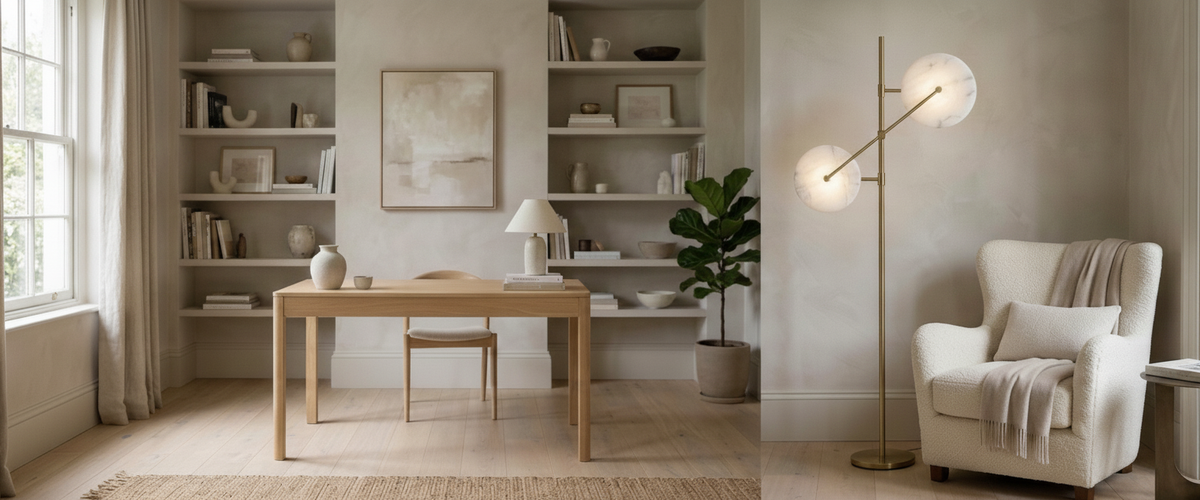

A floor lamp is furniture that happens to make light. It occupies the same floor a side chair would, casts a shadow, and reads as a shape in the room even when it is switched off. So the honest question with modern floor lamps is not whether they look good in a catalogue photo; it is whether the one you want will earn its footprint in your actual living room. Placement is where most of that gets decided.
Get the position right and modern floor lamps do three jobs at once: they light a task, fill a dead corner, and give the eye a vertical line to rest on. Get it wrong and the lamp becomes the thing everyone edges around on the way to the sofa.
Beside a reading chair, offset behind the shoulder, is the strongest starting position.

Key Takeaways
Beside an armchair suits reading and gives a clear, contained pool of light; behind a sofa washes the wall and lifts the whole seating group.
Arc lamps buy you overhead light over a coffee table without a ceiling fixture, but they need clearance and a heavy, stable base.
Two modern floor lamps in one living room is fine, and often better, as long as they balance rather than mirror each other.
Contrast decides visibility: a minimal frame reads best against a busy backdrop, a sculptural stone form against a plain wall.
Warm output and real dimming keep a modern lamp from feeling like an office fixture.

The Sculptural Floor Lamp as Furniture
Before you decide where a lamp goes, be honest about how much room it is asking for. A slim column with a small base tucks almost anywhere. A wide tripod or a marble-footed design stakes a bigger claim on the floor and wants breathing space around it. In the Niori studio we treat modern floor lamps the way we treat an occasional chair: measure the base, then leave a comfortable margin of at least 18 inches (45 cm) so nobody clips it walking past.
Weight matters as much as width. A stone base is what stops a tall lamp toppling, and it is also what makes it feel permanent rather than provisional. Alabaster and marble bases run heavy for their size, which is exactly what a tall frame needs to stay planted. Something like the Odin Floor Lamp with Marble Base shows how that heft reads as intentional rather than incidental: it anchors the piece and keeps a reaching arc lamp from tipping when the room gets busy.

Beside the Armchair Versus Behind the Sofa
These are the two most common living-room positions, and they read completely differently.
Beside an armchair is the reading position. You want the light source roughly at eye level when seated, around 40 to 42 inches (100 to 107 cm) from the floor, a little behind your shoulder so the glow falls onto the page rather than into your eyes. A lamp with a translucent alabaster shade suits this beautifully; the stone diffuses the output into something soft and even, so you get a legible pool of light without a hard glare spot. Where the room needs that diffused warmth rather than a hard downlight, a piece such as the Vellum LED Alabaster Column Floor Lamp is closer to the right design language. This is where people ask where to put a floor lamp in living room layouts, and the answer is almost always: next to the seat that gets used most, offset to one side.
Behind the sofa does a different job. Here the lamp is not lighting a task, it is lighting the wall and the ceiling above the seating group. Taller modern floor lamps with an upward or diffused output wash the backdrop and lift the whole arrangement, which is useful in rooms that otherwise rely on a single central ceiling light. If you have been wondering where to place floor lamps in living room corners that feel dead, the back corners of a sofa are often the fix.
You can browse how these forms differ across our lighting range to see which read as reading lamps and which are built to throw light upward.
Arc Lamps and the Reach Over a Coffee Table
An arc lamp curves out from a grounded base so the shade hangs over a table or seating area, giving you overhead light without wiring a pendant into the ceiling. It is the closest modern floor lamps get to doing a pendant's job, and it is a genuine gift in rented homes or rooms where the ceiling rose sits in the wrong place.
An arc reaches over the table from a weighted base set to one side.
The trade-offs are real, though. An arc needs clearance so nobody knocks their head on the shade; aim to keep the shade at least 6 to 8 feet (1.8 to 2.4 m) above any walking path. It also needs a base heavy enough to counter all that reach. This is exactly where a marble or stone foot pays for itself. Position the base to one side of the coffee table and let the arm carry the shade over the centre. Measure the overhang before you commit; an arc that stops short of the table lights the floor instead of the surface you actually use.
Minimal Frames Against Busy Backdrops
Whether one of these modern floor lamps reads as elegant or invisible comes down to contrast with what sits behind it. A fine brass column against a gallery wall of framed prints can vanish into the noise. The same column against a plain plastered wall becomes a clean vertical line you notice from across the room. For a busy backdrop, a spare form such as the Essence Round Floor Lamp in Black holds its line without competing with what is behind it.
Reverse it for sculptural pieces. A carved alabaster column with visible veining wants a quiet backdrop so the material can be read; put it in front of a busy bookshelf and the stone's character gets lost. The rule we give clients is simple. Busy backdrop, choose a minimal frame. Plain backdrop, let the material do the talking. Our alabaster lighting pieces are designed for that second scenario, where the stone itself is the point.
Warm Output and Dimming
The fastest way to make modern floor lamps feel clinical is to run a cold, undimmable bulb in them. Alabaster and natural stone already warm the light on their way through, which is half the appeal, but the source matters too. Aim for bulbs in the 2400K to 2700K range for living-room comfort; that lands the colour temperature in the warm-white band most people read as relaxing rather than surgical. Warmer light reads as calmer, which is exactly the register a living room wants at night.
Dimming is the other half. A floor lamp that only does full brightness has one setting, and it is rarely the one you want at night. Choose a lamp with an integrated dimmer or a dimmable LED paired with a compatible control, and you get a fixture that shifts from bright reading light to a low evening wash. If your lamp is hard-wired rather than plug-in, or you are adding a wall dimmer, bring in a qualified electrician; the guidance from Electrical Safety First is worth a read before anyone touches a circuit.
When a Wall or Table Light Would Do Better
Sometimes the most useful advice about modern floor lamps is not to use one. In a tight floor plan, where the sofa, coffee table, and a couple of chairs already fill the space, adding a lamp on a base means adding another obstacle at shin height. A wall light frees the floor entirely and puts the glow where you need it. A table lamp on an existing console or side table does much the same without claiming new ground.
Be honest about circulation. If you have to shuffle around a lamp to reach a seat, it is in the wrong place, or it should not be a floor lamp at all. Save the floor version for corners and edges where it fills space rather than blocking it.
Can You Have Two Floor Lamps in a Living Room?
Yes, and larger or open-plan rooms often need two. The trick is balance, not symmetry. Two identical modern floor lamps placed as a matched pair either side of a sofa can look formal and considered, or slightly showroom-stiff, depending on the room. More often the better result comes from two different heights or forms doing two different jobs: a reading lamp beside the armchair, a taller uplight in the far corner. They should feel like they belong to the same family without being twins.
Watch the total light budget. Two lamps plus a ceiling fixture plus table lamps can tip a room into over-lit flatness. Layer them on separate switches or dimmers so you can bring up only what the moment needs.
A Quick Placement Checklist
Measure the base and leave a walk-around margin of at least 18 inches (45 cm) before you buy.
Beside the armchair for reading; behind the sofa to wash the wall.
Check arc-lamp overhang against your coffee table, and confirm the base weight suits the reach.
Match a minimal frame to a busy backdrop, a sculptural stone form to a plain one.
Choose 2400K to 2700K bulbs and a real dimmer.
If the floor is crowded, switch to a wall or table light instead.
Niori builds its modern floor lamps around alabaster and natural stone precisely because the material does the softening for you. Placed well, one of these modern floor lamps becomes the piece a room organises itself around. You can see the current forms on the Niori homepage and work out which position each one is really made for.
A Note on Budget
Cost on a stone-based floor lamp depends on the material, the scale, the complexity of the frame, the engineering behind a reaching arc, and the finishing on any brass detail. Because modern floor lamps vary so widely, rather than quote a band that will not fit your piece, we recommend requesting a tailored quote for the exact lamp and configuration you are considering.