

Most glass wall lights are bought for their metalwork and judged, six months later, by their glare. The brass looked right in the photo, the backplate matched the door handles, and then the first winter evening arrives and the hallway feels either harsh or oddly dim. That gap between purchase and reality almost always comes down to one decision buyers rush past: the glass itself.
At Niori we spend most of our days thinking about how translucent materials handle light, mainly alabaster and natural stone. Glass follows the same rules. It can soften a beam, scatter it, tint it or let it straight through, and each of those outcomes changes how a room feels far more than a gold or black finish ever will.
At a Glance
- Opal glass gives the softest, most even glow and suits eye-level positions.
- Clear and seeded glass add sparkle but show the bulb, so the bulb choice becomes part of the design.
- Ribbed glass stretches light along its flutes and reads well on long walls.
- Smoked or fumé glass is moody and decorative; plan on extra lighting elsewhere.
- Bracket depth and backplate size decide how light falls on the wall behind the fitting.

Why Glass Wall Lights Live or Die by the Glass
A wall light sits close to the eye. Unlike a pendant hung about 2.1 m (7 feet) up, a sconce usually lands somewhere between 150 and 170 cm (60 to 68 inches) from the floor, which is roughly where faces are. Whatever the glass does to the bulb, you see it directly, every time you walk past.
The frame is the supporting act. It sets the style and holds everything in place, yet it barely touches the light output. Swap a brass frame for black and the room looks different by day; swap opal glass for clear and it feels different by night. When we help clients shortlist glass wall lights, we ask about the glass first and the finish second, and the decisions get easier.

Clear, Opal, Seeded, Ribbed and Smoked: What Each Glass Does to Light
Clear Glass
Clear glass hides nothing. Light leaves the bulb at full strength, casting crisp shadows and small bright reflections on nearby surfaces. It works beautifully with a well-chosen filament or globe LED and can look sparse with a cheap one. Avoid clear shades in tight corridors or beside a mirror, where the exposed bulb ends up in your eyeline.
Opal Glass
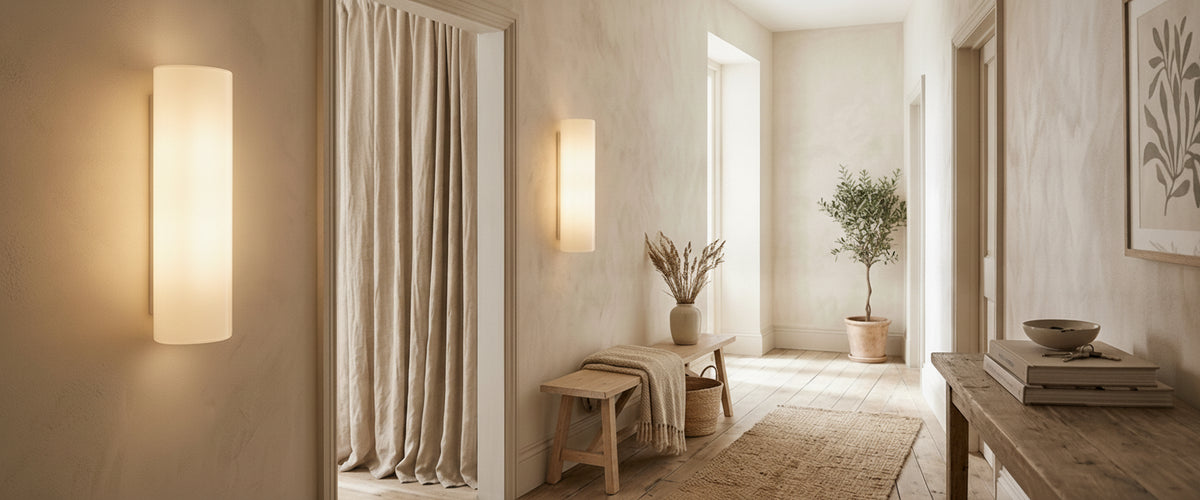
Opal glass is milky and translucent, and it behaves much like a thin alabaster shade: the whole surface glows, the bulb disappears and shadows soften at the edges. For a calm, even pool of light on either side of a bed or fireplace, a twin-shade opal design such as the Antic 2 Light Opal Glass LED Wall Light in gold makes more sense than a single exposed globe. If you only buy one type of glass for a home, this is the forgiving choice.
Seeded Glass
Seeded glass carries tiny trapped air bubbles, a look that echoes older, hand-blown work. The Corning Museum of Glass is a good starting point on the history of hand-blown glass, where bubbles were once a flaw rather than a feature. In practice, each bubble catches the light and throws a faint glint, so seeded shades add texture without much diffusion. Treat them like clear glass when choosing a bulb.
Ribbed Glass
Ribbed or fluted glass bends light along its ridges. Vertical ribs pull the glow into a taller, narrower shape; horizontal ribs spread it sideways. The ribs also blur the bulb, so you get some of the softness of opal with more surface interest. Long cylinder fittings with vertical ribbing suit narrow walls and stairwells where you want height without width.
Smoked and Fumé Glass
Smoked glass, often sold as fumé, is tinted grey or amber-grey. It cuts output noticeably and warms the colour of the light. Where a dining room or bar needs something deliberate and atmospheric, a ribbed fumé cylinder on a black frame, like the Thari Cylinder Ribbed Fumé Glass Linear Wall Light, is closer to the right design language, but it will never light a room on its own. Through a tinted shade, a 3000K LED can look muddy where a 2700K bulb stays rich, so stay at the warm end.
Bracket Depth, Backplates and the Light on the Wall Behind
The wall behind a sconce is part of the fitting. How far the shade sits from it, and how large the backplate is, decide whether you get a soft halo, a hard scallop or nothing at all.
- Shallow brackets (shade close to the wall) throw a tight, bright wash right around the fitting. Good for corridors, but any wall unevenness shows up sharply.
- Deeper projections let light spread wider and fade gently, which flatters textured plaster, limewash and stone cladding.
- Large backplates block light from hitting the wall directly behind the fitting, creating a crisp silhouette. Small or round backplates let the glow wrap more evenly.
- Up versus down: an upward-facing open shade lights the ceiling and makes a low room feel taller; a downward shade puts light on the floor or a console.
Check projection carefully in hallways. Anything that sticks out more than about 10 cm (4 inches) in a narrow passage starts to get knocked by shoulders and bags, and you end up with a cracked shade.
Room by Room: Where Glass Wall Lights Earn Their Place
Living rooms. Pairs of opal or ribbed glass wall lights either side of a fireplace or a large artwork give layered light that pendants cannot. Keep them on a separate dimmer circuit from the ceiling light.
Bedrooms. Opal is the safe bet beside the bed; clear glass at pillow height is uncomfortable to read under. If you want a reading beam, choose a fitting with a separate directional light rather than relying on the glow. A bedside design such as the Nao Rectangular LED Wall Light with Reading Light, which pairs a soft wall wash with its own adjustable beam, is more practical at pillow height than a purely decorative shade.
Hallways and stairs. This is where we see the most regrets. Clear-glass sconces down a staircase are the classic mistake: coming downstairs, every bulb sits straight in your line of sight. Opal or ribbed shades solve it, and if the fitting takes interchangeable glass, the fix is a shade swap rather than a new light.
Bathrooms. Opal and ribbed glass both work well, but the fitting must carry the right IP rating for its position near water. Electrical Safety First explains bathroom zones clearly, and any installation should be done by a qualified electrician.
Dining rooms and bars. Smoked and seeded glass come into their own here, where mood matters more than task light and a central pendant or chandelier does the heavy lifting.
Where they disappear. Plain opal domes on a white wall in a white room tend to vanish visually. That can be a virtue in a utility space; in a main room, add contrast with a darker wall, a stronger frame or a more sculptural shade.
Frame and Glass Pairings That Work, and Ones That Fight
Some combinations simply sit well together:
- Brass with opal: warm metal and a warm glow reinforce each other. Classic and hard to get wrong.
- Black with ribbed or smoked: graphic, slightly industrial, very good against plaster and dark paint.
- Aged brass with seeded: reads traditional and handmade, suited to period rooms.
- Chrome or nickel with clear: crisp and cool, best in bathrooms and contemporary kitchens.
The pairings that fight are usually temperature clashes. Polished chrome with amber fumé glass looks undecided. Heavy matt black frames around delicate seeded globes can feel clumsy. And mixing glass types on the same wall (opal sconces next to a clear-glass mirror light, say) splits the eye between two different kinds of light.
If you want the diffusion of opal with more depth and natural variation, alabaster is the obvious next step. It glows through its own veining, so each shade looks slightly different when lit. You can compare stone and glass options side by side in our full lighting range, which helps when you are matching wall lights to a pendant in the same room.
Before You Commit: A Glass Wall Light Checklist
- Glass type first. Decide what the light needs to do (glow, sparkle, mood) and choose the glass to match.
- Glass thickness. Thicker glass diffuses a little more and survives cleaning better. Very thin shades chip at the rim where they meet the gallery.
- Diffuser coverage. Check whether the shade fully encloses the bulb or leaves the top or bottom open. An open bottom at eye level means visible bulb.
- Shade replaceability. Ask whether replacement glass is available. Some manufacturers sell spare shades; many do not.
- Projection and height. Measure the passage width and mark the mounting height on the wall before ordering.
- Bulb and dimming. Choose warm LED (2700K to 3000K), ideally CRI 90 or above, and confirm the bulb and driver are dimmable on your switch.
- Installation. Most wall lights are hard-wired. Book a qualified electrician and check the backplate covers your existing box.
Bulbs and Dimming for Glass Wall Lights
Match the bulb to the glass. Clear and seeded shades need a bulb that looks good bare, such as a globe or a soft filament LED. Opal and ribbed glass forgive almost any shape but reward a warm colour temperature. Smoked glass needs more lumens than you expect and should always be dimmable, because full brightness through a tint can look flat while a low setting looks rich.
Dimming changes everything with glass wall lights. A good opal sconce at 30 percent reads almost like candlelight against a stone wall, which is exactly the effect we design our alabaster pieces around. If that warm, mineral glow is what you are chasing, explore our alabaster lighting alongside your glass shortlist before you decide.