
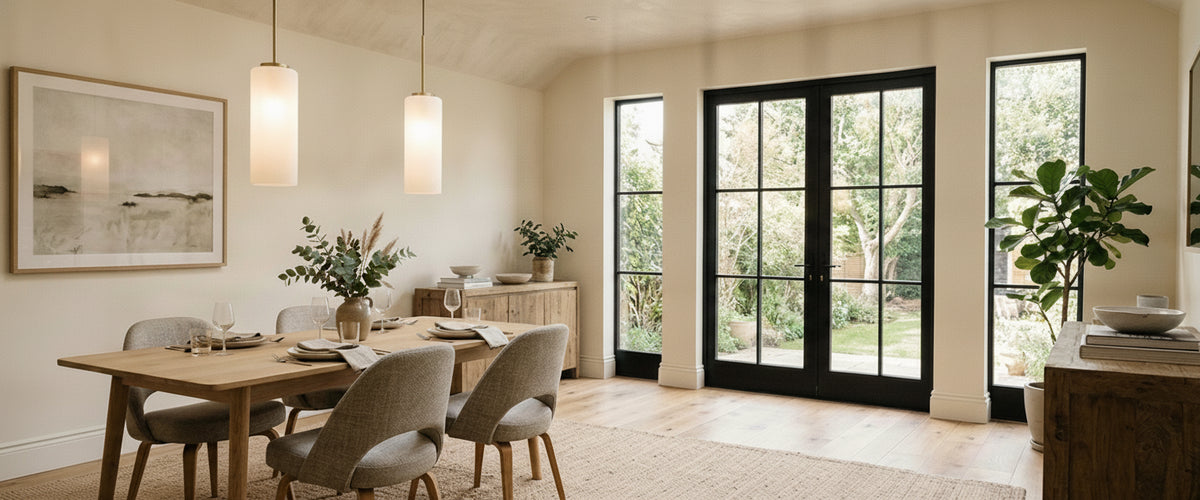

A glass pendant has nowhere to hide. Put a cheap lamp inside an alabaster shade and the stone forgives you. Put the same lamp inside clear glass and everyone at the table is squinting at it by pudding. That honesty is exactly why glass pendant lights are so popular over kitchen islands and dining tables, and why they go wrong so often. The material looks simple. The decisions behind it are not.

At a Glance
- Choose the bulb first: with clear and textured glass, the lamp is part of the design.
- Match the glass to the room: clear for sightlines and drama, opal for soft general light, smoked for evening rooms, textured for sparkle without glare.
- Hang with intent: roughly 75 to 90 cm (30 to 36 in) above a worktop, slightly lower over a dining table.
- Pick one colour temperature per sightline: 2700K for living and dining, 3000K only in a hard-working kitchen.
- Look up before you buy: the ceiling behind a transparent pendant is part of what you see every evening.

Why Glass Pendant Lights Punish a Bad Bulb Choice
Every shade material sits somewhere on a scale between hiding the light source and showing it. Alabaster sits at the hiding end: the stone takes the lamp's output, scatters it through its crystalline structure and returns a warm, even glow with the bulb reduced to a soft hot spot. Clear glass sits at the other extreme. Whatever you screw into the holder, with its shape, brightness and colour, is presented to the room as if under a vitrine.
That changes the order in which you should shop. With glass pendant lights, decide on the lamp before you fall for the fixture. A standard frosted A60 bulb inside a clear globe looks like a light bulb in a jar. A budget LED with a visible ring of chips reads as a cluster of hot dots. A tall filament lamp in a short globe crowds the glass and throws harsh streaks across a ceiling.
The good options are fewer than you might think. Inside clear glass, a dimmable warm filament lamp with modest output is usually right, because over an island you will often run two or three pendants together. Think in lumens rather than watts; the Energy Saving Trust's lighting advice is a sensible primer on reading the box. If you want clear glass without seeing a filament, a large opal globe lamp inside the shade gives a soft moon within the glass, which is a lovely effect over a dining table. Whatever you pick, look for a colour rendering index of 90 or above so food and skin tones look right.
A familiar example: three clear globes over an island, lit with 4000K corn-style LEDs, look like a purchase worth returning. Swap in 2700K dimmable filament lamps, with the same fixtures at the same height, and the kitchen suddenly looks finished. The pendants were never the problem.
Clear, Opal, Smoked and Textured: Four Glass Types, Four Different Rooms
Clear Glass
Clear glass pendant lights are the choice when you want light without visual bulk. They keep sightlines open across an open-plan kitchen, let a garden view through the back windows read uninterrupted, and suit small rooms where a solid shade would feel heavy. The trade-off is glare and maintenance: fingerprints, dust and insect shadows all show, and the glass does nothing to soften the lamp.
Opal Glass
Opal is the closest glass gets to stone. Opacifying ingredients turn the glass milky so it diffuses rather than transmits, a technique with a long history that the Corning Museum of Glass documents well. It works in hallways, bedrooms and family kitchens where you want even light and no glare. In those rooms, a plain opal globe such as the Vetra Opal Glass Pendant Light in Brushed Gold makes more sense than a clear shade that leaves the lamp on show, and the warmer metal finish sits comfortably beside timber and brass. The difference from alabaster is character. Opal glows uniformly and slightly cool; alabaster glows warmer, and its veining means no two shades are identical. If you love the diffusion of opal but find it a little clinical, browsing alabaster pendants and wall lights is the logical next step.
Smoked Glass
Smoked or tinted glass is an evening material. It reads as a dark, glossy object by day and a low, amber-grey glow at night, which suits dining rooms, snugs, bars and restaurant interiors. It also absorbs a meaningful share of the light, so treat smoked glass pendant lights as mood pieces and plan task light separately. Where you want some of that evening warmth without committing to fully dark glass, a graded copper tint such as the Slice Glass Pendant Light in Copper Ombre sits closer to the middle ground, warming the glow while giving up less light than a fully smoked shade.
Textured Glass
Ribbed, fluted, hammered and seeded glass are the compromise. The texture breaks a filament into lines or flecks, so you get sparkle with far less direct glare than clear glass. Ribbed glass over a kitchen island is one of the most forgiving combinations we know, because it hides a slightly imperfect bulb and still looks crisp in daylight.
Drop Length and Globe Diameter: The Numbers That Flip a Pendant
Over a kitchen island, hang glass pendant lights so the bottom of the shade sits roughly 75 to 90 cm (30 to 36 in) above the worktop. Over a dining table, 70 to 85 cm (28 to 33 in) usually works: low enough to pull the light onto the table, high enough that seated guests can see each other beneath the shade. In hallways and walkways, keep the lowest point at least 2.1 m (about 7 ft) above the floor.
Ceiling height then decides how much flex you are looking at. A new-build with a 2.4 m (7 ft 10 in) ceiling leaves only a short drop over an island; a Georgian or Victorian room at 3 m (10 ft) or more leaves a long run of cable, which becomes part of the composition. Braided fabric flex in a colour that matches the canopy looks deliberate. Coiled excess flex never does.
For diameter, think about the island or table rather than the room. A row of pendants should span roughly two-thirds of the island's length, with clear space between shades so they read as separate objects. Two larger globes often suit a shorter island; three smaller ones suit a longer run. Remember that clear glass reads smaller than its true size, so you can go a size up. Opal does the opposite at night, when it reads as a solid glowing ball. That is why, over a shorter island, a pair of larger opal globes such as the Vetra Opal Glass Large Pendant Light in Black tends to look calmer than three small ones crowding the run, with the black fitting giving each shade a clean outline against a pale ceiling.
Large blown-glass shades can be surprisingly heavy, so check the fixing as well as the look. Pendants should be installed by a qualified, registered electrician who can confirm the ceiling fixing will carry the weight. In England, domestic electrical work falls under Part P of the Building Regulations and new circuits are notifiable, so this is not a DIY job.
Where Transparency Earns Its Place, and Where It Exposes the Ceiling
Transparency earns its place when there is something worth seeing through it: a period ceiling with intact cornicing, a skylight, a run of steel-framed glazing, a view into the garden. It also suits rooms where several fixtures share a sightline, because clear glass lets them overlap visually without clutter.
It works against you when the ceiling above is busy. Clear glass pendant lights frame whatever sits behind them, which might be a grid of downlights, a smoke alarm, a hairline crack or an old ceiling rose. In installation photos, the eye often lands on the canopy and the first stretch of flex before it reaches the shade itself. If your ceiling is less than perfect, choose textured or opal glass, or tidy the ceiling first. Check the view from where you will actually sit, too. From a sofa or dining chair you see the underside of the shade and the ceiling behind it; standing, you mostly see the shade side-on.
Colour Temperature Inside Glass: Why 2700K and 3000K Are Not Interchangeable
A 300K gap sounds trivial on a spec sheet. Inside clear glass, with the lamp fully visible, it is obvious. 2700K reads as warm, close to traditional incandescent light, and sits comfortably beside brass, timber and natural stone. 3000K is crisper, useful in a working kitchen with pale worktops, but it can make warm materials look slightly flat.
The real problem is mixing. A 3000K row over the island next to 2700K alabaster wall lights in the dining area reads as two rooms that have not been introduced. Keep one colour temperature across any single sightline. The one exception is tinted glass: smoked and amber shades warm the light further, so a 3000K lamp inside smoked glass can sit happily beside 2700K elsewhere. Test before committing.
For dimming, warm-dim LED lamps are worth the effort. They drift warmer as they dim, much as old filament bulbs did, which is exactly what you want at the end of a dinner. Pair them with a compatible trailing-edge dimmer, or expect flicker and buzz.
The Backdrop Problem: Your Ceiling Is Half the Design Decision
Glass is a reflective surface, so it borrows colour from what surrounds it. Under a white ceiling, clear glass practically disappears by day and the fixture becomes a floating lamp. Smoked glass, by contrast, stands out sharply as a dark object.
Paint the ceiling a deep colour, such as inky blue, forest green or aubergine, and the effect reverses. Clear glass with a warm lamp glows like a lantern against the dark, while smoked glass can vanish altogether. Opal sits in between, reading as a soft moon. Exposed timber in a barn conversion warms everything, so amber, smoked or ribbed glass tends to look more at home there than cool opal.
So decide on ceiling colour and glass type together. If a redecoration is planned within the year, buy the pendant for the ceiling you are going to have, not the one you have now.
How to Choose Glass Pendant Lights: A Buyer's Checklist
- Purpose: is this task light over a worktop, mood light over a table, or a decorative accent? Clear and textured suit task; smoked suits mood; opal covers general light.
- Lamp: choose the bulb shape, lumens, CRI and colour temperature before the shade.
- Ceiling: photograph it from a seated position. If the photo shows clutter, avoid clear glass.
- Height: measure ceiling to worktop or table and work out the flex length you will see.
- Scale: plan the row to span about two-thirds of the island or table.
- Weight and fixing: confirm with your electrician that the ceiling can take it.
- Bathrooms: check the IP rating against the zone before choosing any pendant.
- Care: clear glass shows dust within weeks; textured and opal are more forgiving.
Glass rarely has to work alone. Some of the most successful schemes we see pair glass pendant lights over the island with stone wall lights or an alabaster table lamp in the seating area, so the crisp glass does the practical work and the stone supplies warmth. You can see how these materials sit side by side across the wider niori lighting range. If you are specifying for a project and need help with scale, quantity or finish, ask for a tailored quote; pricing depends on material, size, complexity and installation.