
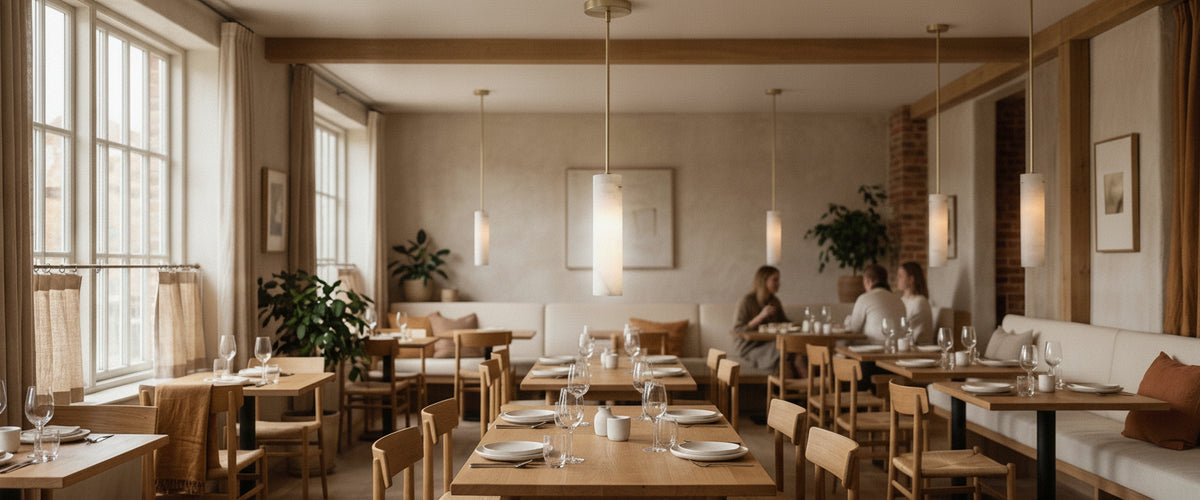

Forty pendants behave nothing like four. A shade that looks composed over a kitchen island can turn a restaurant ceiling into visual static once it is repeated down a 65 ft (20 m) dining room, run fourteen hours a day and dimmed every evening at seven. Commercial pendant lighting fixtures have to do everything a domestic pendant light does, then keep doing it through cleaning crews, refits, temperature swings and a lighting scene that changes with every service. Most specification problems we see start because the brief was written as if it were for a home.
At a glance
Write the brief around hours of use, maintenance access and control systems before choosing a shape.
Shade material decides how light spreads across a large room; alabaster and opal glass diffuse, metal directs.
Linear runs suit long tables and counters; clusters suit double-height voids; single drops suit rhythm and repetition.
Suspension height and ceiling fixing are the two decisions most often underestimated.
For commercial LED pendant lights, check CRI, flicker performance, driver quality and dimming protocol, not just lumens.
Large or multi-zone schemes usually justify a lighting designer.

How a Brief for Commercial Pendant Lighting Fixtures Differs From a Domestic One
A homeowner chooses a pendant because they like it. A venue owner or architect is choosing a system: dozens of identical commercial pendant lighting fixtures that must match in colour, hang at consistent heights and respond together when the controls change. That shifts the first questions away from style. How many hours a day will the lights run? Who cleans them, and from what height? Is there a building management system or a scene controller already in place? Will the fit-out contractor or a separate electrician install them?
Fire, accessibility and insurance requirements also enter early in UK hospitality and workplace projects, and they often dictate where a fitting can hang and how it is fixed. Any electrical connection, from a single drop to a full run, should be designed and installed by a qualified electrician working to current wiring regulations. None of this is DIY territory, however simple the fitting looks.
The domestic habit worth keeping is the one most commercial briefs drop: thinking about how the light feels at seated eye level. commercial pendant lights fixtures are often specified from a reflected ceiling plan, where every fitting is a neat circle on a grid. Guests never see the plan. They see the glow at the edge of their vision for two hours over dinner.

Shade Material at Volume: Alabaster, Opal Glass and Metal
Material choices that seem subtle on a single fitting become dramatic across a run of commercial pendant lighting fixtures, because every shade adds its light signature to the room.
Alabaster and natural stone
Alabaster is a fine-grained form of gypsum, soft enough to carve thin and translucent enough to glow from within (the British Geological Survey has useful background on gypsum deposits and their properties). Lit from inside, the stone spreads light through its whole surface, so a row of alabaster pendants reads as a warm, even band rather than a string of hot spots. Natural veining means no two shades are identical, which works well in hotel lobbies and restaurants where a little variation feels crafted rather than mass-produced. In the studio, we have noticed that alabaster at 2700K reads perceptibly warmer than opal glass at the same colour temperature; the stone filters the light slightly towards honey. Plan for that when matching other fittings.
Two practical points. Alabaster is heavier than glass, so the ceiling fixing matters more (more on that below). It is also porous and sensitive to water, which rules out steamy kitchens or spaces cleaned with wet sprays. Dry dusting and a soft cloth keep it looking right for decades. Onyx and marble behave differently again: onyx is more translucent and more dramatic in its banding, while marble usually works better as an opaque canopy or base detail.
Opal glass
Opal glass diffuses almost as softly as alabaster and is more consistent from piece to piece, which suits large office floors where uniformity matters more than character. It is easier to wipe clean, though it can look clinical in hospitality settings unless the colour temperature is kept warm.
Metal
Metal shades push light downwards and leave the ceiling dark. That is useful over bar counters and work surfaces, but a room lit only by metal domes can feel like a series of spotlit islands with gloom in between. Brass interiors soften the effect; matt black exteriors make it starker. Where a bar or pass needs light pooled firmly on the surface below, a closed dome such as the Lira Dome Pendant Light, Matt Black is closer to the right design language than a diffusing shade, provided softer ambient sources carry the rest of the room.
Many of the strongest schemes mix materials: diffusing stone or glass for ambient glow, with directional metal reserved for task zones. Browsing the alabaster lighting collection next to metal pendants is a quick way to see how differently the two carry light.
Linear, Cluster or Single Drop: Matching the Arrangement to Scale
Arrangement is where acoustic and visual scale meet. Large, hard-surfaced rooms already feel loud; a cluttered ceiling makes them feel louder still, even though light makes no sound. Calm, repeated forms help a busy room read as ordered.
Commercial linear pendant lighting follows the geometry of long tables, banquettes, counters and reception desks. It gives a strong directional line and reduces the number of ceiling drops, which keeps the plane above cleaner.
Clusters suit double-height voids, stairwells and atriums, where a single fitting would look lost. Staggered drop heights fill vertical space and turn the light into a focal point.
Single drops in repetition create rhythm over individual tables or along a corridor. The spacing becomes part of the architecture, so align it with tables, columns or ceiling beams rather than an arbitrary grid. Over small two-person tables, a compact shade such as the Renata Mini Drum Pendant Light, Matt Black keeps the rhythm going without crowding sightlines the way a wide dome would.
One lesson from a members' club fit-out we supplied in Edinburgh: the client wanted a long linear run over a communal table, but the table was moved twice during the build. Individual alabaster drops on a rail-style layout would have adapted; a fixed linear bar did not. Where furniture is likely to move, repetition of single pendants is the more forgiving choice.
Suspension Height and Canopy Engineering
Suspension height and canopy engineering are where commercial pendant lighting fixtures most often go wrong on site, and both are expensive to fix after the ceiling is closed.
For dining tables, the bottom of the shade typically sits around 75 to 90 cm (30 to 35 in) above the tabletop, low enough to create intimacy without blocking sightlines across the table. Over circulation areas, the fitting must clear head height comfortably and allow for tall guests and service trolleys. In double-height spaces, the drop should relate to a mezzanine or balcony line so the light reads intentionally from both levels.
Canopy engineering is the quieter problem. Natural-stone pendants carry real weight, and a plasterboard ceiling alone is not a fixing. The ceiling needs a structural point or a pattress designed for the load, ideally agreed with the contractor and, for heavier fittings, checked by a structural engineer. Confirm the ceiling void depth early too. On one Edinburgh project the void was shallower than the drawings showed, and the driver housings had to be relocated to a remote position. Cable length, canopy finish and how the drop will be adjusted on site should all be settled before ordering, not during installation.
Specifying Commercial LED Pendant Lights That Hold Up
Lumens tell you how much light a fitting produces. They say nothing about how good that light looks or how long it will behave. For commercial LED pendant lights, check these instead:
CRI 90 or above for hospitality and retail. Food, skin tones, timber and stone look flat under low-CRI sources, and alabaster loses its warmth.
Colour temperature consistency. Ask for tight binning so forty fittings match. A slightly greener lamp in a row of warm ones is surprisingly obvious.
Driver quality. Cheap drivers cause flicker, buzzing and early failure. Specify reputable drivers with low flicker at all dimming levels.
Dimming protocol. Match the driver to the control system: mains phase dimming, 0-10V or DALI. DALI allows individual addressing and scene control across large schemes; the DALI Alliance publishes guidance on certified products and system design.
Serviceability. Replaceable lamps or drivers mean a failure is a ten-minute job, not a full fitting replacement. On simpler runs built around standard lamps, a bayonet-cap suspension such as the 6" BC Pendant Holder Set, White Pre-Wired keeps lamp changes quick for maintenance staff, with the connection itself still made by your electrician.
For stone shades, a warm 2700K source with smooth dimming down to low levels keeps evening scenes candle-like without the stone turning grey.
Choosing Commercial Pendant Lighting Fixtures: A Decision Checklist
Define hours of use, cleaning method and access height.
Choose the shade material for the light you need: diffused glow or directed task light.
Fix the arrangement to furniture and architecture, allowing for layout changes.
Confirm drop heights from finished floor and tabletop levels, not ceiling height alone.
Agree ceiling fixing, void depth and driver location with the contractor.
Match drivers and dimming protocol to the control system.
Ask for a sample in the actual space, lit at the intended colour temperature.
Request a tailored quote; budget depends on material, scale, engineering, installation and finishing.
Commercial pendant lighting fixtures in natural stone reward this discipline more than most, because the material is part of the design rather than an afterthought. You can compare forms across the full lighting range before shortlisting.
When Large Commercial Pendant Lighting Needs a Lighting Designer
A supplier can advise on individual commercial pendant lighting fixtures. A lighting designer takes responsibility for the whole scheme: light levels, glare, layered scenes, emergency lighting coordination and how pendants work alongside wall lights and concealed sources. Large commercial pendant lighting across multiple zones, listed buildings, or venues where the lighting is central to the brand almost always justifies one.
The signal is usually complexity rather than size. If the scheme needs more than one dimming scene, covers spaces with different uses, or involves heavy fittings in a sensitive ceiling, bring a designer in early. Niori regularly works alongside designers and architects on alabaster and natural-stone pendants for hospitality projects, and the best results come when the stone is chosen at concept stage, not slotted in once the ceiling plan is fixed.
Get the brief, the fixing and the drivers right, and commercial pendant lighting fixtures stop being a line on a schedule. They become the reason a room feels warm at nine o'clock on a wet Tuesday.