
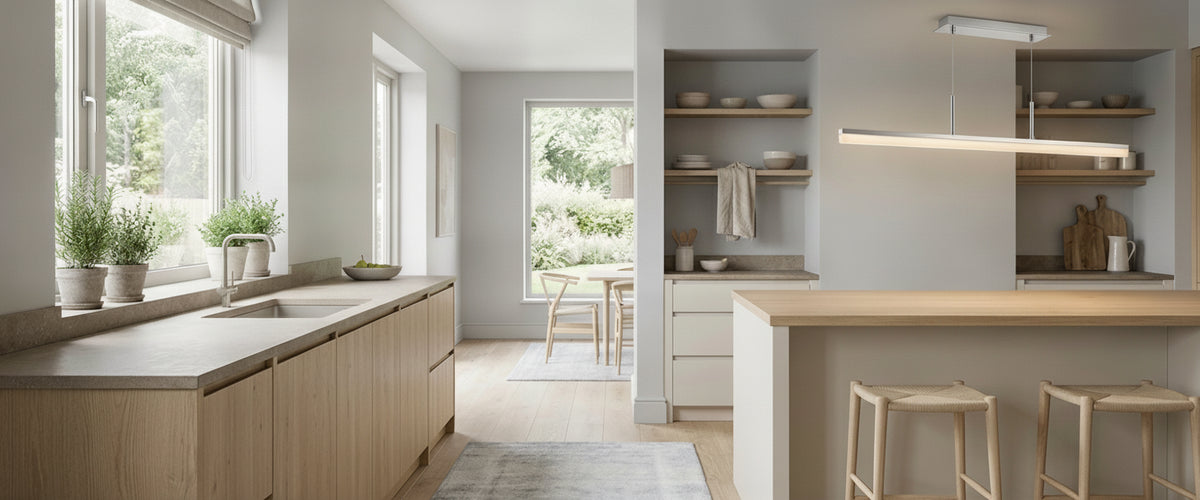

Chrome is the one finish in the house that answers back. Put it on a kitchen ceiling and it throws back every downlight, every curl of steam and every fingerprint from the last bulb change. chrome kitchen ceiling lights can look crisp and architectural, or they can turn a warm family kitchen into something closer to a dental surgery. The difference rarely comes down to the fitting alone. It comes down to the surface finish, the height of the ceiling, the colour of the cabinets and the light source inside. At Niori we work mostly in alabaster and natural stone, and a surprising number of our kitchen projects pair translucent stone shades with chrome canopies and galleries, so we see both outcomes often.

Key Takeaways
- Brushed chrome forgives steam, grease and fingerprints far better than polished chrome over a working kitchen.
- Low ceilings (under about 2.4 m, or 8 ft) suit flush or semi-flush chrome; pendants need height or an island to justify them.
- Warm white bulbs at 2700K to 3000K with a CRI of 90 or above stop chrome reading cold.
- A diffusing shade, such as alabaster or opal glass, softens the glare chrome would otherwise bounce around the room.
- Echo chrome once or twice in taps or hardware, not on every surface.

Why Chrome Behaves More Aggressively in a Kitchen
In a sitting room, chrome reflects soft furnishings, a rug and perhaps a painted wall. In a kitchen, it reflects other hard, bright surfaces: gloss doors, quartz worktops, a glass splashback, stainless appliances. Reflections stack on reflections. A single bare lamp over an island can appear five or six times across the room before it reaches your eye.
Kitchens also run hotter, wetter and greasier than anywhere else in the house. Polished chrome shows a fine film of cooking residue within days, and that film scatters light into a dull haze that looks like dirt rather than patina. Aged brass hides this; stone hides it better. Chrome advertises it.
Then there is the task itself. You are looking down at a chopping board, a hob and a sink, often with the light behind or above you. Glare from a mirror-bright fitting lands right in your peripheral vision. The Society of Light and Lighting, part of CIBSE, has long treated glare control as central to comfortable task lighting, and a home kitchen is a working space in exactly that sense.
Polished or Brushed Chrome Over a Worktop and Splashback
Polished chrome is a mirror. It produces sharp, specular reflections, so a pendant above a white quartz island will print a bright hotspot on the stone and another on the splashback behind. That can be lovely in a sleek, minimal kitchen where the ceiling fittings are few and carefully spaced. In a busy family kitchen it reads as clutter.
Brushed chrome (sometimes sold as satin chrome) has fine directional grain that breaks reflections into a soft sheen. The fitting still looks metallic and clean, but it no longer behaves like a second light source. Over a glossy tiled splashback, brushed is almost always the safer choice.
Our rule of thumb: if the splashback or worktop is polished, choose brushed chrome kitchen ceiling lights. If the surfaces are honed, matt or textured, polished chrome has room to shine without fighting them. One reflective plane per sightline is plenty.
Ceiling Height and Cabinet Colour Decide the Outcome
Height first. On a standard ceiling of around 2.4 m (8 ft), a chrome pendant over open floor space puts bright metal at eye level for anyone over average height, and it becomes the first thing you see on entering. Flush and semi-flush chrome kitchen ceiling lights keep the metal up and out of the sightline. On a period ceiling of 2.7 to 3 m (roughly 9 to 10 ft), pendants come into their own, because the drop gives the metal a setting rather than a collision course.
Cabinet colour is the quieter half of the equation. Chrome is cool-toned, so it sits comfortably against white, grey, navy and black, and it can look thin and cheap against warm oak, terracotta or deep green unless something warms the light. Take alabaster pendants with polished chrome galleries hung over sage cabinetry in a Victorian terrace kitchen. On paper, the chrome should clash. Once lit, the alabaster glows a soft honey colour and the chrome picks up that warmth in its reflections. The metal stops looking like metal and starts looking like a frame for the stone.
Flush, Semi-Flush and Pendant Clusters: Which Format Suits Which Layout
Galley and Narrow Kitchens
Flush ceiling lights or a neat run of downlights keep a narrow room from feeling crowded overhead. Space them so light lands on the worktops rather than in the middle of the walkway, otherwise you cook in your own shadow. Where the ceiling joists force the run off-centre, tilting fittings such as GU10 Tilt Downlights in brushed chrome let you angle the beam back onto the counter, and the brushed finish keeps the trims from glinting against a glossy splashback.
L-Shaped and Open-Plan Kitchens
Semi-flush fittings give a little more presence than flush ones without the visual weight of a pendant. In an open-plan room, a chrome semi-flush over the cooking zone can mark it out from the dining end, where you might switch to a warmer, softer fixture. A low-profile timber drum like the Bloom LED Wood Drum Flush Light in ash gives the table that warmth while staying flush to the ceiling, so the chrome over the hob reads as the working zone rather than the whole room's theme.
Kitchens With an Island
This is where pendant clusters belong. Two or three pendants in a line, or an odd-numbered cluster over a larger island, gives the room a clear centre. Hang them so the bottom of each shade sits roughly 75 to 85 cm (30 to 33 in) above the worktop, then adjust for your own sightlines. A chrome rod or cord with an alabaster or glass shade is the format we recommend most, because the metal handles the structure and the shade handles the light. You can browse that combination across our alabaster lighting collection.
How to Choose Chrome Kitchen Ceiling Lights: A Buyer's Checklist
- Finish: brushed for busy family kitchens and glossy surfaces; polished for minimal, matt-surfaced rooms.
- Shade or diffuser: exposed bulbs in chrome are the fastest route to glare. Choose alabaster, onyx, opal glass or frosted glass if the fitting sits within view.
- Moisture rating: fittings close to the hob or sink should carry an appropriate IP rating; ask your electrician which zones apply. Above a sink, a sealed fitting with a frosted lens, such as the IP65 Fixed Downlight in chrome, handles steam while hiding the bare lamp from view.
- Weight and fixing: stone shades are heavier than glass. Confirm the ceiling can take the load and that the fixing is rated for it.
- Plating quality: thin plating can pit or lift in humid kitchens. Ask about the base metal and finishing process.
- Budget: cost depends on material, scale, engineering, installation and finishing. For bespoke drops or clusters, request a tailored quote rather than guessing.
Bulb Temperature and CRI for Warm, Not Clinical, Chrome
The bulb is where most chrome kitchen ceiling lights go wrong. A 4000K cool white lamp in a chrome fitting gives that flat, blue-white supermarket look, and it drains the colour from food, timber and skin. Stay at 2700K to 3000K for a home kitchen. If you want crispness for prep, 3000K over the worktops and 2700K over the table is a good split.
Colour rendering matters just as much. Look for a CRI of 90 or above, which keeps tomatoes red, herbs green and stone veining true. Cheap LEDs with a low CRI make chrome look grey and greasy even when it has just been polished.
Put everything on a dimmer. Use an LED-compatible (usually trailing-edge) dimmer and dimmable lamps, or you will get flicker and hum. Bright for cooking, low for supper: the same chrome fitting can look like two different rooms. Alabaster shades reward dimming in particular, because the stone moves from cream to a deep amber glow as output drops.
Carrying Chrome From the Ceiling Into Taps and Hardware Without It Looking Contrived
Matching everything is the giveaway. Chrome lights, chrome tap, chrome handles, chrome kickboards and a chrome extractor all at once turns the kitchen into a catalogue page. Pick one or two partners for your chrome kitchen ceiling lights, usually the tap and perhaps the cabinet pulls, and let other materials do the rest.
Mix sheens rather than metals if you want cohesion: brushed chrome on the ceiling with a polished chrome tap, for example, so they relate without looking like a set. Then bring in something warm and natural. A marble worktop, a stone table lamp on a dresser, a timber shelf. In our studio we photograph chrome next to alabaster constantly, and the chrome always looks better for having a warm, matt neighbour. If you are planning the whole room, the wider lighting range includes wall lights and table lamps that can carry stone tones beyond the ceiling.
Installation and Care
- Always use a qualified electrician for new ceiling circuits and fittings. Kitchen electrical work in England and Wales can fall under Part P of the Building Regulations; the Planning Portal explains when notification is required.
- Isolate power and let fittings cool before cleaning.
- Clean chrome with a soft cloth dampened in mild, warm soapy water, then dry and buff. Avoid abrasive pads, bleach and limescale removers.
- Dust alabaster with a dry, soft brush or cloth. Never use water, sprays or degreasers on the stone, which is porous and marks easily.
- If there is no extractor, keep stone shades out of the direct path of rising steam where possible, and check fixings once a year.
Chrome kitchen ceiling lights work when the metal is allowed to do one job well, framing the light, and something softer takes care of the glow. Get the finish, format and bulb right, give the chrome a warm material to play against, and it will look sharp for years rather than harsh by Christmas.