
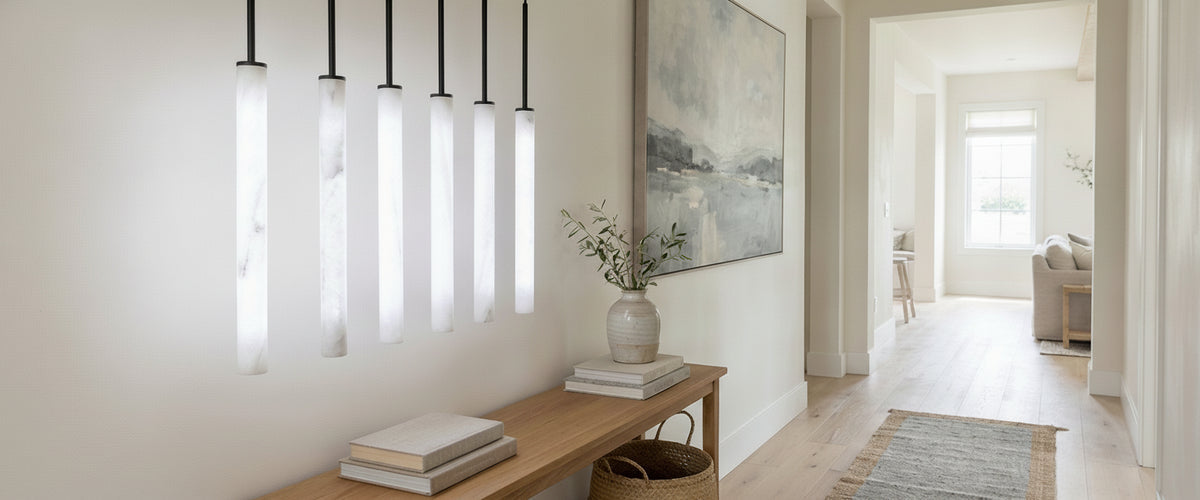

Most pendants light a room in one direction. An alabaster tube pendant lights lights it in two, and that one fact decides where it works, how high it hangs and which bulb belongs inside it. Buy it as if it were a dome or a cone and you will be disappointed. Buy it for what it actually does and few fittings are as quietly useful over a kitchen island, down a hallway or above a dining table.

Key Takeaways
- Two-way light: an open cylinder washes the ceiling and pools on the surface below, while the stone wall glows softly in between.
- Thickness matters: thinner walls glow brighter and show more veining. Thicker walls read calmer and warmer.
- Grouping changes character: one tube is a sculptural accent, a linear run is a working light, a cluster is a focal point.
- Drop height: roughly 75 to 90 cm (30 to 35 in) above a worktop, with about 2 m (6 ft 7 in) of clear headroom in walkways.
- Bulb choice: filament bulbs give sparkle and a visible hot spot. Opal soft-white LEDs give an even, lantern-like glow.

Why a Cylinder Sends Light in Two Directions
A dome pendant is a hood. It pushes almost everything downward and leaves the ceiling in shadow. A tube is open at the bottom and, on most designs, at the top as well. Light escapes through both ends, so you get a soft wash across the ceiling plaster and a defined pool on the table or worktop beneath. The alabaster wall adds a third layer: a diffused, honey-toned glow that you see from across the room.
That three-part spread is why an alabaster tube pendant light works in rooms where a single downlight feels harsh. The ceiling wash lifts the room's perceived height, the downward pool gives you enough light to chop or read, and the glowing stone gives the eye something warm to rest on. If your ceiling is dark, heavily textured or timber-clad, expect the upward component to be absorbed. The tube will then behave more like a glowing column than a room light, which can be exactly what you want in a moody dining space.
The reverse is also worth knowing. If you need a focused task light over a desk or a breakfast bar and have no interest in lifting the ceiling, a hooded shape such as the Bissi Dome Pendant Light or the narrower Astra Cone Pendant Light does that one job more directly than any tube. Choose the cylinder when you want the whole room to feel the light, not just the surface beneath it.
Stone Thickness: The Variable Suppliers Rarely Advertise
Alabaster is a fine-grained form of gypsum, soft enough to carve and translucent enough to pass light when cut thin. Every millimetre of wall changes the result. A thin wall glows bright and shows the veining in sharp relief, almost like a lit X-ray of the stone. A thicker wall lets less light through, so the cylinder reads as a softer, amber object and more of the output leaves through the open ends.
Two pieces cut from different blocks can transmit very different amounts of light even when the outside dimensions match. That matters most when you buy a run. If the tubes have slightly different wall weights, one alabaster tube pendant light can glow noticeably darker than its neighbours once the room is dark. Daylight hides the difference; a torch held against the stone, or the fitting switched on in the evening, reveals it. If you are buying more than one, ask your supplier whether they match tubes by light transmission rather than by appearance in daylight alone.
Neither thickness is better. Thin suits a lighter, more decorative glow; thick suits a calmer room where the pendant should feel solid and architectural. What matters is knowing which you are getting.
Single Pendant, Linear Run or Cluster
Grouping shifts the fitting's personality more than any other decision.
- Single tube: an accent. Over a small bistro table, at the end of a corridor or beside a reading chair, one alabaster tube pendant light acts almost like a lit sculpture. It will not light a large room on its own.
- Linear run: a working light. Two or three tubes in a line over an island or a long dining table spread the downward pools evenly. Allow space between them so each reads as its own object; crowded tubes merge into a single bright band.
- Cluster: a focal point. Several tubes hung at staggered heights from one canopy create a chandelier effect, well suited to stairwells, double-height halls and hotel lobbies. Staggering also lets each tube read as a separate object rather than a flat wall of stone.
For a cluster, think about the view from below. In a stairwell you will see straight up into the open ends, so a bare bulb becomes very visible. That links directly to the bulb question further down.
Getting the Drop Height Right
Low-Ceilinged Rooms
Period cottages and many post-war homes sit around 2.3 to 2.4 m (7 ft 7 in to 7 ft 10 in). Here an alabaster tube pendant light is often better than a dome, because the upward light brightens the ceiling instead of leaving a dark band above the fitting. Keep the suspension short and hang tubes over furniture rather than in walkways, so nobody has to duck.
Over Kitchen Islands and Dining Tables
The standard starting point is 75 to 90 cm (30 to 35 in) between the base of the tube and the worktop. Go lower over a dining table if you want intimacy, as long as the sight line across the table stays clear; go higher over an island where people stand and move. Sit down and stand up under a temporary marker before the electrician fixes anything.
Corridors and Landings
Aim for about 2 m (6 ft 7 in) of clear headroom. In a narrow hallway a slim tube is the right shape: it reads as vertical rather than bulky, and the ceiling wash makes a tight space feel less like a tunnel. On a low landing or upstairs corridor, a row of short-drop tubes keeps the headroom clear without making the ceiling feel heavy.
Filament Versus Soft-White LED Inside an Alabaster Tube Pendant Light
The same stone gives two very different glows depending on what sits inside it.
A clear filament LED creates a concentrated hot spot. Through a thin wall you will see a bright core with the veining radiating from it, which looks lively and slightly theatrical. Through a thick wall the hot spot softens to a warm blush. The risk is glare from the open ends, particularly in clusters or anywhere people look up into the fitting.
An opal or frosted soft-white LED spreads light evenly across the inside of the cylinder. The whole tube glows like a lantern, the veining reads more gently, and glare drops sharply. For most kitchens and dining rooms this is the safer choice.
Whichever you choose, stay warm: around 2700K for kitchens and 2200K to 2700K for dining and living spaces. Cooler light turns alabaster grey and chalky. Check the bulb is dimmable and that the dimmer is LED-compatible; a mismatched dimmer is a common cause of flicker. The Energy Saving Trust's lighting advice is a useful plain-English reference on LED efficiency and colour temperature.
The Four Checks to Make Before You Order
- Diameter: match it to the room and the grouping. Narrow tubes suit corridors and runs of three; wider tubes hold their own as single pieces over a table. A wider cylinder also lets more light escape from its ends.
- Grade: ask about the stone's veining, colour and wall thickness, and request photos of the actual piece lit from inside if you care about a particular look. Natural stone varies, so expect individuality rather than uniformity.
- Suspension length: measure ceiling to finished drop height, then add a margin. Confirm whether the cable or rod can be shortened on site, and by whom.
- Ceiling rose and fixing: alabaster is heavier than glass or fabric. Check the rose and the ceiling fixing are rated for the weight, and that a joist or suitable support sits where you want the light. Installation should always be done by a qualified electrician; in England and Wales new lighting circuits fall under Approved Document P of the Building Regulations.
Budget for an alabaster tube pendant light follows the same variables: the scale of the tube, the grade and thickness of the stone, the complexity of the metalwork, whether pieces need matching for a run, and installation and finishing. For a multi-pendant or contract project, request a tailored quote rather than guessing from a single fitting.
Living With Stone: Care in Two Minutes
Because alabaster is gypsum, it dislikes water. Dust the tube with a soft dry brush or microfibre cloth, and never spray cleaner directly onto the stone. Avoid hanging it where steam rises constantly, such as directly over a hob without extraction. Small surface marks are part of a natural material ageing; heavy staining should be looked at by a stone specialist rather than scrubbed.
If you are weighing up a tube against other shapes, browse the full alabaster lighting collection to compare how domes, globes and cylinders carry the same stone. At Niori, alabaster and natural stone sit at the heart of what we make, and the tube remains one of the forms we recommend most often, precisely because it does two jobs at once: it lights the room, and it gives the room something worth looking at.