
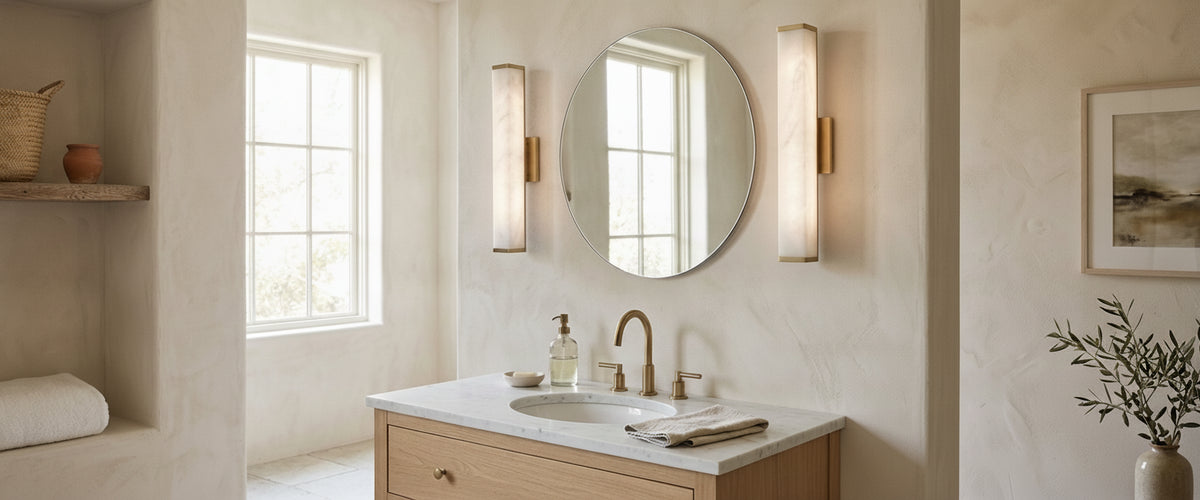

Most wall lights fail quietly. They glare from a hallway, bounce a hard reflection off a bathroom mirror, or sit on a plaster wall looking like an afterthought. Ceramic wall sconce lighting fixes more of those problems than people expect, because fired clay handles light differently from polished metal or blown glass. It also brings decisions about glaze, opacity, height and moisture that are easy to get wrong when buying online. This guide comes from a studio that works with alabaster and natural stone every day, so we will also tell you plainly when a ceramic sconce is the right call and when stone will serve the room better.

Quick Answer
Ceramic wall sconce lighting shapes light rather than glowing. Most ceramic wall lights are opaque, so they push light up and down the wall instead of lighting up from within.
Glaze changes color temperature. A glossy white glaze reads cooler and sharper at 2700K; matte, oatmeal or terracotta glazes read warmer.
Mounting height depends on the room. Roughly 5 to 5.5 ft (1.5 to 1.7 m) in hallways, a little higher in living rooms, and at face height either side of a bathroom mirror.
Bathrooms need an IP rating. Confirm IP44 or higher for any ceramic bathroom wall lights near a basin, bath or shower.
Want light through the material itself? That is where alabaster, onyx and thin translucent stone outperform clay.

How Fired Clay Scatters Light
Polished brass and chrome are mirrors: they throw back a crisp, directional image of the bulb. Blown glass lets light pass and often shows the filament or LED module as a bright point. Fired clay does neither. Its surface, even when glazed, is microscopically uneven, so light hitting it breaks up and leaves at many angles. The result is a soft, matte wash with no hot spot, which is why ceramic wall sconce lighting feels calmer at eye level than a metal shade of the same size.
The catch is that standard stoneware and earthenware are opaque. A ceramic sconce lights the wall around it, so the wall finish becomes part of the fixture. Ceramic wall sconces lighting a limewash or clay plaster wall show that wash at its best; gloss paint shows every ripple and filler patch. Thin porcelain is the exception, transmitting a faint glow when it is cast fine enough, but it rarely matches the depth you get from alabaster, where light travels into the stone and lights its veining from inside. If you love that inner glow, it is worth browsing our alabaster lighting collection alongside any ceramic shortlist, because the two materials solve different problems.
On limewash, a ceramic sconce throws an even wash above and below with no hot spot.
Glaze Finish and Opacity: Getting Warmth Right at 2700K
Glaze is the single decision that sets the mood of ceramic wall sconce lighting, and it is often treated as a color choice when it is really a lighting choice. Glazes are glass fused to the clay body at high temperature (the Victoria and Albert Museum's ceramics collection is a good place to see how much range that process allows), and each type reflects light in its own way.
Gloss white: the most reflective option. At 2700K it still looks clean and slightly cool, and it can show a bright band where the bulb is closest. Best in contemporary bathrooms and narrow corridors where you want maximum bounce, provided you keep its reflection out of any mirror.
Satin and matte white: softer reflection, no glare band, warmer read. The safest all-rounder.
Reactive and speckled glazes: pooled color and iron flecks break up the wash further. Lovely in kitchens and dining rooms; can look busy if repeated too many times along one wall.
Unglazed terracotta or bisque: absorbs more light, so output drops noticeably. It pushes the light toward amber, which suits snugs and bedrooms more than task areas.
Bulbs matter as much as glaze in ceramic wall sconce lighting. Choose a 2700K LED with a CRI of 90 or above so earthy glazes do not turn muddy, and pair it with a compatible trailing-edge dimmer. A frosted lamp, rather than a clear filament style, softens the shadow edges cast on the wall and stops a bright point showing through the openings.
Handmade Variation Is the Point
Every handmade ceramic wall light carries marks of its making: glaze thicker at one rim, a slight lean in the throw, a speckle where the iron came through. Buyers sometimes return a pair because the two pieces do not match exactly. We understand the instinct, and we see the same conversation with alabaster, where no two blocks share a vein pattern.
Decide before you order whether you want identical or related. If you are flanking a mirror or a bed, related works better than identical: the eye reads the pair, then enjoys the differences up close. If you need a strict run of eight ceramic wall sconces lighting a hotel corridor, say so when you order and ask the maker to select from one firing. Glaze color shifts more between kiln loads than between pieces from the same load.
Mounting Height by Room
Hallways and Landings
For ceramic wall sconce lighting in a hallway, mount around 5 to 5.5 ft (1.5 to 1.7 m) to the center of the fixture, and keep projection shallow so nobody clips it with a shoulder or a suitcase. Space them so the pools of light on the wall just overlap; gaps create a striped corridor. Up-and-down designs are ideal here because they light ceiling and floor at once.
Living Rooms
Living rooms are where people mount too low. Aim for roughly 5.25 to 6 ft (1.6 to 1.8 m) so the bulb sits above seated eye line and you never look into the opening from the sofa. In period rooms with high ceilings, go higher still, with ceramic wall sconces lighting the alcoves either side of a fireplace or shelving rather than floating in the middle of a wall.
Bathrooms
Beside a mirror, ceramic wall sconce lighting works best at roughly face height, about 5.25 to 5.5 ft (1.6 to 1.7 m), with the fixtures around 3 to 3.25 ft (90 cm to 1 m) apart so light falls evenly across the face. Above-mirror ceramic bathroom wall lights cast shadows under the eyes; side placement removes them. A mistake we see often: a beautiful gloss-glazed sconce placed so its reflection doubles in the mirror. Test the angle with a flashlight before the electrician fixes the backbox.
Side-mounted sconces light the face evenly and avoid shadows under the eyes.
Bedrooms
For reading, mount your ceramic wall sconce lighting 12 to 18 in (30 to 45 cm) above the top of the headboard, slightly to the outside of the pillow. Here a matte or bisque finish earns its place, because the room wants warmth rather than output.
Pairing Ceramic With Stone and Brass Without Visual Noise
Natural materials sit well together, but only if one of them leads. A matte ceramic sconce beside an alabaster pendant works because both diffuse; the stone glows, the clay washes, and neither competes for attention. That shared softness is why ceramic wall sconce lighting pairs so easily with stone. Trouble starts when you add a speckled glaze, a heavily veined marble vanity and a busy patterned tile in one sightline. Pick one textured hero per wall.
Keep metal finishes in the same family: if your alabaster ceiling light has brass detailing, use brass fixings or backplates on your ceramic wall sconce lighting too. In a farmhouse kitchen, for example, plain cream ceramic wall lights over open shelving can let a single onyx pendant above the table carry all the color and pattern. The scheme works because the sconces stay quiet. You can see how stone, brass and glass sit together across our wider lighting range.
Ceramic Outdoor Wall Lights
Taking ceramic wall sconce lighting outside comes down to the clay body. High-fired stoneware and porcelain are dense and resist frost well; low-fired earthenware and terracotta are porous and can crack after a few hard winters if water gets in and freezes. If you want ceramic outdoor wall lights, check the clay body as well as the IP rating, and look for sealed fittings with a gasket at the wall. Under a deep porch or covered terrace, the choice widens considerably.
On a fully exposed wall, where frost and driving rain make clay a gamble, it is often wiser to keep the up-and-down wash and drop the ceramic body. A sealed IP54 fitting such as the Zevi EL GU10 Up Down Outdoor Wall Light throws light along the wall above and below in much the same way good ceramic wall sconce lighting does indoors, so a front door can echo the hallway without risking a cracked shade. Against pale render, scale matters more than finish: a compact white body like the Reka 100x100 7W LED Up Down Wall Light stays visually quiet, much as a plain cream ceramic sconce would, and lets the pool of light do the work.
Can You Paint Ceramic Wall Lights?
Some are designed for it, and paint is an easy way to make ceramic wall sconce lighting blend into a wall. Ceramic paintable wall lights are usually supplied in unglazed white bisque so you can match them to your wall color or treat them as a blank canvas. Glazed pieces can be painted too, but the glaze must be keyed and primed first or the paint will peel. If the light was not sold as paintable, check the manufacturer's guidance first.
Switch off and isolate the circuit. If the light is already installed, have a qualified electrician remove it from the wall; do not paint a live fitting in place.
Lightly sand glazed surfaces with fine-grit paper, then wipe with a damp cloth and let it dry fully.
Apply a bonding primer suited to glazed ceramic. Bisque can usually take paint directly.
Use a matte wall paint, chalk paint or acrylic in thin coats. Keep paint away from the lampholder, cable entry and any interior surface close to the bulb.
Let it cure for the time stated on the can before refitting, and use LED lamps to keep surface heat low.
In bathrooms, use a moisture-resistant topcoat and accept that painted surfaces will need touching up sooner than glaze.
Before You Order: A Buyer's Checklist
Ceramic wall sconce lighting looks simple on a product page and gets complicated at installation. Confirm these points first:
IP rating. The second digit covers water. Bathrooms near a basin or shower generally need at least IP44; outdoors, aim higher where the fitting is exposed. The IEC's explanation of IP ratings is a clear reference.
Backplate size. It must cover a standard UK round or square backbox, plus any old plaster scars from a previous fitting.
Lampholder type. E14, E27, G9 or GU10 each limit your bulb choice; check the maximum wattage and whether the fitting suits dimmable LEDs.
Projection and weight. Ceramic is heavier than spun metal. Make sure the wall, especially plasterboard, can take the load with the right fixings.
Clay body and finish. Stoneware or porcelain for damp and outdoor spaces; earthenware for dry interiors.
Installation. All hardwired wall lights, and anything in a bathroom, should be fitted by a qualified electrician.
Budget for ceramic wall sconce lighting depends on material, scale, how much of the piece is made by hand, the engineering behind the fitting, and installation and finishing. For larger or matched projects, ask for a tailored quote.
When Stone Is the Better Choice
Choose ceramic wall sconce lighting when you want a quiet, matte wash and a texture that reads as handmade. Choose alabaster or onyx when you want the fixture itself to glow, when a pair needs to feel luminous rather than sculptural, or when the light is the focal point of the room. Niori works in alabaster and natural stone because that inner glow is something clay cannot reproduce, but the two materials sit together well when each does its own job. If you are planning a scheme that mixes both, our team is happy to talk it through from the Niori homepage.