
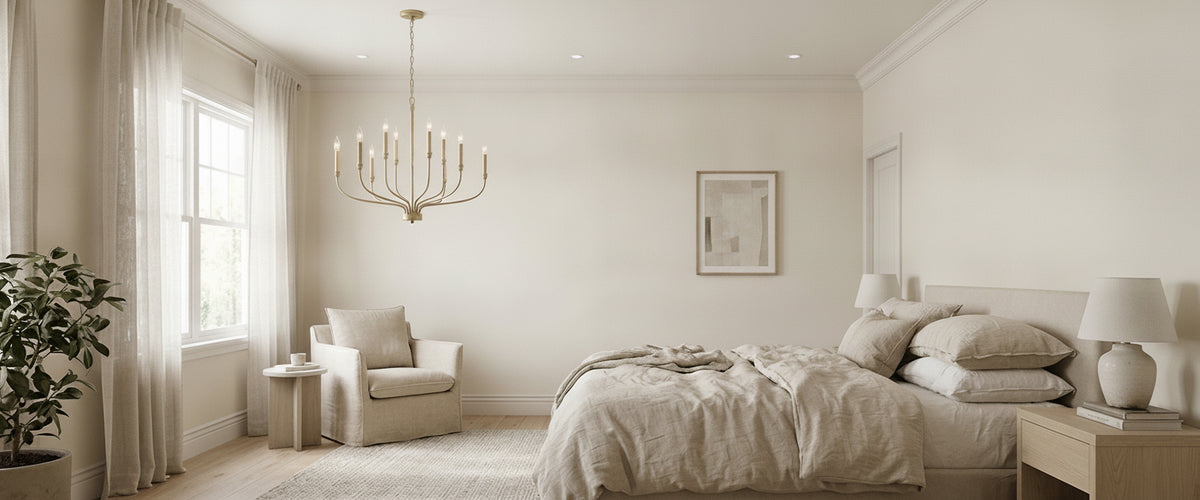

Most bedroom ceilings get a fixture screwed into the geometric center, and most bedrooms are quietly worse for it. Choosing a brass chandelier for bedroom use is one of the few decisions in the house that improves when you place the piece by eye rather than by tape measure, because the room gets used lying down, in low light, with the ceiling sitting directly in your field of view. A brass chandelier for bedroom ceilings gets judged from the pillow, not the doorway. Get the position and the dimming right and the fixture reads as jewelry. Get it wrong and you have installed a very handsome interrogation lamp above your pillow.

Quick Answer: What Makes a Brass Chandelier Work in a Bedroom
Position beats symmetry. A brass chandelier for bedroom placement can sit off-center over a seating corner, a bench at the foot of the bed, or the walkway side of the room, and that often looks more considered than dead center.
Clearance is non-negotiable. Keep at least 7 feet (about 2.1 m) of floor clearance in walking zones; over a bed you can hang lower, but never where a standing adult can meet it.
Finish decides glare. Satin and antique brass diffuse evening light. Polished, unlacquered brass throws hot specular highlights straight back at you.
Two modes, not one. A brass chandelier for bedroom use needs a bright dressing setting and a low pre-sleep setting, which means a dimmer and compatible lamps from day one.
Alabaster does the softening. Stone shades turn a bare filament into a warm, even glow, which is why so many of the pieces in our range pair brushed brass with alabaster.
Judge the fitting at close range. Canopy, chain and ceiling rose are the parts you will stare at from bed on any brass chandelier for bedroom installs. They are where cheap fixtures give themselves away.

The Bedroom Is the One Room Where a Brass Chandelier Can Hang Off-Center
Dining rooms have a table to answer to. Entry halls have a stair void. Bedrooms have neither, because the bed rarely sits in the middle of the ceiling plane and the room is read from a reclining position. That freedom is the reason a brass chandelier for bedroom use can be placed where it does the most visual work rather than where the joists happen to be convenient.
We shipped an alabaster and brushed brass chandelier to a client who was adamant it should sit dead center on the ceiling. Her electrician had already roughed in the box. Once the bed and a pair of nightstands went in, the fixture hovered awkwardly over her feet, and the reading corner by the window sat in shadow. She had the box moved about 3 feet (90 cm) toward the corner, hung the chandelier above a slipper chair and a low table, and the room finally had a focal point that was not the headboard. That is the lesson worth stealing: hang a brass chandelier for bedroom lighting over the part of the room you want people to look at.
Off-center works best when something below it justifies the position. A bench, an armchair, a round table, a bathtub in an open suite. Floating a brass chandelier for bedroom use above empty carpet just looks like the installer missed.
Over the Bed Versus Over the Room: What Each Position Does at Night
Hanging a brass chandelier for bedroom drama directly over the bed is the bolder choice and the more demanding one. It frames the headboard, gives the bed a sense of ceremony, and pulls the eye up in a room with tall ceilings. It also means every bulb, screw and dust mote sits in your line of sight while you are trying to fall asleep. If you go this route, the shades must be fully diffusing. Open flame-tip lamps pointing down over a pillow are a poor idea; carved alabaster shades or downward-facing stone discs are a far better one, because the stone scatters the light before it reaches your eyes.
Position a brass chandelier for bedroom lighting over the room instead and the effect changes entirely. The fixture becomes ambient wash rather than headline act, the bed stays calm, and the light reads as a glow at the edge of vision. This is the safer choice for smaller rooms, for beds pushed against a window wall, and for anyone who finds overhead light in the sleeping zone unsettling.
One practical note that gets ignored: think about the person who changes the sheets. A low fixture directly over a king bed makes bed-making a contortion exercise. Ask yourself whether you can flick a duvet without hitting brass.
Drop Length and Ceiling Height: Where a Brass Chandelier Earns Presence
Drop length is where good intentions collapse. The common rule of thumb, roughly 2.5 to 3 inches of drop per foot of ceiling height (about 6 to 8 cm per 30 cm), is a starting point rather than an answer for a brass chandelier for bedroom ceilings, because it assumes an empty room.
Under a standard 8 foot (2.4 m) ceiling, a brass chandelier for bedroom use needs to sit high and read as sculptural. Choose a wider, shallower form with a short stem, and think of it as ceiling jewelry rather than a hanging piece. A compact three-light frame such as the Arco 3 Light Chandelier in Brass holds its proportion in that kind of room in a way a long-chained tier never will. Long chains in low rooms crush the space and put the fixture at forehead height for anyone tall.
At 10 to 12 feet (3 to 3.7 m), a brass chandelier for bedroom schemes finally gets to breathe. Tiered alabaster chandeliers and layered arms come into their own here, as do linear forms. A piece like the Aurelian LED Layered Arms Alabaster Chandelier in Brushed Brass is built for that volume, where a longer drop brings the light down into the room instead of leaving it stranded at the ceiling. Over a bed, most designers land somewhere between 6.5 and 7 feet (roughly 2 to 2.1 m) from the floor to the base of the fixture, adjusted so it clears the mattress with obvious room to spare. In walkways, keep the full 7 feet.
Scale matters as much as height. As a rough sizing check, add the room's length and width in feet and treat that number in inches as a sensible diameter. A 12 by 14 foot bedroom points toward roughly a 26 inch (66 cm) fixture. Undersize it and a brass chandelier for bedroom use looks apologetic; oversize it in a low room and the ceiling feels like it is descending.
Satin, Antique and Unlacquered Brass in Low Evening Light
Brass is not one material with one behavior. The finish decides how a brass chandelier for bedroom use reads after sunset, which is the only lighting condition that really counts in a sleeping room.
Satin and brushed brass is the workhorse. The fine grain scatters reflections into a soft sheen, so lamps behind or beside the metal do not bounce back as hard points of light. It also hides fingerprints, which matters on any part you touch when adjusting a shade.
Antique and burnished brass reads darker and warmer, with variation across the surface. Against alabaster it looks less like new hardware and more like something inherited. A frame such as the Apollo 5 Light Chandelier in Burnished Brass suits rooms with deep paint colors and layered textiles, where this is usually the finish that settles fastest.
Polished and unlacquered brass is the risk. Polished brass creates specular highlights: small, intense reflections that catch the eye from a pillow. Unlacquered brass will patina over time as the surface oxidizes, which some buyers love and others discover with dismay six months in. If you want a brass chandelier for bedroom lighting that stays bright, choose a lacquered or protected finish and clean it gently; conservation guidance on architectural metals is clear that abrasive polishes and harsh cleaners wear away plating and coatings permanently, and that gentle methods should always be tried first (National Park Service, Preservation Brief 27).
Why Alabaster Changes What the Brass Is Doing
Brass gives structure. Stone gives the light its character. Alabaster is mildly translucent, so light entering the shade travels a short distance through the material and leaves it softened, warmed and marked by the natural veining. You get glow rather than glare, and a fixture that still looks like an object when it is switched off, which in a bedroom is most of the time.
That combination is the core of what we build at Niori. Brushed brass arms with carved alabaster discs, heritage brass frames with stone cups, linear forms for long rooms and dressing areas. If you are weighing shapes for a brass chandelier for bedroom use against your ceiling height, it helps to browse the alabaster lighting collection with the bed layout in front of you rather than shopping in the abstract.
The alabaster on a brass chandelier for bedroom duty is softer than marble or onyx and dislikes water. Dust it with a dry, soft cloth. Skip household sprays, vinegar and anything abrasive. If a shade needs more than dusting, a barely damp cloth followed immediately by a dry one is the limit.
Why a Bedroom Chandelier Needs Two Lighting Modes
Bedrooms do two jobs. Early in the day they are a dressing room, where you need enough output to judge color on fabric. Late at night they are a wind-down space, where anything above a low glow feels aggressive. A single fixed brightness cannot serve both, which is the trap most people fall into with a brass chandelier for bedroom lighting.
Specify a dimmer with the fixture, not after it. Choose lamps rated for dimming, and look for dim-to-warm LEDs that shift from around 2700K down toward 2200K as you lower the level, mimicking the way a filament or candle behaves. That warm, low-level setting matters for more than mood; evening exposure to bright, cool light suppresses melatonin and delays sleep timing, which is why warm and dim beats bright and neutral after dark (Harvard Health Publishing).
Check the compatibility of the driver and dimmer before installation, since mismatched LED drivers are the usual cause of flicker and buzzing at low levels. Any hard-wiring, dimmer change or ceiling box relocation should be done by a qualified electrician, and if the fixture is heavy the box must be rated for its weight.
Layer the rest, because brass chandeliers for bedrooms rarely work alone. A pair of alabaster wall lights flanking the headboard, or a stone table lamp on each nightstand, means you can read without switching the main fixture on at all. The broader lighting collection is worth scanning for pieces in the same brass finish so the room stays coherent.
Canopy, Chain and Ceiling Rose: The Details That Give a Cheap Fitting Away
You will look at the top of a brass chandelier for bedroom use more than you look at the top of any other fixture in the house, because you are lying beneath it. That is where quality shows.
Canopy. It should be solid metal in the same finish and alloy tone as the body, machined to sit flush against the ceiling. Thin stamped canopies flex, rattle and show a rim of shadow.
Chain or rod. Welded links with a consistent finish on every face, including the inside. Painted-on brass color wears through at the joints within a year.
Cable. Braided fabric cord or a color-matched cable, twisted neatly through the chain rather than dangling beside it.
Sockets and shade fittings. Metal, not plastic sprayed gold. Shade cups should hold alabaster without visible adhesive or gaps.
Adjustability. Chain or rod segments that can be removed on site, so the installer can dial in the exact drop your brass chandelier for bedroom ceilings needs.
Buyer's Checklist Before You Order
Measure ceiling height and mark the proposed fixture center on the floor with tape. Live with it for a day before you commit a brass chandelier for bedroom use to that spot.
Confirm the drop leaves 7 feet (2.1 m) of clearance in any walking route.
Add room length and width in feet, then use that number in inches as your target diameter.
Match the brass finish to hardware already in the room: handles, taps in the ensuite, curtain poles.
Confirm the ceiling box or mounting point is rated for the fixture weight, and have an electrician verify it.
Specify the dimmer and lamps together, and ask about driver compatibility.
Plan the second layer of light before you buy the chandelier, not after.
Ask for a tailored quote. Cost on a brass chandelier for bedroom lighting in stone depends on the alabaster itself, the scale, the metalwork, the engineering behind the fixture and the installation, so a considered figure beats a guess.
Do the placement work first and the shopping second. A brass chandelier for bedroom use is a small object making a large claim on the room, and the difference between one that looks inevitable and one that looks bolted on is almost always a decision made before anyone touched the ceiling.