
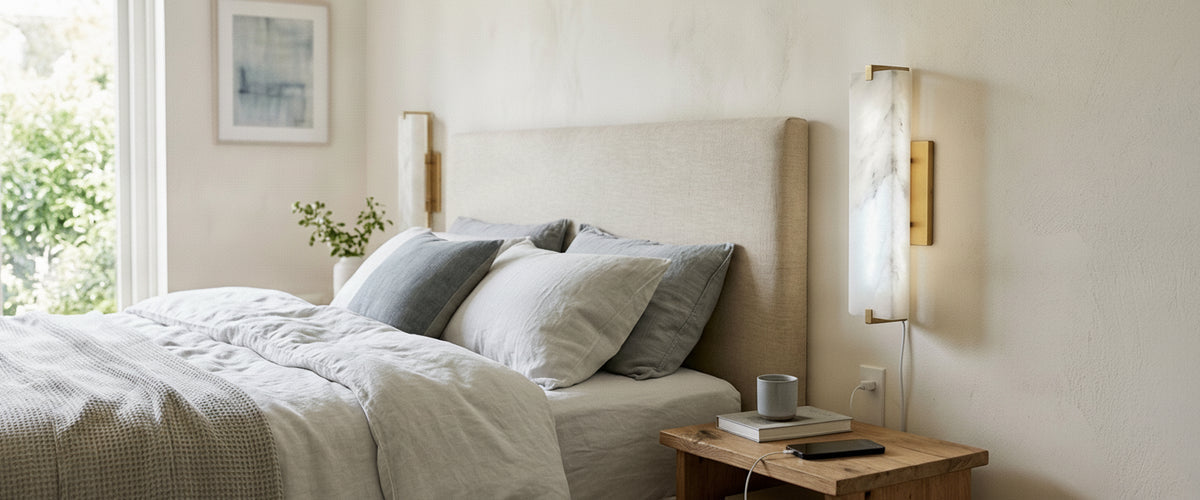

Your phone spends the night as an alarm clock, and the socket it needs is buried behind the headboard again. That is why so many people type "bedroom wall lights USB" into a search bar: they want power at arm's length without a cable snaking across the floor. A light with a built-in port earns its place when the bed hides your sockets or the bedside table has no room for a charger. The catch is a deeper backplate packed with electronics and a narrower choice of shade materials, which is why a stone or alabaster light from our bedroom wall lights range usually works better beside a separate charging point. This guide covers what the USB port really changes, from projection and wiring to light quality, and when a plain USB-C socket is the smarter buy.
Quick answer
It pays to give bedroom wall lights USB ports when the bed hides the sockets, the bedside table is small or wall-hung, or the bed floats in front of a paneled wall.
Expect a deeper backplate or a deeper back box, because the port needs its own power module.
Ask whether the USB has a permanent feed. On a switched circuit, it will only charge while the light is on.
Check that the bedroom wall lights' USB ports are USB-C. A socket below is easy to upgrade; a light with an outdated port means replacing the whole fitting.
If you want the warm, diffused glow of alabaster, pair a stone wall light with a separate charging point rather than hunting for bedroom wall lights with USB that do everything.

Why USB Moved Up to the Bedside Wall Light
The old arrangement was a double socket at baseboard height and a lamp on the table. Then the headboard got bigger. Upholstered, wall-to-wall and often fixed, the modern headboard tends to swallow the sockets behind it. Add a phone charger, a watch charger and an e-reader, and the floor turns into an extension-cord tangle that you cannot reach without climbing out of bed.
Giving bedroom wall lights USB ports was the obvious fix. The fitting already has power and already sits at arm's height. What changed is the light itself. USB bedroom wall lights need a small power converter to step mains voltage down to the 5V or more that USB delivers. That converter takes up space and produces a little heat. Both affect how the fitting is designed.

Backplate Depth and Projection Once a Port Is Inside
A plain wall light can be very slim, with its connection block tucked into a standard back box. Once you give bedroom wall lights USB electronics, the designer has two choices: make the backplate deeper or ask for a deeper box in the wall. Most do a bit of both.
Projection matters more by the bed than anywhere else. If you sit up to read, your shoulder and the back of your head sit close to the wall, and USB bedroom wall lights that stick out an extra inch or two become something you knock. Measure the headboard first. If it stands proud of the wall, the light either needs to clear the top of it or sit beside it, and the backplate should never press against upholstery.
Height follows from the bed, not the wall. For reading, the light source usually works best a little above shoulder height when you are sitting up, which often lands somewhere around 4 feet to 4 feet 7 inches (1.2 to 1.4 meters) from the floor depending on mattress height. Mark it with the bed in place. In a loft conversion we supplied in Bristol, the bed went under the eaves, and the only workable spot sat lower than the client expected; a slim bedroom wall light with an underside USB port saved them from a fitting that would have caught them every morning.
The Light Quality Trade-Off
Most USB bedroom wall lights use integrated LEDs, often with a separate adjustable reading light alongside a softer ambient glow. Done well, that is a practical combination. The reading beam can be aimed at the page without lighting up the whole room for a sleeping partner. Where one person reads while the other sleeps, a fitting with its own directed beam, such as the Nao Circular USB LED Wall Light with Reading Light in matt white, makes more sense than a single wide glow. Niori's Nao wall lights pair a USB port with a reading light in circular and rectangular forms, finished in matt white or black.
A directed reading beam and an underside port keep these lights useful and discreet beside a tall headboard.
What giving bedroom wall lights USB charging tends to cost you:
Replaceable lamps. Integrated LEDs share space with the electronics, so you replace the fitting rather than a bulb at the end of its life.
Dimming flexibility. Not every integrated driver plays well with every dimmer. Check compatibility before you buy the switch.
Shade material. There is little room for a deep stone diffuser once a power module sits in the base.
What the port does not touch is color quality. A good LED with a warm color temperature (2700K is a sensible default for bedrooms) and a high color rendering index looks the same on USB bedroom wall lights as on plain ones. Warm, low light in the hour before sleep also counts for more than many people assume; the Sleep Foundation's guidance on light and sleep explains why bright, cool light late at night works against you.
This is where alabaster earns its place. A carved alabaster shade turns a lamp into a soft, even wash with the stone's veining showing through, a quality no small opal diffuser can quite match. That stone needs space around the light source, which is why few makers give alabaster bedroom wall lights USB ports. Our preferred bedroom approach is a pair of alabaster wall lights for the glow, with charging handled separately. A medium-sized stone piece such as the Selvara LED Medium Alabaster Wall Light in brushed brass does the atmospheric work beside the bed, and a USB socket or a slim USB reading light handles the phone. The alabaster lighting collection is the place to see how different stone shades handle the same warm source.
Stone for the glow, a separate USB-C socket for the phone.
Which Bedroom Layouts Genuinely Need a Built-In USB
Fitting bedroom wall lights with USB makes sense in fewer rooms than the marketing suggests. They earn their place in these:
Full-width or fixed headboards that cover the original sockets.
Floating or wall-hung bedside shelves with no room for a plug-in charger.
Paneled or limewashed feature walls where you would rather not cut a socket into the finish.
Guest bedrooms, vacation rentals and hotel rooms, where guests should find the charger without being told. A Cotswolds guest-house refurbishment we supplied went this way purely because the owner was tired of finding adapters left behind.
Compact rooms where the bed meets the wall on one side and only a wall light fits.
In most homes, bedroom wall lights' USB ports are a convenience rather than a necessity. If you have a proper bedside table and a reachable socket, a USB-C socket mounted just above the table is usually the better buy. It costs less to swap when charging standards move on, and it frees you to choose the wall light purely for its light and material.
How the USB Slot Reads When the Light Is Off
By day, USB bedroom wall lights are objects on the wall, and the port is a small plastic slot that does not care how carefully you chose the finish. Where it sits matters. Designers who give bedroom wall lights USB slots on the underside get it right, because an underside port all but disappears; a port on the face of the backplate is visible from across the room.
Match the finish to the wall, not to the bedding. Matt white fittings on pale walls let the port recede. Matt black reads crisp against deep colors such as ink blue or olive, and on a dark wall a squarer profile like the Nao Rectangular USB LED Wall Light with Reading Light in black holds a clean line against the headboard. In the studio, though, we have noticed black shows scuffs around the port quickest, since that is where fingers fumble in the dark. Brushed brass ages well but makes a black or white port more obvious by contrast. If the fitting is in stone, the port is better placed on a separate faceplate so the alabaster stays untouched by hardware.
How to Choose: Decision Criteria
When shortlisting, judge the bedroom wall lights' USB specification as closely as the finish.
Port type and output. Look for USB-C and enough output to charge your phone at a reasonable speed.
Permanent or switched feed. Decide whether you want to charge overnight with the light off. Most people do.
Projection against headboard height. Confirm clearance with the bed in position.
Reading light control. Separate switching for the reading beam and the ambient light is worth having.
Dimming. Check driver and dimmer compatibility in writing.
Material priority. If the glow of stone matters most, separate the charging from the light.
For the wider picture, including pendants and table lamps that share the room, the full lighting collection is the place to compare styles side by side.
What Your Electrician Needs to Know Before Installation Day
Fixed wiring is a job for a qualified electrician, not a weekend project. Work should comply with BS 7671, the IET Wiring Regulations, and some jobs, particularly new circuits, may be notifiable under Part P in England and Wales. Your electrician will advise.
Send them this checklist before first fix:
The exact fitting and its installation instructions, including any required back box depth.
Whether your bedroom wall lights' USB ports need a permanent live in addition to the switched live. This is the detail most often missed.
Your chosen mounting height and center lines, measured from the bed in position.
Headboard dimensions, so cable entry points are not hidden behind it.
Switching plan: two-way from the door and the bed, and whether each side switches independently.
Dimmer model, so it can be checked against the LED driver.
Wall finish timing. Cables and boxes should go in before plastering or paneling.
Get those right and giving your bedroom wall lights USB charging becomes one of those quiet improvements you stop noticing within a week. Get them wrong and you are charging your phone with the lights on. If you are planning a bedroom around stone, warm light and fewer cables, Niori's team can help you choose fittings and request a tailored quote for larger projects.