
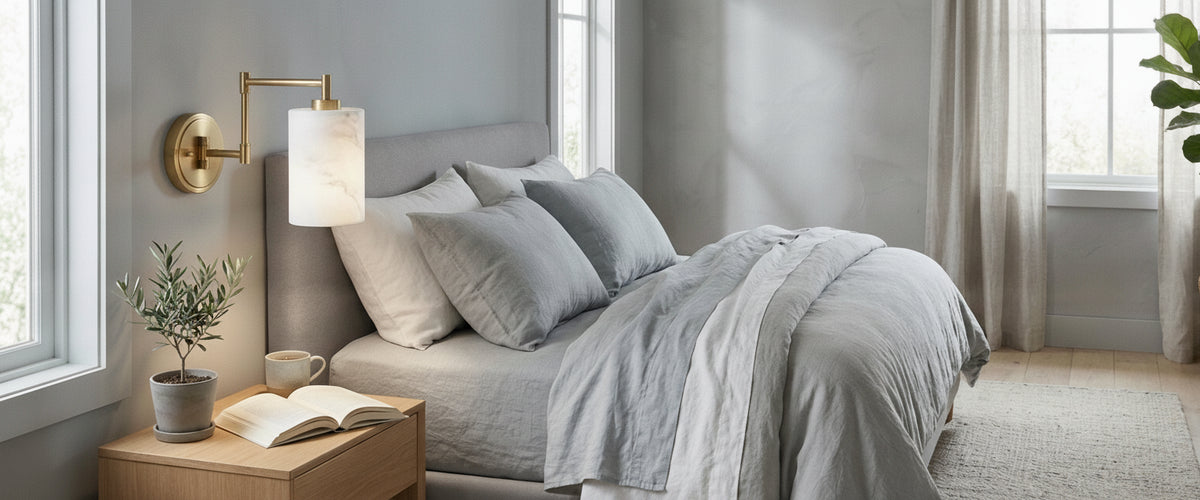

Most bedside lights fail at the exact moment you need them. You turn a page, shift onto one elbow, and the light lands on the duvet instead of the book. An adjustable wall sconce fixes that with one movement of the wrist, but only if it is mounted at the right height, has enough reach and holds the right bulb. Get those wrong and you have a hinged fixture you never touch. At Niori we spend most of our time with alabaster and natural-stone lighting, and most of the questions we get about directional wall lights trace back to the same few mistakes. This piece covers how to avoid them.

Key Takeaways
- Height first: for reading in bed, the light source usually sits around 20 to 24 inches (50 to 60 cm) above the top of the mattress, not at eye level when standing.
- Reach matters more than pivot angle: the arm has to bring the light over the page, not just tilt toward it.
- Warm and shielded beats bright: a 2700K bulb that is hidden from the eye will outperform a brighter, cooler one.
- Plan the cable before the wall is finished: a hard-wired install almost always looks better than a plug-in one, and it needs a qualified electrician.
- Dimming turns a task light into a night light: check that bulb, driver and dimmer are compatible before you buy.

What a Fixed Wall Light Cannot Do
A fixed sconce throws its light where the maker decided it should go. That suits a hallway or the space either side of a mirror. Beside a bed or armchair it is a compromise, because the person reading moves and the light does not. Lean back and you are in your own shadow. Sit up and the glare catches the corner of your eye.
An adjustable wall sconce handles both with a swing or a tilt. One fitting covers the late-night chapter, the morning coffee and the moment you need to find a dropped earring under the bedside table. That flexibility is why they are so common in hotel rooms: the guest gets a proper task light without a lamp eating up the bedside surface.
There is a trade-off. A fixed alabaster sconce gives a soft, even glow across the wall that a directional fitting cannot match, because the stone diffuses light through its whole body rather than pushing it in one direction. The most comfortable bedrooms tend to use both: a fixed alabaster wall light for ambient warmth and an adjustable one for reading. If you want to compare the diffused side of that pairing, the alabaster lighting collection shows how differently stone handles light from a metal shade.
Adjustable Wall Sconce Height and Horizontal Position
The most common error we see is mounting an adjustable wall sconce at standing eye height, around 5 feet (1.5 m) off the floor, because that is where wall lights usually go. For reading, that is too high. The light comes from above and behind your head, and your own skull throws a shadow across the page.
For a bed, measure from the top of the mattress rather than the floor, since mattress and bed-base heights vary a lot. A light source roughly 20 to 24 inches (50 to 60 cm) above the mattress usually lands just above shoulder height when you sit against the headboard. Tall upholstered headboards push that up a little; the sconce needs to clear the top edge so the arm can swing without scraping fabric.
Beside an armchair, aim for the light to sit slightly above and to the side of the seated shoulder, often around 48 inches (122 cm) from the floor depending on the chair. Sit in the chair, hold a book where you normally would, and have someone mark the wall. Ten minutes of this saves a lot of filling and repainting.
Horizontally, the backplate generally sits a few inches outside the edge of the headboard or chair, so the arm reaches inward over the reader rather than starting directly behind them. For a double bed, mirror the positions exactly; uneven sconces read as a mistake from the doorway even when they work fine in bed.
Pivot Range Versus Arm Reach
Spec sheets for an adjustable wall sconce list two separate things that buyers often confuse. Pivot range tells you how far the head tilts or rotates. Arm reach tells you how far the light can move away from the wall. A head with a generous tilt on a short arm still only lights the wall beside you.
For an adjustable wall reading lighting beside a bed, reach is what lets you bring the light over the page while the backplate stays outside the headboard. Swing-arm designs with an elbow joint give the most control. Short-neck fittings, like a dome head on a compact pivot, suit tighter spots: narrow bedside alcoves, or shelving above a desk where the light only needs to angle down a few degrees. Where a long arm would only get in the way, a compact dome such as the Tessa Dome Adjustable Wall Light in matt black makes more sense than a full swing-arm.
Check two practical things in person or with the supplier. First, whether the joint holds its position without drifting down over a few weeks; cheap friction joints sag. Second, whether the arm folds flat against the wall when not in use. A protruding arm at head height is the kind of thing guests walk into at 2 a.m.
Bulb Type and Colour Temperature Matter More Than Wattage
In an adjustable wall sconce, the bulb is closer to your eyes and aimed at a bright white page, so its quality shows up far more than in a ceiling light. Wattage tells you very little with LEDs. Look at lumens for output, colour temperature for warmth and the colour rendering index (CRI) for how true colours look.
For bedrooms, 2700K is our default. It sits comfortably next to the honeyed tone alabaster gives off, and it is easier on the eyes late at night. A cooler 3000K reading light beside an alabaster sconce can make the stone look slightly grey by comparison; at 2700K the two read as one warm scheme. For a study or a reading chair used in daytime, 3000K is reasonable. Above that, rooms start to feel clinical after dark. The Lighting Research Center has published extensively on how light spectrum and timing affect alertness, which is worth knowing if you read right before sleep.
Shielding is the other half. The bulb should sit recessed inside the shade so you see the lit page, not the glowing source. Many reading lights with integrated LEDs handle this well because the module is built into the head. Where one fitting has to give both a general wall glow and a focused beam for the page, a design like the Nao Circular LED Wall Light with Reading Light in matt white does both jobs far better than a single exposed bulb. If the fitting takes a replaceable bulb, check the shade depth before you choose one with a long glass envelope that pokes out.
Cable Management and Backplate Depth
This is where installs look either finished or improvised. A hard-wired adjustable wall sconce, with the cable buried in the wall and terminated behind the backplate, disappears into the room. A plug-in version with a fabric cord running down to a socket can look intentional in a rented flat or a period room where chasing walls is off the table, but it needs to be planned: a straight vertical drop, a cord colour that suits the wall and a socket placed so the cable does not loop.
Backplate depth matters more than people expect. The backplate has to house the connection and sit flush to the wall without a visible gap. On uneven plaster in older UK houses, a slim backplate can rock or leave a shadow line along one edge, so the wall may need making good first. Integrated models with a USB port or a built-in switch carry more inside the plate, which makes neat fixing even more important. If bedside charging is on your list, a fitting such as the Nao Rectangular USB LED Wall Light with Reading Light is worth planning for at this stage, while there is still time to prepare a flat wall for the plate to sit against.
Weight is the final check. An arm held out from the wall creates use on the fixings. Metal reading lights are relatively light, but natural-stone and alabaster wall lights are heavier, and stone should never hang from a plasterboard plug alone. Any hard-wired installation should be done by a qualified electrician, who can also confirm the fixing method for your wall type and whether the work falls under building regulations.
Dimming Changes the Sconce's Whole Role After Dark
At full output, an adjustable reading wall light is a task lamp. Dimmed to a fraction of that, angled toward the wall, it becomes a soft night light that lets one person read while the other sleeps, or guides you to the door without flooding the room. That second role is what makes a dimmable adjustable wall sconce worth paying attention to.
Dimming is also where compatibility trips people up. Integrated LED fittings use a driver, and that driver has to work with the dimmer on the wall; mismatches cause flicker, buzzing or a light that jumps from low to off. If the sconce takes a replaceable bulb, the bulb itself must be marked dimmable. Ask your electrician to check the full chain before installation rather than after.
How to Choose an Adjustable Wall Sconce: Decision Criteria
- Room and use: bedside reading needs reach and a shielded source; a desk or shelf may only need a tilting head.
- Arm type: swing-arm for flexible reach, compact pivot for tight alcoves.
- Light source: integrated LED for a slim head and low maintenance, replaceable bulb if you want control over warmth later.
- Extras: built-in switches and USB charging save a trip to the socket beside the bed.
- Finish: matt black reads graphic against pale walls; matt white recedes; brass adds warmth. Consider how it sits beside any alabaster or marble fittings in the same room.
- Budget: cost depends on material, engineering of the joint, installation and finish. For stone or bespoke pieces, request a tailored quote.
For the wider picture, including pendants and table lamps that can share the work, look through the full lighting range before settling on the wall fittings.
Installation and Care Checklist
- Sit or lie in the reading position and mark the wall before any drilling.
- Measure bed heights from the mattress top, not the floor.
- Confirm the arm clears the headboard and folds back flat.
- Agree cable routing and switch position with a qualified electrician at the planning stage.
- Check dimmer and driver compatibility.
- Use fixings rated for the fitting's weight and your wall type.
- Dust metal heads with a dry microfibre cloth. Keep alabaster dry and away from cleaning sprays: the stone is soft, as Britannica's entry on alabaster notes, and water can mark its surface.
- Recheck that the joint holds its angle after a month and tighten if needed.
One of the most common fixes at the snagging stage of hotel and residential projects is the same one: rooms are beautifully finished, but the reading lights have been hung to line up with the ambient wall lights rather than with the people using them. Dropping them by a few inches makes the difference obvious the moment someone sits in bed. Placement is the whole job. Get the height, reach and bulb right, and an adjustable wall sconce becomes the light you reach for every night.