
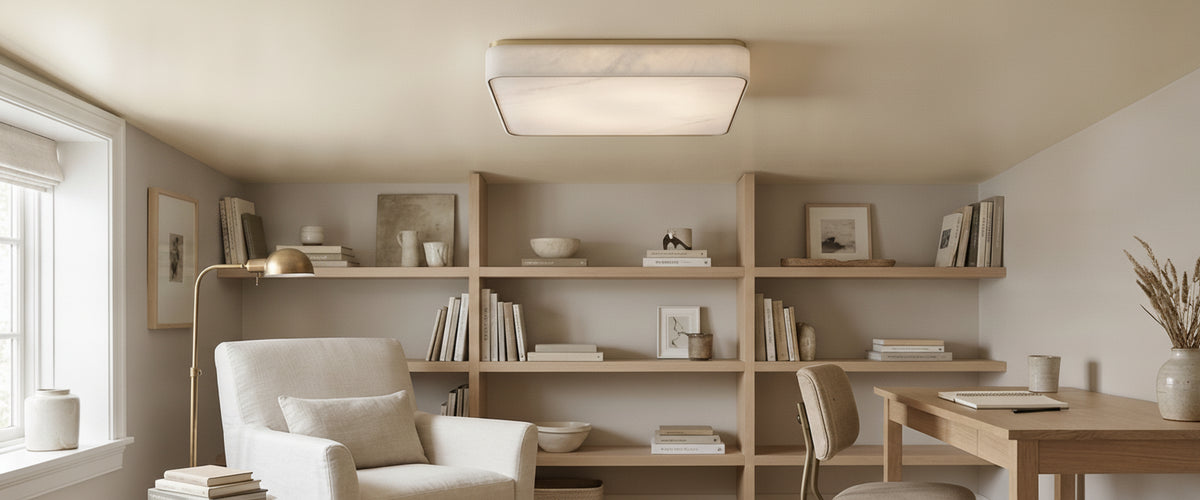

Most disappointing ceiling lights are bought from a photograph taken at eye level. You see the stone, admire the veining and order. Then it goes up, and from two metres below it looks like a flat, glowing disc with none of the character you paid for. An alabaster flush mount is one of the most rewarding fittings for a low or modest ceiling, but it asks more of the buyer than a pendant does. The stone sits tight to the plaster, you only ever see it from underneath, and every choice about thickness, veining and bulb shows up directly in the light.
Key takeaways
- A flush fitting shows only one face of the stone, so the veining has to work in plan view.
- Thicker stone gives a warmer, slower glow. Thin discs pass more light but can look uniform.
- Warm bulbs and proper dimming are what stop alabaster reading as plastic.
- Check diameter against the room footprint before you look at finishes.
- Dense veining and clear stone produce very different moods, even at the same size.

Why an Alabaster Flush Mount Reads Differently From a Pendant
A pendant hangs in open air. You catch it from the side as you walk past, light leaks from the top and bottom, and the stone has edges and depth you can read. Press that same material against a ceiling and most of those cues disappear. The light now comes from one face only, the stone has no shadow side, and the plaster around it becomes part of the composition.
That changes how veining reads. On a pendant bowl, veins wrap around a curve and stretch with perspective. On an alabaster flush mount, they sit flat, almost like a map seen from below. Strong diagonal veins can look graphic and deliberate. Faint, scattered marks can vanish entirely once the bulb is on. It is worth asking to see the underside of the specific piece, lit, before you commit, because that face is the only one you will live with.

Thick Slab or Thin Disc: How Depth Shapes the Light
Alabaster is a fine-grained form of gypsum, and its translucency drops quickly as the stone gets thicker. That is the whole game with an alabaster flush mount.
A thin disc lets more light through and spreads it evenly across the room below. It is efficient, but the even glow can flatten the stone into a single tone, especially with a bright bulb. A thicker slab holds the light back. The edges stay darker, the centre glows honey or cream, and the veining shows as depth rather than surface pattern. You lose some output and gain atmosphere.
In the studio we test this by holding offcuts of different thicknesses over the same lamp. The thin pieces look clean and bright. The thick ones look like they are lit from inside. Neither is wrong; they suit different rooms. A hallway that needs real working light leans thin. A bedroom or dining room where the fitting is the main ambient source often looks better with more stone.
Ceilings Where a Flush Alabaster Ceiling Light Thrives
The obvious home for a flush alabaster ceiling lights is the standard 2.4 metre (about 8 foot) ceiling found in so many UK houses and flats, where a pendant would put heads at risk. Victorian terraces with lowered kitchen ceilings, loft conversions, cottage bedrooms and narrow Georgian landings all fit here. The fitting sits out of the way and the stone still adds warmth that a plain opal diffuser never manages.
Smooth, light plaster helps. The glow bleeds slightly onto the surrounding ceiling and creates a soft halo, which is half the appeal. Where things go wrong:
- Very high ceilings. At three metres and above, a flush disc shrinks to a dot and the veining is lost. A chandelier or pendant suits that volume far better.
- Dark or heavily textured ceilings. Deep colours absorb the halo; artex or rough finishes break it up.
- Sloped ceilings. Most flush fittings are designed for level mounting. Check before ordering for a pitched loft.
- Ceilings crowded with downlights. A grid of spots will out-shine the stone and make it look decorative rather than useful.
Bulbs and Dimming: Stopping the Glowing Plate Effect
The phrase we hear most from people unhappy with an alabaster flush mount is that it looks like a lit plate. Nine times out of ten the bulb is the cause.
Alabaster already shifts light towards warm cream. Put a cool 4000K bulb behind it and the stone turns grey and chalky. Stick to around 2700K, or 2200K to 2400K if you want candlelight warmth in a bedroom or dining room. Bulbs with a high colour rendering index (CRI 90 or above) keep the subtle amber and rust tones in the veining from turning muddy.
Output matters too. Overpowering a thin disc washes out the pattern. Choose a bulb that gives enough light for the room and then use a dimmer to find the point where the stone glows rather than glares. That usually sits well below full brightness. Make sure the LED lamp is marked dimmable and the dimmer is LED-compatible, or you will get flicker and buzz that no amount of beautiful stone can hide.
Diameter Versus Room Footprint: The Measurement Most Buyers Skip
People choose finish, then stone, then diameter, almost as an afterthought. It should be the other way round. An undersized alabaster flush mount in a generous room looks timid, and an oversized one in a small bedroom feels like a lid.
A useful starting rule: add the length and width of the room in feet, and treat the total as a rough diameter in inches. A room of 12 by 14 feet (about 3.7 by 4.3 metres) points towards a fitting of around 26 inches (66 cm). Stone ceiling lights rarely come that large as a single disc, so in bigger rooms consider two matching fittings, or let the flush light anchor the space while wall lights and lamps carry the rest. For that supporting layer, a fitting that works on both wall and ceiling, such as Vetra 1 Light Opal Glass Wall/Semi-Flush Ceiling Light, Gold, keeps a warm metal finish and a soft diffused glow at eye level without competing with the stone overhead. Masking-tape a circle of the intended size on the ceiling before ordering. It takes five minutes and saves a lot of second-guessing.
Dense Veining or Clear Stone?
Two alabaster flush ceiling lights of the same size, same bulb and same room can feel like entirely different fittings. Clear, lightly marked stone gives a calm, even glow that suits minimal interiors, bathrooms (with an appropriately rated fitting) and spaces where the ceiling should recede. Densely veined stone acts more like a piece of art overhead. It throws less light, pulls the eye upward and gives a room a warmer, more layered character.
One client fitting out a rented-to-owned flat in Edinburgh ordered two fittings for a hallway and a living room, both from the same block of stone. Once installed, the hallway piece read almost white while the living room piece showed broad smoky bands. Same quarry, very different personalities. Because alabaster is natural, no two pieces match exactly, and that is worth embracing rather than fighting. If you need consistency across several rooms, say so when ordering so pieces can be selected together. Browsing the full alabaster lighting collection side by side is a quick way to see how much the stone varies from fitting to fitting.
Buyer Checklist Before You Order
- Ceiling height. Ideally under about 2.7 metres for a true flush fitting; higher than that, a semi-flush design such as Arc Semi-Flush Ceiling Light, Gold & White, which brings the light source down from the plaster, or a pendant will hold its presence better.
- Room footprint. Work out the target diameter first, then shortlist.
- Role of the light. Main working light favours thinner stone; mood light favours thicker.
- Veining preference. Ask to see the underside, lit if possible.
- Bulb plan. Warm white, high CRI, dimmable, with a compatible dimmer.
- Metalwork. Brass rims warm the stone; darker finishes frame it more sharply. Match to existing switches and hardware.
- Weight and fixing. Stone is heavy. Confirm the ceiling can take a secure fixing into a joist or a suitable support.
- Budget. Cost depends on stone size, thickness, carving, metalwork and installation. Request a tailored quote rather than guessing.
Installation and Long-Term Care
An alabaster flush mount carries more weight than a glass equivalent, and it hangs directly over people. Always use a qualified electrician. In England and Wales, new lighting circuits and some work in kitchens and bathrooms fall under Approved Document P of the Building Regulations, and a registered installer can self-certify the work. Ask them to fix into a joist or a proper support bracket rather than plasterboard alone.
Alabaster is soft and dislikes water. Dust it with a dry, soft brush or microfibre cloth, switch the light off and let it cool first, and never use sprays, polishes or damp cloths, which can mark the surface permanently. In a steamy bathroom, check the fitting's IP rating and position carefully. Treated with that small amount of care, the stone will last for decades and gently mellow in tone.
Niori specialises in alabaster and natural stone, so we see a lot of ceilings, good and bad. The fittings that look best years later are the ones chosen for the room in front of the buyer, not the photo on the screen. If you are still weighing a flush stone light against a pendant or wall lights, our broader lighting range makes it easier to plan the whole room at once.