
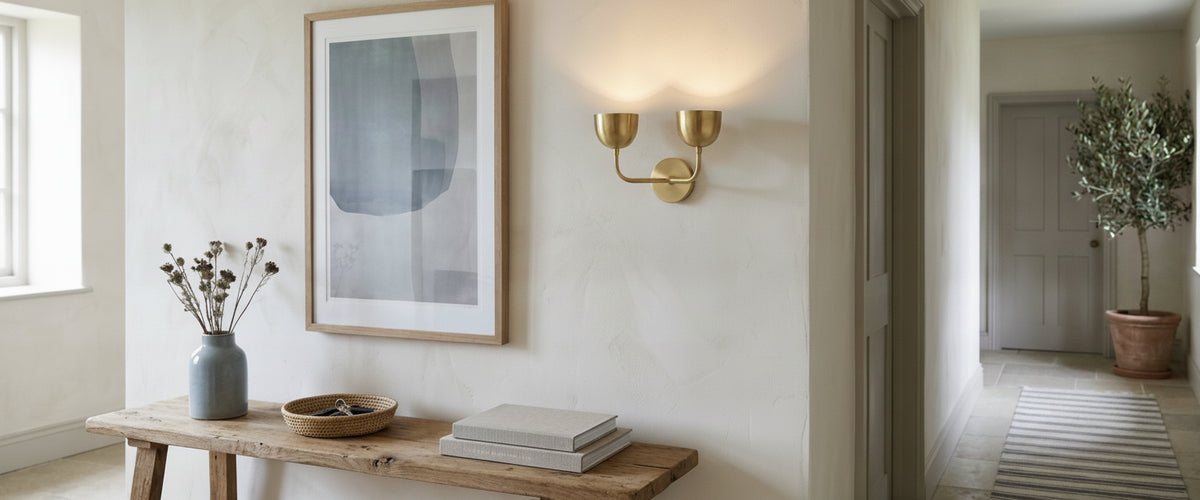

Two bulbs on one backplate sounds like double the light. In practice it gives a different shape of light altogether, and most of the disappointing installations we hear about come from treating a 2-light modern brass wall light as a single lamp with a spare. The pair changes how shadows fall and how the wall itself is lit. It also changes what your electrician needs to know before the first hole is drilled.

Quick Answer: Choosing a 2-Light Modern Brass Wall Light
Two sources soften shadows and wash a wider band of wall, which suits hallways, beds and mirrors far better than a single cone of light.
Modern brass reads warmer and cleaner than antique brass; pick the finish against your wall colour, not in isolation.
Arm spread matters more than overall size. The gap between the two lamps should relate to whatever sits beneath or between them.
Buy matched bulbs of the same make, wattage and colour temperature, and check your dimmer's minimum load.
Confirm backplate depth and mounting centres against the box in your wall, and use a qualified electrician for the connection.

Why Two Points of Light Behave Differently
A single wall light throws one pool of light and one set of shadows. Put two lamps a short distance apart and each one fills the shadow the other casts. Faces look softer, a framed print loses its hard drop shadow, and the wall gets an even horizontal band of glow rather than a bright hotspot fading to grey.
That overlap is the whole point of a 2-light modern brass fitting. It also explains why the shade matters so much. Open brass cups throw crisp light up and down in two distinct scallops. Fit the same arms with alabaster or etched glass diffusers and the two sources merge into a broad, low-contrast wash, because the stone scatters light through its own thickness rather than letting it escape in a beam. In a narrow corridor that difference decides whether the wall looks lit or merely marked.
Alabaster diffusers merge two sources into one soft band of light.
Modern Brass Versus Antique Brass: Warmth Before You Switch On
Brass sets the temperature of a room before any bulb is lit. A satin or brushed modern brass has a pale, slightly lemony warmth and a fine directional grain that catches daylight as a soft sheen. Antique brass is darkened chemically to a deeper honey or bronze tone, so it recedes on the wall and reads older and heavier.
Neither is better. A modern brass wall lights against chalky off-white or pale plaster looks crisp and architectural. Against a deep green or oxblood wall, antique brass often sits more comfortably, because bright modern brass can look brassy in the unflattering sense when the background is dark and saturated. Where you want the warmth of brass without the whole fitting reading gold, a two-tone finish helps: on a piece such as the Stealth 6 Light Wall Light in Brass & Black, the matt black frame keeps the brass as an accent, which suits graphic, pale-walled schemes particularly well. We generally suggest holding a finish sample against the wall at the time of day you use the room most. North-facing hallways in particular can make bright brass look cooler and greener than it does in a studio photograph.
Brass is an alloy of copper and zinc, and an unlacquered surface will slowly darken and develop patina when exposed to air and skin oils, a process the Copper Development Association covers in its notes on the metal. Lacquered finishes hold their colour far longer. Decide which behaviour you want before buying, because you cannot easily convert one into the other later.
If you want brass detailing with a softer glow, our alabaster lighting pairs the metal with natural stone shades that take the edge off it and turn two sources into one continuous warm surface.
The Spacing Problem: Considered Pair or Accident?
A 2-light modern brass fitting looks intentional when its spread answers something in the room. Over a console table, the arms should land roughly within the table's width so the light frames the surface. Above a headboard, the lamps should sit comfortably inside the line of the bed. When the spread bears no relation to anything, the fitting looks as though it was ordered from a photograph and hung where the cable happened to be.
Watch the arm length too. Short arms keep both lamps close to the backplate and produce a tight, punchy pool. Longer, swept arms spread the light wider but need more clear wall either side. A useful test: tape two paper circles to the wall at the exact lamp positions and live with them for a day. It sounds fussy, but it is the quickest way to catch a fitting that is correct on paper and wrong in the room.
Hallway, Bedside and Bathroom: The Sightlines That Decide Placement
Hallway Column
In a long hall, you see wall lights edge-on as you walk towards them, so the profile counts as much as the front view. A common mistake with 2-light modern brass fittings in a narrow terrace hallway is mounting them at eye level, where the bulbs are visible from the front door and the whole space glares. Raising them to around 180 cm (about 5 ft 11 in) and switching to diffused shades usually solves it. As a rule, keep the lamps just above the eye line of whoever is coming in. In a very narrow hall where projecting arms would catch shoulders and coats, a semi-flush fitting such as the Galaxy 3 Light Semi-Flush Ceiling & Wall Light keeps the brass close to the surface and is often the more practical choice.
Mounted around 180 cm, the bulbs stay out of the line of sight from the front door.
Bedside Alcove
Alcoves either side of a chimney breast are a natural home for a pair of two-light fittings, but in a tight recess the two lamps can light the alcove walls more than the room. Choose a slimmer spread, and set the lamps high enough to clear your head when sitting up in bed, typically somewhere between 120 and 150 cm (roughly 4 to 5 ft) from the floor depending on mattress height. If the recess is too shallow for a wall fitting at all, or rewiring is not on the cards, an adjustable lamp such as the Funk Adjustable Table Lamp in Matt Black & Brass can be angled onto a book without spilling across the pillow, and keeps the same brass language as the rest of the room.
Bathroom Mirror
A single light directly above a mirror casts shadows under the eyes and chin. A 2-light modern brass fitting mounted horizontally above the glass is better, and a pair flanking the mirror at face height is better still. Bathroom placement falls under the zone system in the UK Wiring Regulations, so check the IP rating against the zone with your electrician; IP44 is the rating most commonly specified for fittings in zones 1 and 2.
Bulb Pairing and Dimming on a Two-Lamp Circuit
Flicker on a two-lamp fitting almost always comes down to the bulbs or the dimmer rather than the fitting itself. LED lamps from different makers, or even different batches of the same model, use different internal drivers. On a shared dimmer they respond to the same signal at slightly different speeds, which shows up as shimmer at low settings or one lamp dropping out before the other.
The fix is dull but reliable: buy both bulbs together, same brand, same wattage, same colour temperature. For stone and brass we usually suggest 2700K, which keeps alabaster honeyed rather than chalky. Then check your dimmer's minimum load. Two 4W LEDs give a total of 8W, which is below the minimum load of many older dimmers designed for halogen. A modern trailing-edge LED dimmer rated for low loads usually cures the buzz and the flicker in one go.
Backplate Depth, Mounting Centres and UK Wiring Details
Before ordering any 2-light modern brass wall light, ask three questions. How deep is the backplate, and will it cover the box already in your wall? What are the mounting centres, meaning the distance between the fixing holes, and do they line up with your existing box or will a new one be needed? And is the fitting Class I (needing an earth) or Class II (double insulated)?
Slim modern backplates sometimes leave little room for connectors, which matters if your wall box is shallow or the plaster is uneven. New circuits and most electrical work in a bathroom are notifiable under Part P of the Building Regulations, and any installation should meet BS 7671. Use a qualified, registered electrician for the connection, even if you are confident putting up the bracket yourself.
Buyer's Checklist Before You Order
Finish sampled against your wall in real daylight, lacquered or unlacquered decided.
Arm spread measured against the table, bed, mirror or doorway it serves.
Shade choice confirmed: open brass for direction, alabaster or glass for an even wash.
Mounting height chosen for the main sightline, not just the floor plan.
Two matched bulbs ordered together, colour temperature agreed.
Dimmer type and minimum load checked.
Backplate depth, mounting centres and earth requirement shared with your electrician.
IP rating confirmed for any bathroom zone.
If you are planning a whole scheme, it helps to see wall lights alongside pendants and table lamps in the same finishes; our full lighting collection makes it easier to keep brass tones consistent from room to room. Niori designs alabaster and natural-stone lighting with brass detailing for homes, hotels and design projects, and for larger or bespoke specifications we are always happy to prepare a tailored quote.