
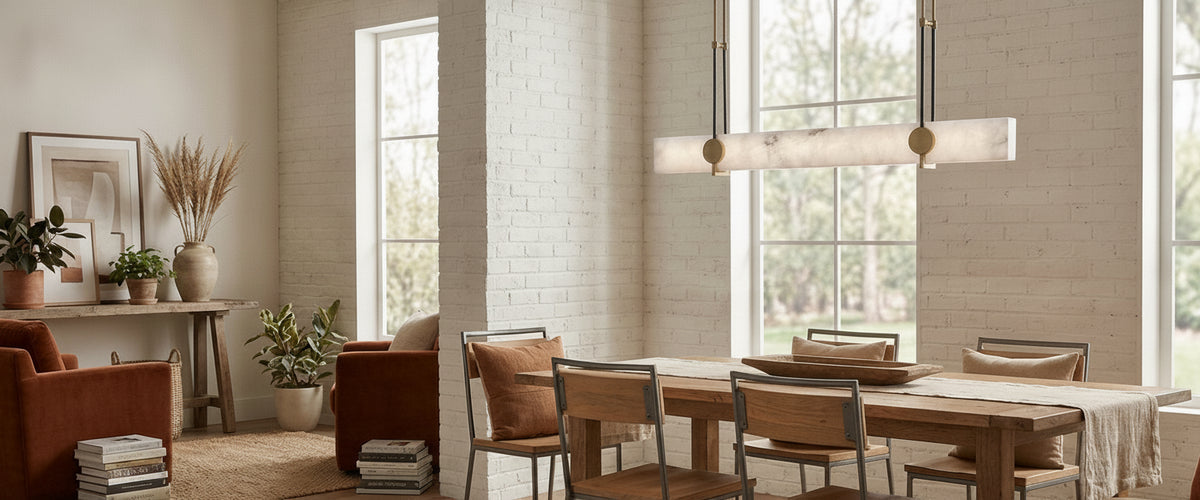

Most industrial dining rooms fail at about half past eight in the evening. In daylight the blackened steel pendants, the exposed brick and the reclaimed table look sharp and considered. Once the plates come out and the overheads are the only source of light, the room turns flat, glary and faintly canteen-like. An industrial dining room needs lighting that keeps its raw honesty and still flatters faces, food and a second bottle of wine. That balance is a craft, and most of it comes down to arithmetic, metal choice and colour temperature.
Key Takeaways
- Industrial is about honest construction, not a catalogue of cage bulbs and pipe fittings.
- Table surface changes everything: bare steel reads warm over oak and clinical over pale marble.
- Hang pendants roughly 70 to 85cm (28 to 33in) above the tabletop and space them evenly, leaving clear distance at each end of the table.
- Two metals is comfortable, three needs a rule, such as one dominant finish and two accents.
- Warmth comes from bulbs at 2700K or lower, dimming and a diffused source, which is where alabaster earns its place.

What Industrial Actually Means in an Industrial Dining Room
Strip away the clichés and industrial design is about visible construction. You can see how the fitting is made: the rivet, the folded edge, the cable running from ceiling rose to shade. Materials are left close to their natural state, with steel showing its mill scale, brass allowed to dull and stone left with its veining intact. The style grew out of converted warehouses, mills and workshops, many of them now protected as part of Britain's industrial heritage, and the original buildings were lit for work rather than atmosphere.
That last point matters. A factory pendant was designed to throw hard, downward light onto a workbench. Put six of them over a dining table and you have recreated the workbench. In an industrial dining room, the goal is to borrow the honesty of those fittings while changing what the light does once it leaves the shade.

Bare Steel Over Oak, Bare Steel Over Marble
In the studio we often hold a blackened steel shade over different table samples before a client commits to an industrial dining room scheme. The difference is immediate. Over a thick oak or walnut top, the dark metal picks up the warmth of the timber and the whole arrangement reads as rich and slightly rustic. The wood absorbs some light and bounces the rest back in amber tones, so even a fairly hard downlight feels forgiving.
Pale marble behaves differently. It reflects more light, and it reflects it cooler. A bare steel dome over white Carrara throws a crisp pool onto the stone with sharp edges, and the contrast between black shade and white surface can look graphic in photographs but clinical in person. A Bristol restaurant we supplied had exactly this problem: five matte black domes over long marble tables, and diners kept describing the room as "bright" in a way that was not a compliment. Swapping the domes for alabaster pendants with dark steel fixings kept the industrial frame and gave the marble something warm to reflect. Nothing else in the room changed.
The rule of thumb: the cooler and paler the tabletop, the more you need a diffusing or warm-toned source above it. Oak can take bare metal on its own; marble and pale concrete usually want a stone or glass element in the mix.
Pendant Count, Spacing and Drop Height
This is where an industrial dining room scheme either coheres or looks like it was hung on the day. Start with the table, not the ceiling.
- Drop height: 70 to 85cm (28 to 33in) from tabletop to the bottom of the shade suits most rooms. Go lower for wide, heavy shades that would otherwise block sightlines across the table at eye height; go higher if the shades are open and small.
- Count: a round or square table for four usually takes one substantial pendant. A rectangular table up to around 180cm (6ft) suits two; longer tables often take three. Odd numbers look intentional over long tables; even numbers suit a symmetrical room.
- End clearance: keep the outer pendants at least 30cm (12in) in from each end of the table so the light falls on plates rather than the floor.
- Spacing: divide the remaining length evenly between pendants. If the shades start to crowd each other visually, drop one rather than shrinking them all.
- Scale: as a guide, combined shade width across a run of pendants should cover roughly half to two thirds of the table length.
A linear chandelier is the alternative when the ceiling is high and the table is long. It reads as one deliberate gesture, which often suits a lofty conversion better than a row of individual drops competing with exposed beams or ductwork.
Mixing Metals Without Chaos
Black iron, aged brass and raw copper can share an industrial dining room, but only if one of them is in charge. Pick a dominant finish, usually the one covering the largest area, such as window frames, shelving brackets or the table base. Let the second metal appear in smaller doses on the lighting and hardware. Treat a third as a single accent, never as an equal partner.
Undertone helps more than people expect. Aged brass and copper both sit on the warm side, so they pair comfortably with each other and with black iron, which is effectively neutral. Polished chrome or bright nickel dropped into the same room will look like it arrived from a different project. Finish level matters too: matte iron with satin brass feels coherent; matte iron with mirror-polished brass looks undecided.
Remember that living finishes keep changing. Unlacquered brass dulls towards a soft brown, and raw copper darkens and can eventually show green tones where it is handled or exposed to moisture. In a dining room that is part of the appeal, but plan for it. If you want metals to age together, buy them unlacquered at the same time.
Keeping the Scheme Warm Enough for Dinner
The fastest way to soften an industrial dining room without turning it into a farmhouse kitchen is to change the light source, not the fittings. Choose LED lamps at 2700K as a baseline, and consider 2200 to 2400K filament-style lamps where the bulb is visible. Look for a colour rendering index (CRI) of 90 or above so food and skin look natural rather than grey.
Dimming is non-negotiable. Dinner light should sit well below the level you use for homework or laying the table, and every overhead circuit in the room should be on a dimmer that is compatible with the LED lamps you choose. A qualified electrician, ideally one registered with a scheme such as NICEIC, should fit the dimmers and any new pendant points; mismatched dimmers and drivers are the usual cause of flicker and hum.
Then add one diffused source. Alabaster is particularly good at this. The stone is translucent, so light passes through it and emerges with a honey or cream cast, picking up the veining as it goes. An alabaster pendant beside blackened steel keeps the industrial structure visible while removing the hard hotspot. Wall lights do similar work at the perimeter: a pair of alabaster sconces on an exposed brick wall lift the vertical surfaces and stop the table looking like a lit island in a dark room. Pendants, wall lights and lamps that pair stone with steel and brass detailing sit side by side in our alabaster lighting collection, which makes it easier to judge how each finish will sit against darker metalwork.
When Industrial Details Start Competing With the Dining Function
There is a tipping point in every industrial dining room, and you can usually feel it before you can name it. It arrives when the fittings demand more attention than the people at the table. Watch for these signs:
- You can see bare filament bulbs from a seated position and find yourself squinting.
- Pendants are hung so low that guests lean around them to talk.
- Cage shades cast striped shadows across plates and faces.
- Every fitting in the room is a statement, so none of them is.
- The only light source is overhead, leaving eyes in shadow.
A homeowner in a converted Manchester mill told us her dining area looked brilliant on Instagram and terrible at Christmas dinner. The pendants were exposed-bulb clusters at full brightness, with nothing else in the room. The fix was simple: shield the bulbs with stone shades, add two table lamps on the sideboard and put everything on dimmers. The bones of the room stayed exactly as industrial as before.
Buyer Checklist for an Industrial Dining Room
- Measure the table first. Length, width and shape decide pendant count and scale.
- Check the tabletop material. Pale marble or concrete needs a warmer, diffused source; dark timber is more forgiving.
- Confirm ceiling height and structure. Heavy stone pendants need a secure fixing point; ask your electrician to check before ordering.
- Choose one dominant metal. Limit accents and keep undertones consistent.
- Specify lamps properly. 2700K or warmer, CRI 90+, dimmable, with a compatible dimmer.
- Plan a second layer. Wall lights, table lamps or a floor lamp in a corner prevent the overhead-only trap.
- Think about care. Alabaster should be dusted with a soft, dry cloth and kept away from water and cleaning sprays; unlacquered metals will patinate.
- Request a tailored quote for bespoke work. Budget depends on material, scale, engineering, installation and finishing, especially for long linear fittings.
If you are still weighing pendants against a chandelier or want to see how stone sits alongside darker metalwork, our full lighting range covers every fixture type. Get the arithmetic and the warmth right, and an industrial dining room can be both honest in its materials and kind to the people eating in it.