
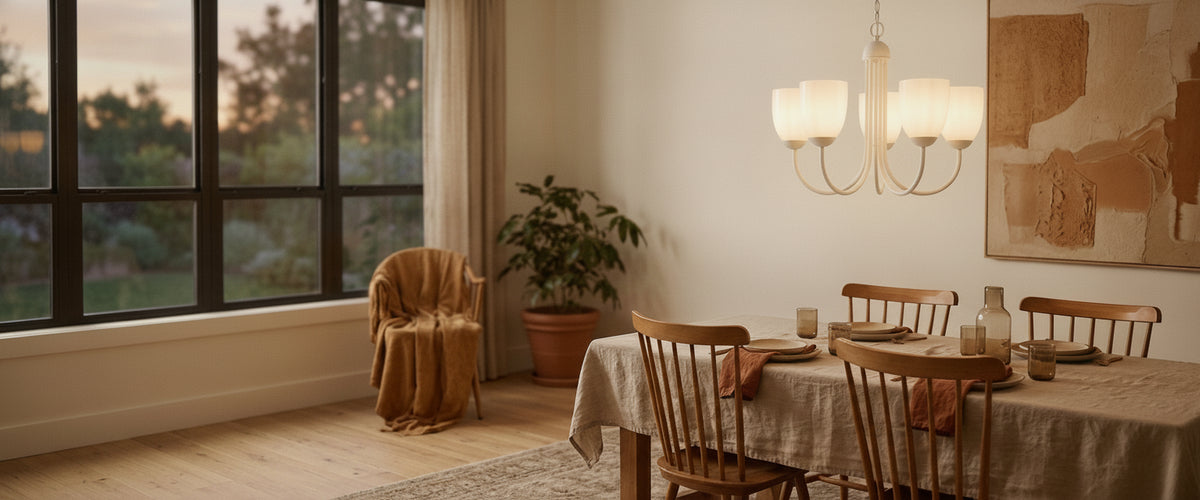

Most white glass chandeliers look identical in a product photo and completely different once they are on your ceiling. One reads soft and milky at dusk. The next throws a flat, faintly blue cast that makes a dining room feel like a dentist's waiting area. Before you commit to a white glass chandeliers, it helps to know that the glass recipe matters less than you think and the bulb behind it matters more. At Niori we work mostly with alabaster and natural stone, materials that are judged almost entirely on how they carry light. We apply the same test to glass.
Quick answer: what decides whether a white glass chandelier works
- Glass type: opal diffuses evenly, frosted softens but can show the bulb, seeded and clear-blown glass sparkle rather than glow.
- The shade of white: listings rarely say whether the white is cool, neutral, or milky-warm. Ask, or ask for a photo of the fitting lit.
- Scale: add the room's length and width in feet. The total, read as inches, is a sensible starting diameter.
- Bulbs: 2700K or warmer with a CRI of 90 or above keeps white glass from looking clinical.
- Before ordering: confirm suspension length, lampholder type and count, dimmer compatibility, and the total weight against your ceiling.

Opal, Frosted, Seeded or Mouth-Blown: How Each Glass Handles Light
Opal glass is white all the way through. Light enters the shade wall, scatters inside it, and leaves as an even glow with no visible hotspot. It is the closest glass gets to alabaster, though a little flatter: stone has veining and density shifts that make the glow move across the surface, while opal is uniform. Choose opal if you want a calm, lantern-like presence and do not want to see the bulb.
Frosted glass is clear glass with an etched or sandblasted surface. It softens the light, but a bright bulb can still show as a pale smudge through the shade. Pair frosted globes with low-glare or opal-coated LED bulbs and the effect improves considerably.
Seeded glass carries tiny trapped air bubbles. In white or lightly tinted versions it gives sparkle and texture rather than diffusion, which suits kitchens and casual dining spaces where a little liveliness helps.
Mouth-blown glass describes a making process, not a finish. A white blown glass chandelier will show slight variations in wall thickness from globe to globe, so one shade may glow a touch brighter than its neighbour. We consider that a feature. If you want perfectly matched globes, machine-pressed glass is the more predictable buy.
A white murano glass chandeliers sits in its own category. The Venetian island's furnaces have been producing lattimo, a milk-white glass, for centuries, and the Murano Glass Museum holds examples that show how dense and porcelain-like it can be. If a listing describes a Murano glass chandelier as white, ask whether the glass is genuinely made on Murano and whether it is lattimo or a cased white over clear. The two light very differently.

How to Read "White" on a Product Listing
White in glass runs from a cool, almost blue-white to a creamy ivory. Listings rarely say which. A few clues help:
- Opal or milk glass usually lands neutral to slightly warm.
- Gloss white painted interiors tend to read cooler and brighter.
- Cased glass (white layered over clear) often looks crisper, with a faint clear rim at the edge.
- Photos shot unlit on a white background tell you almost nothing. Ask for a lit image, ideally in a room.
In the studio we once hung an opal globe next to an alabaster shade on the same 2700K bulb. The alabaster read honey-warm; the glass read noticeably cooler and whiter. Neither was wrong, but anyone matching a glass fitting to cream walls or warm oak should expect that shift.
Scale and Ceiling Height: Will Your White Glass Chandelier Float or Loom?
White glass has more visual weight than clear glass, because it reads as a solid mass even when switched off. That means a white glass chandelier can look heavier than its dimensions suggest.
- Diameter: add room length and width in feet; use the total in inches as a starting diameter. A 14 by 12 foot (4.3 by 3.7 m) room suggests roughly 26 inches (66 cm).
- Over a table: aim for a fitting about half to two-thirds the table's width, with the bottom 30 to 36 inches (76 to 91 cm) above the tabletop.
- Over a walkway: keep at least 7 feet (2.1 m) clear beneath the lowest globe.
- Ceiling height: below about 8 feet (2.4 m), look at semi-flush or compact clusters; a three-light design in a white and brass finish, such as the Ramses 3 Light Chandelier in White & Brushed Brass, keeps the white mass in proportion where a sprawling cluster would crowd the room. Above 10 feet (3 m), a larger white glass globe chandelier can drop lower and fill the volume.
Size down slightly for opal over frosted. The solid white reads bigger. And if you love a many-globe silhouette but the room cannot take that much white, a clear-globe branching design such as the Galaxy 12 Light Branching Chandelier with clear glass globes carries twelve lamps with far less visual mass when switched off.
Where White Glass Strengthens a Room, and Where It Drains It
White glass is strongest against contrast: dark painted ceilings, deep green or oxblood dining rooms, walnut joinery, black-framed glazing. A modern white glass chandelier with brushed brass arms hung against a charcoal ceiling is one of the easiest ways to give a dining room a focal point without adding pattern. Over a longer table, a larger white and brushed brass design such as the Ramses 9 Light Chandelier in White & Brushed Brass carries that contrast along the full length of the table.
It struggles in rooms that are already white on white. Pale walls, pale ceiling, pale floor, and a white globe cluster in the middle all flatten into one tone, and the room loses its shape after dark. In those spaces, warmer materials do more work. Alabaster and onyx bring a honeyed glow and visible veining that a uniform white globe cannot, which is why many of our clients with bright, minimal interiors end up browsing the alabaster lighting collection instead.
Bathrooms and kitchens are a middle ground. White glass looks clean there, but check the IP rating for any zone near water and keep the bulb warm enough that skin tones do not turn grey.
Bulbs Behind White Glass Matter More Than the Fitting
Glass is passive. It can only soften or scatter what the bulb gives it, and white glass exaggerates whatever colour temperature sits behind it. A 4000K bulb in an opal globe looks like an office. The same globe at 2700K looks like a lantern.
Our working rules for any white glass chandelier:
- Colour temperature: 2700K for living and dining rooms; 2200K to 2400K if you dim heavily in the evening.
- CRI 90 or higher: lower-CRI LEDs make white glass look greyish and flatten food and skin tones.
- Lumens: opal absorbs more light than frosted or clear glass, so plan on a little more output per lamp than you would for a clear fitting. Around 400 to 450 lumens per lamp is a reasonable starting point for a multi-light dining fixture on a dimmer.
- Dimming: use dimmable LEDs and a compatible dimmer, and have a qualified electrician confirm the pairing. Mismatched dimmers cause flicker that white glass makes very obvious.
One London client called us about a glass cluster in her dining room that looked "chalky" every evening. The fitting was fine. The installer had used 3000K bulbs with a low CRI. Swapping to 2400K, high-CRI lamps fixed it in ten minutes.
White Glass or Alabaster? Decision Criteria for Buyers
If you are still undecided between glass and stone, these are the questions that usually settle it:
- Do you want uniformity or character? Glass is consistent from globe to globe. Alabaster carries veining, so every shade is different.
- How warm is the room? Cool, contemporary schemes suit white glass. Timber, plaster, and natural fabrics usually suit alabaster's warmer glow.
- How much does weight matter? Stone shades are heavier, which affects ceiling fixings and suspension choice.
- How much daylight presence do you want? White glass reads as a bright object when off. Stone reads quieter and more sculptural.
Budget depends on material, scale, complexity, engineering, installation, and finishing, so for larger or bespoke fittings it is worth requesting a tailored quote rather than comparing listings. You can see how glass, brass, and stone pieces sit together across the full niori lighting range.
Before You Confirm the Order: A Pre-Purchase Checklist
- Suspension length: measure floor to ceiling and decide where the bottom of the fitting should sit. Check whether the cable, chain, or rod is adjustable and by how much.
- Lampholder type and count: E14, E27, and G9 fittings take different bulbs. Count them, and check that warm, high-CRI, dimmable versions exist in that cap.
- Total weight: get it in kilograms and confirm your ceiling can carry it. Heavier fittings may need a joist fixing or a dedicated bracket.
- Ceiling rose size: make sure it covers your existing junction or any old plaster damage.
- Globe access: can you change bulbs and clean globes without dismantling the fitting?
- Spare glass: ask whether replacement globes are available. Hand-blown shades vary, so matching later can be tricky.
- Installation: any chandelier should be wired and fitted by a qualified electrician. That is not optional.
Glass is easy to care for: switch off, let it cool, and wipe with a soft cloth and mild glass cleaner. Do not use abrasive pads on frosted or etched finishes, which can polish patches shiny. Do that, choose the bulb as carefully as the fitting, and a white glass chandelier will glow the way the photograph promised.