
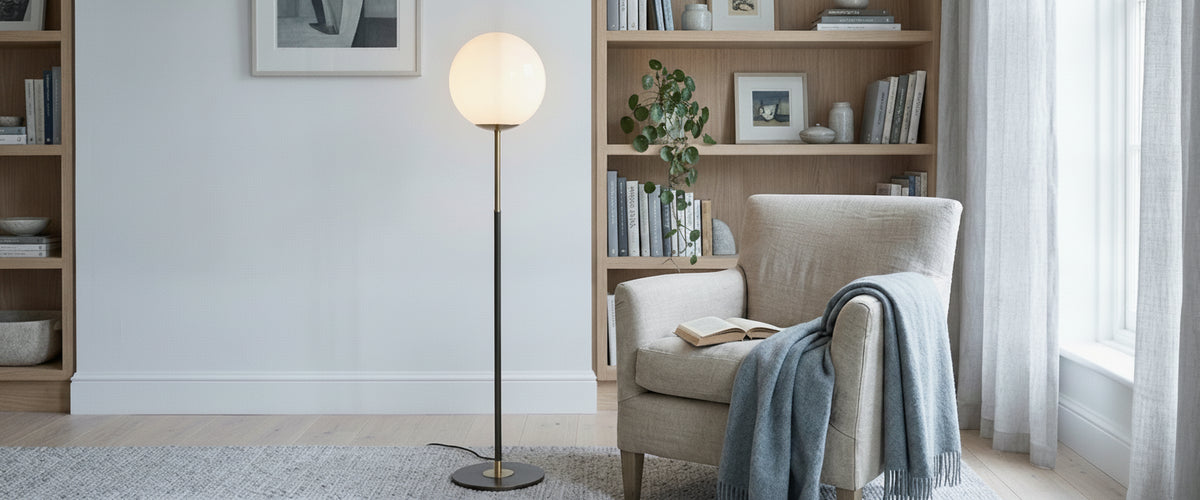

Most floor lamps aim. A drum shade throws light down onto a chair, a cone puts a hard circle on the floor, a task arm points at a book. A glass globe floor lamp refuses to commit, and that is the whole reason to own one. The sphere pushes light outward in every direction at once, so instead of a spotlight you get a soft radius of glow that reaches the walls, the ceiling and the people sitting nearby. That behavior makes the glass globe floor lamp brilliant in some rooms and oddly useless in others, which is why it deserves more thought than a quick add-to-cart.

Key Takeaways Before You Shop
The sphere is omnidirectional. A glass globe floor lamp lifts the ambient level of a whole room rather than lighting one seat.
Glass finish sets the radius. Clear glass shows the bulb and glares; opal spreads evenly; seeded softens the edge; smoked shrinks the reach and deepens the mood.
Diameter and stem height work together. A small globe up high reads as a point of light. A large globe low down washes the floor.
The bulb is on show. Color temperature and filament shape are more exposed inside a globe than in any other fixture type.
Build quality lives in three places: the seam line of the glass, the weight of the base, and how precisely the diffuser seats into its collar.
Alabaster is the alternative to a glass globe floor lamp when you want the same soft ambient spread with mineral depth instead of transparency.

Why the Sphere Diffuses in Every Direction
Shade geometry is destiny. A cone or drum has an open top and bottom and opaque sides, so the light escapes in two directions and the walls stay dark. A sphere has no top or bottom to speak of; the glass wraps the source, and every part of that surface becomes a secondary emitter. Sit in a room lit only by a globe and you will notice the shadows are shallower and the corners are less sunken. A glass globe floor lamp behaves more like a small, low sun than a torch.
That has a practical consequence people rarely think about. Because a glass globe floor lamp raises the general light level rather than concentrating it, it is a poor reading lamp on its own. Pair it with a directional source if the chair beside it is where someone actually reads. Use it as the mood layer, not the working layer.
Multi-globe designs change the math again. Three or five spheres staggered up a slim stem turn a glass globe floor lamp into a vertical constellation, spreading the same total output over a taller column of air. Rooms with high ceilings take these well because the eye gets something to follow upward instead of one bright dot floating at hip height. A five-sphere arrangement such as the Giro 5 Light Globe Glass Floor Lamp shows how that vertical spread works in practice: no single globe has to carry the room, so each one can run gently.
Clear, Opal, Seeded and Smoked: How Each Glass Changes the Glow
Listings filed under floor lamp globe glass and listings filed under glass globe floor lamp describe the same silhouette, but the glass itself varies enormously, and it changes the result far more than the shape does.
Clear Glass
Sharp, jewel-like, and completely honest about the bulb inside. Clear globes give you the widest reach and the highest glare risk. They only work with a deliberately decorative bulb and a dimmer you actually use. In a dining room where the lamp sits above eye level of seated guests, clear is fine. At eye height beside a sofa, a clear glass globe floor lamp will sting.
Opal Glass
The safest choice and the most even. Opal, sometimes sold as white or milk glass, scatters the source across the whole surface so the globe reads as one luminous ball with no hot spot. The ambient radius is slightly smaller than clear glass but far more comfortable. If you want a glass globe floor lamp you can look directly at, opal is it.
Seeded Glass
Tiny trapped bubbles catch and split the light, giving a faint sparkle at the surface while still letting the filament read through. It sits between clear and opal: more texture than clear, more visible source than opal. Seeded suits rooms with a lot of hard modern surfaces, because the glass has enough life in it to stop the fixture looking clinical.
Smoked Glass
Gray or bronze tint absorbs a real portion of the output, so a smoked glass globe floor lamp delivers a smaller, moodier pool and a darker object when it is off. Beautiful in a snug, a screening room, or a bar corner. Wrong in a north-facing room that is already short of light. Step up the bulb output to compensate.
Diameter and Stem Height Decide Where the Light Lands
The two dimensions are inseparable on any glass globe floor lamp. Raise a globe and the light spreads wider but thinner; drop it and the pool tightens and brightens on the floor.
As a working rule, a glass globe floor lamp in the 150 to 180cm range (roughly 58 to 71 inches) puts a single globe above the shoulder of a seated adult, which keeps the glass out of the direct sightline and pushes the glow across the room. Smaller globes, in the 15 to 25cm band (about 6 to 10 inches), read as points of light and suit multi-arm designs. Where you want that height without a heavy silhouette, a slim three-sphere piece like the Atom 3 Light Globe Glass Floor Lamp at 180cm distributes small globes up the stem rather than parking one large sphere at eye level. A single sphere much larger than that becomes sculpture and needs floor space around it; crowd it with a side table and an armchair and it stops working visually.
One more thing to measure: the base footprint against your traffic route. It is easy to fall for a wide-footed glass globe floor lamp and then discover it eats the walkway between the sofa and the kitchen. Tape the diameter on the floor before ordering. It takes two minutes and saves a return.
Rooms Where a Glass Globe Floor Lamp Anchors, and Rooms Where It Floats
Living rooms are the natural home. Place the lamp behind or beside a sofa corner, off-center from the seating axis, and the omnidirectional glow fills the space that a ceiling fixture leaves flat. In open-plan ground floors, a tall multi-globe design is a useful way to mark the edge of a lounge zone without building a wall. A 170cm piece such as the Global 3 Light Globe Floor Lamp is tall enough to register as a boundary marker from across the room while staying below the visual weight of a pendant.
Bedrooms respond well too, provided the glass is opal or seeded. A glass globe floor lamp in the corner opposite the bed gives enough light to move around at night without the ceiling light interrogation. Dining spaces are trickier: a floor lamp near a table competes with the pendant above it, and two round light sources in one sightline rarely settle. If the room already has a globe chandelier, choose a different form for the floor.
Where it floats awkwardly: narrow hallways, where the wide spread is wasted on walls half a stride away; bathrooms, where a plug-in floor lamp is a bad idea and a qualified electrician should be handling anything permanent; and long, low-ceilinged rooms where the ambient glow flattens out and the glass globe floor lamp reads as a stray marble. In those spaces, wall lights or a table lamp with a directional shade earn their keep instead. It is worth browsing the wider lighting range before you settle on a floor format, because the right answer in a corridor is almost never a floor lamp.
Bulb Choice: The Globe Hides Nothing
Inside a drum shade, any bulb will do. Inside a glass globe floor lamp, the bulb is part of the design, and two decisions matter.
Color temperature. Stay between 2200K and 2700K for living spaces. Anything at 3000K or above turns opal glass slightly blue-white and kills the warmth that makes the lamp worth having. The US Department of Energy's guidance on LED lighting is a good primer on how color temperature and rendering quality affect how a room feels. Aim for CRI 90 or better; low-CRI LEDs make timber and textiles look gray.
Filament shape. In clear or seeded glass, a straight-line LED filament looks architectural, a spiral looks retro, and a bare chip-on-board module usually looks cheap. Center the bulb properly: an off-axis filament inside a sphere is glaringly obvious from across the room. In opal glass none of this matters, so use a plain frosted LED and spend the difference on dimming.
Dim it, always. Every glass globe floor lamp benefits from a smooth trailing-edge dimmer or a compatible in-line control, and the glare risk in clear glass all but disappears once you can run the lamp at half output.
Seam Quality, Base Weight and Diffuser Fit: What to Check
Seam line. Mouth-blown globes carry a faint mark where the glass was worked; molded globes can show a hard vertical ridge. Run a finger around the equator. A ridge you can catch a nail on will also catch the light and draw the eye. The traditions behind hand-worked glass are well documented by institutions such as the Toledo Museum of Art, and it is worth knowing which process you are buying.
Wall thickness. Hold the globe up to a window if you can. Thin patches glow brighter than the rest and will show as blotches once lit.
Base weight. A tall glass globe floor lamp with a light base is a hazard in any home with dogs or children. Marble and solid brass bases carry real mass; ask what the base is made of, not just what it looks like.
Diffuser fit. The globe should seat into its collar with no rattle and no visible gap. Loose fits buzz on dimmers and let dust into the interior surface, which is the one surface you cannot easily clean.
Cord and switch. Check the cord length against your nearest socket, and look for a foot switch or in-line dimmer rather than a fiddly toggle under the shade.
Serviceability. Can you replace the bulb without removing the entire glass sphere? On multi-globe designs, this question separates good engineering from bad.
Glass Globe or Alabaster? Two Ways to Make Soft Light
Glass and stone solve the same problem differently. A glass globe scatters light through a uniform, manufactured surface: clean, graphic, consistent from one piece to the next. Alabaster scatters light through a mineral, and every slab has its own veining, so the glow arrives with warmth and grain baked into it. Look at a lit alabaster shade and you can see the stone's internal structure in the light itself, faint honey and cream bands that no glass finish reproduces.
Choose glass when you want precision, repeatability and a lighter visual footprint. Choose stone when you want the fixture to feel like an object even when it is off. Our alabaster lighting collection covers floor and table lamps as well as pendants and wall lights, and buyers often mix the two materials in one room: a glass globe floor lamp for the ambient layer, an alabaster table lamp beside the sofa for depth and texture.
On budget, be realistic rather than guided by a headline figure. Cost tracks the quality and origin of the glass or stone, the scale of the piece, the metalwork and finishing, and the engineering behind the multi-globe arms on a taller glass globe floor lamp. Send us the room dimensions and the look you are after and we will quote it properly.
Living With It: Care That Keeps the Glow Clean
Glass globes collect dust on the inside as well as the outside, and dust is a diffuser you did not ask for. Wipe the exterior with a soft, barely damp microfiber cloth and dry immediately; skip ammonia-based sprays if the fixture has brass or bronze detailing, because they attack lacquer and living finishes alike. Let the bulb cool fully first. If a globe is removable, take it off once or twice a year and clean the interior surface, which is usually where the output has quietly fallen away.
Alabaster shades follow different rules: dust dry, never soak, and keep household cleaners away from the stone entirely. Marble and brass bases like the same restraint. Handled sensibly, a well-made glass globe floor lamp lasts decades, and the small habits are what keep the light looking the way it did on day one.