
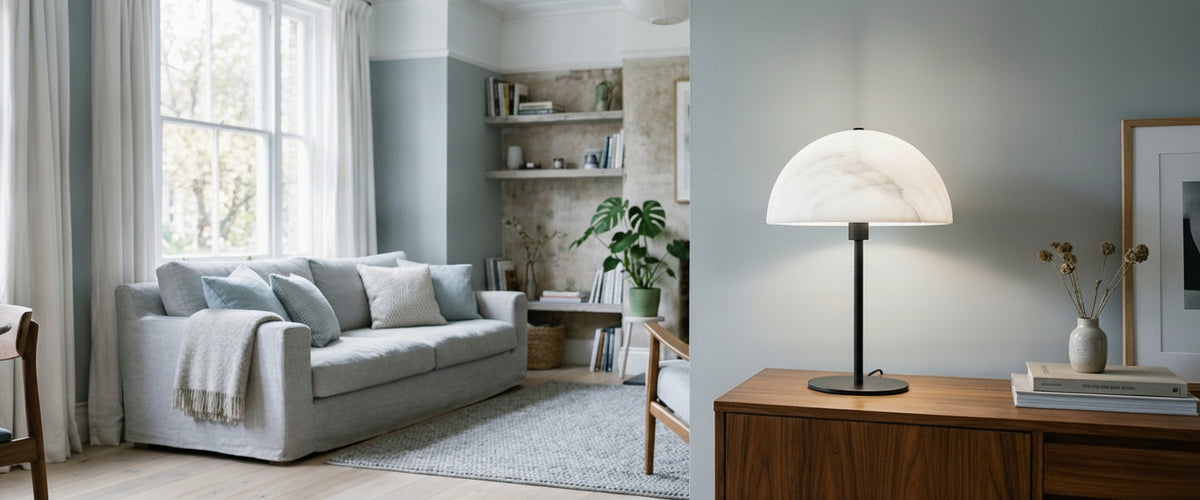

A black table lamps is the easiest lamp to fall for and one of the hardest to place well. On a white studio backdrop it looks graphic and certain. On a walnut sideboard in a dim London living room at 6pm, it can turn into a dark smudge under a glowing shade, with no outline left at all. Most of the problems people bring to us come down to a handful of decisions made before the box ever arrives, and none of them are about whether black is "in". This is how we think about a black table lamp at Niori, where most of our day is spent studying how light behaves once it hits stone, glass and metal.

Quick Answer: Choosing a Black Table Lamp
- Base material matters more than the shade of black. Glazed ceramic holds its depth for years. Cheaper painted metal and resin are where wear shows first.
- Check the shade lining. A white or pale lining throws light down. A dark lining gives a moody glow but very little usable light.
- Look at the wall behind it. Black reads as a statement against pale or mid-tone walls and disappears against charcoal, navy or deep green.
- Repeat a metal, not a colour. Tie a black lamp into the room through a brass, bronze or chrome detail you already have.
- Measure the seated eye line before you commit to a pair.

Why a Black Base Behaves Differently Once the Lamp Is On
Every lamp changes when you switch it on, but black changes the most. A white, cream or stone base catches spill light from the shade and glows faintly, so it stays visible as part of the composition. A black base absorbs that same light. The shade becomes the brightest thing in your eye line and the base drops back. This is why a black lamp can look top-heavy at night even when its proportions were perfect in daylight.
That effect is useful if you want the light to feel like it floats. It is a nuisance if you bought the lamp for its sculptural base. Finish makes a real difference here. A gloss glaze picks up highlights from the shade and the room, keeping the silhouette legible. A matt finish swallows them, and can read as a flat cut-out after dark.
Ceramic, Metal and Resin: How Black Ages Over Years
Showroom lamps are judged in weeks. Lamps at home are judged after three winters of dusting, knocks from a vacuum and afternoon sun through a south-facing window.
Black Ceramic
A well-made black ceramic table lamps is the safest long-term bet. The colour sits in a fired glaze rather than a surface coat, so it does not fade and everyday scuffs barely register, though a deep chip can expose the paler clay body beneath. Reactive or crackle glazes add variation that hides fingerprints well. The trade-off is weight and fragility: a dropped ceramic base cracks rather than dents.
Black Metal
Powder-coated steel and painted brass give the crispest modern black table lamp silhouettes, and the slim stems that ceramic cannot manage. Quality varies hugely. Cheap powder coat can chip at the switch and base edges within a year, exposing bright metal that is hard to touch up invisibly. Ask whether the coating is powder-coated or wet-sprayed, and whether the base edge is rounded, since sharp edges wear first.
Black Resin and Composites
Resin makes complex shapes affordable, but some formulations shift from black towards a faint brown or grey under sustained daylight. If the lamp will sit near a window, ask whether the resin is UV-stabilised. Expect it to feel lighter than ceramic, which affects stability under a large shade.
Shade Shape and Lining: Where Black Lamp Decisions Go Wrong
The base gets the attention, but the shade decides how the lamp actually lights a room. Three things to check:
- Lining colour. A black shade with a white interior throws a clear pool of light downward onto the table, and a gold lining warms it. Both are good for reading. A black shade lined in black looks dramatic and gives almost nothing to read by. Treat it as accent lighting only.
- Shade shape. A tapered cone or empire shade concentrates light on the surface below. A drum spreads it more widely, washing the wall behind. On a black lamp, a drum often looks better because the lit wall gives the dark base something to stand against.
- Opacity. Opal glass, linen and stone shades glow through their whole surface, softening the contrast between bright shade and dark base. Where you want a matt black frame without losing its outline after dark, an opal glass design such as the Vetra Opal Glass Table Lamp in Matt Black is closer to the right balance than an opaque shade with a hard pool of light beneath it.
This last point is where alabaster earns its place. Alabaster is a fine-grained form of gypsum, soft enough to carve thin and translucent enough to transmit light through its natural veining. Paired with a dark base or placed beside a black piece, an alabaster shade or lamp diffuses light evenly rather than producing a hard hotspot, which keeps the whole composition readable. If you want to see how that warm, stone-filtered glow compares with fabric and glass, look through our alabaster lighting before settling on a shade.
Backdrop Contrast: When a Black Table Lamp Is a Statement and When It Vanishes
The wall behind a lamp does more work than the table beneath it. Against white, plaster pink, sage or warm stone, a black table lamp draws a clean line and looks deliberate. Against charcoal, navy, oxblood or deep green, it disappears after sunset, leaving a glowing shade apparently hovering in mid-air.
A typical case: a pair of black lamps chosen for a drawing room painted deep bottle green. In daylight photos they look tailored. By evening, they are gone. The fix is usually simple. Swap one for a pale stone lamp to break the symmetry, and move the black lamp to a lighter hallway console, where it can suddenly look like the best thing in the house.
Room by room, our rule of thumb:
- Living rooms: black works well on side tables against pale walls, or in front of a window where daylight frames the silhouette.
- Bedrooms: fine on bedside tables if the headboard or wall is light. On dark upholstered headboards, choose a lighter base or a glowing stone lamp instead.
- Hallways and consoles: often the best spot, because lamps here are seen against a plain wall at standing height.
- Hospitality: in bars and restaurants with dark joinery, black lamps can feel moody and intentional, provided there is enough ambient light elsewhere.
Pairing Black With Metals and Furniture Tones
Black is a neutral, but it is not invisible to other finishes. The question we hear most is what goes on a black lamp table, and the answer usually depends on the metal already in the room.
- Brass and bronze warm a black lamp and are the easiest pairing in traditional and mid-century schemes. A brass switch, finial or collar ties the lamp to brass handles or picture lights nearby. If the room already carries brass, a lamp that builds it into its own structure, like the Funk Adjustable Table Lamp in Matt Black & Brass, makes that connection without needing extra accessories.
- Chrome and nickel push black towards a sharper, more graphic look that suits monochrome interiors.
- Warm woods like oak and walnut soften black. Very dark woods compete with it, so add contrast through the shade.
- Marble and stone furniture gives black a clean ground. A black base on a white marble side table is a classic for good reason.
Black on black is the tricky one. A black lamp on a black side table can look sleek, but only if the shapes are clearly different, such as a rounded ceramic base on a square metal table. If the shape, finish and colour all match, the lamp and table merge into one object.
Scale, Proportion and Build Details Before You Buy a Pair
Dark objects read visually heavier than light ones, so a black table lamp can look larger than a white lamp of identical size. Err slightly smaller with black, or choose a slimmer base. For a narrow bedside table or shelf, a compact 29cm piece such as the Matt Black LED Touch Table Lamp with Cone Shade keeps the dark mass in proportion. Its cone shade also directs light down onto the surface rather than out across the wall.
For seated rooms, the bottom edge of the shade should sit roughly at eye level when you are sitting down. That is often around 97 to 107cm (38 to 42 inches) from the floor. Add your table height to the lamp height and check the total before ordering. The shade should be no wider than the table top, so it does not overhang and catch on passing shoulders.
Pre-Purchase Checklist
- Confirm overall height, shade diameter and base footprint against your table.
- Ask about the finish: glaze, powder coat, paint or resin, and whether it is UV-stable.
- Check the shade lining colour and whether the shade is replaceable.
- Confirm the bulb fitting (E27, E14 or integrated LED) and maximum wattage.
- Check switch type and position: inline, base, touch or rotary.
- If buying a pair, ask whether handmade or glazed pieces will vary slightly from one another.
- Look for a weighted base if the shade is large or the lamp sits in a busy spot.
Bulbs, Dimming and Safe Installation
Warm white bulbs around 2700K suit black lamps best, because cooler light can make black finishes look blue and flat. Choose a high colour-rendering LED (CRI 90 or above) so the room around the lamp looks right too. If you want to dim, check that both the bulb and the lamp's switch are dimmable. A touch dimmer paired with a non-dimmable LED is likely to flicker or fail to dim smoothly.
Plug-in lamps need no installation, but anything beyond changing a bulb is a job for a qualified electrician. That includes rewiring a vintage base, fitting a new switch or connecting lamps to a dedicated lighting circuit. The Lighting Association is a good starting point for understanding product safety standards before you buy.
Where Stone Fits Into a Black Scheme
Black lamps do their best work alongside something that glows. In many of the rooms we help with, the strongest arrangement is a black lamp on one surface and a stone lamp, wall light or pendant elsewhere. That way the room carries both crisp outlines and soft, diffused light. If you are planning lighting across a whole room rather than one table, our full lighting collection makes it easier to balance dark accents with alabaster and natural-stone pieces that bring warmth back into the scheme.