
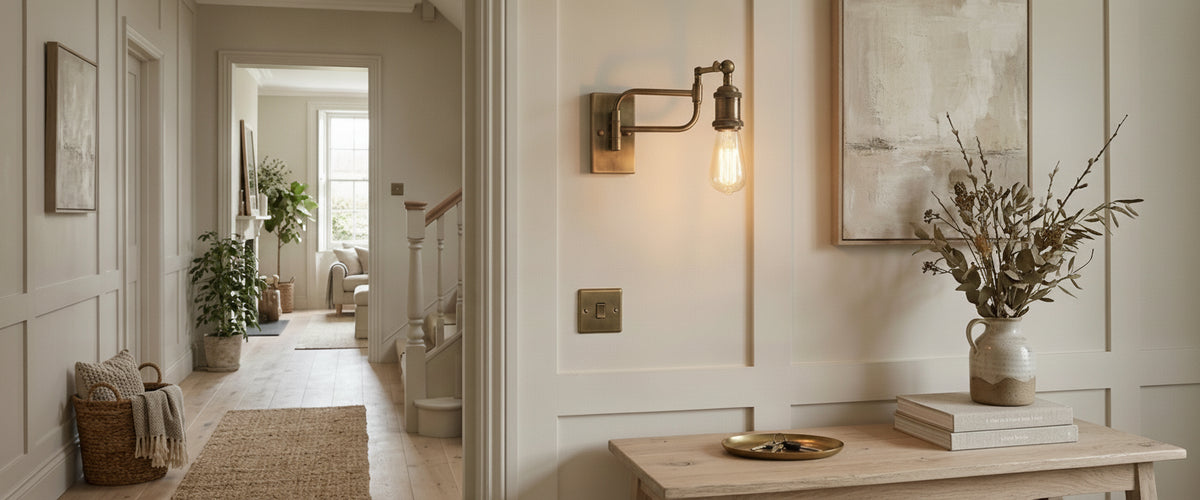

Most people spend weeks choosing an alabaster pendant and about four minutes choosing the socket beneath it. That is the wrong way round. An antique brass plug socket sits in your eyeline every time you sit down, catches the warm light falling from the fixtures above, and is one of the few metal surfaces in a room you touch every day. Chosen well, it reads like a quiet piece of joinery hardware. Chosen badly, it looks like a gold sticker on the skirting.
At Niori we spend our working lives thinking about how alabaster and natural stone shape light, and the faceplates under our fixtures are where many careful schemes come unstuck. What follows is the advice we give clients who ask us, usually a little late, what to put on the walls.

Key Takeaways
Finish names are not standardised. Antique brass, aged brass and satin brass can describe three very different objects depending on the maker.
Warm light exaggerates brass. Under 2700K bulbs and the warm glow of alabaster, bright or orange-toned brass reads far louder than it did in the showroom.
Order everything at once. Faceplates from different batches rarely match, and the mismatch shows most on a single wall.
Wiring is not a DIY job. Any socket or switch change should be carried out by a qualified electrician.

Why Socket and Switch Finishes Read Louder Than You Expect
A faceplate is small, but it is a flat, reflective, rectangular surface sitting against a plain wall. A standard UK single plate is about 3.4 in (86 mm) square, and a double is roughly 5.7 by 3.4 in (146 by 86 mm). Nothing else in a room has quite that geometry. Your eye finds an antique brass plug socket the way it finds a light switch in a dark hallway: instantly, and without asking.
Lighting makes this worse. Alabaster diffuses light rather than throwing it, so a room lit by stone wall lights and pendants has soft, even illumination across every vertical surface. There are no deep shadows for a faceplate to hide in. A polished plate bounces that glow straight back at you; a well-aged antique finish absorbs some of it and gives back a low, honeyed sheen. A simple test before you commit: hold your sample plates beneath a lit alabaster wall light. The difference between two plates that looked identical in daylight is often startling once the lamp goes on.
Under warm alabaster light, a layered antique finish gives back a low sheen rather than glare.
Antique Brass, Aged Brass and Satin Brass: Three Names, Three Objects
Brass is an alloy of copper and zinc, and the ratio between them sets its base colour before any finishing begins. Most brass is roughly 60 to 70 percent copper, with the rest zinc; the more copper, the redder and warmer the base metal. The Copper Development Association is a useful starting point if you want the metallurgy. For buyers, the finishing matters more than the alloy, and this is where the names start to mislead.
Antique Brass
Usually a chemically darkened finish, sometimes with the high points relieved back to brighter metal so the surface looks handled. Good antique brass has depth: brown in the recesses, warm gold on the edges. Poor antique brass is a flat brown coating that reads as bronze from a metre away. When someone searches for an antique brass plug socket, this darker, layered look is usually what they have in mind.
Aged Brass
Lighter and more golden than antique, designed to suggest a decade of gentle wear rather than a century. Many lamp bases use a brushed aged brass, which is softer and more forgiving next to raffia, linen or stone. If you want to judge that tone against a natural shade, a piece such as the Ombressa Table Lamp with Raffia Shade in Brushed Aged Brass gives a truer sense of the colour than any finish name. It sits comfortably between polished and antique.
Satin Brass
Bright metal with a fine brushed grain and a lacquer coat. It reads clean and contemporary, and under warm light it can tip yellow quickly. Satin brass looks best in cooler, brighter rooms; it often feels too new beside honed marble or veined alabaster.
The practical lesson: never order from a finish name alone. Ask for a physical sample, and look at it under the bulbs you will actually use.
Wall Finishes That Let Antique Brass Breathe, and the Ones That Kill It
An antique brass plug socket needs a wall with some warmth or texture to sit against. Limewash, clay plaster and chalky mineral paints are ideal; they have the same matte, slightly uneven quality as the metal and give it a natural context. Deep greens, ochres, oxblood and warm greys all flatter it. Panelled walls in a painted Georgian or Victorian room are perhaps the most forgiving setting of all.
The finishes that undo it are brilliant white emulsion and high-sheen paint. Against stark white, a dark antique plate looks like a hole in the wall, and the contrast is magnified when soft alabaster light washes evenly across the surface. Glossy walls compete with the metal's own sheen, so neither looks deliberate. If you are committed to white walls, choose a warmer white with a touch of yellow or grey, or step down to a lighter aged brass.
Tiled and stone walls are a separate case. Against honed marble or travertine in a bathroom or kitchen, antique brass looks right at home, but check with your electrician which fittings are suitable for the location before you choose by eye. Bathrooms in particular have strict rules on where sockets can go.
Where Antique Brass Plug Socket Placement Earns Its Premium
Not every socket deserves the upgrade. Behind the fridge, inside a utility cupboard or at the back of a wardrobe, a plain white plate is fine and nobody will ever know. Spend the money where the faceplate shares a sightline with your lighting. In new homes in England, Approved Document M places sockets and switches between about 18 in and 47 in (450 mm and 1200 mm) above the finished floor, which is exactly the band your eye sweeps when you walk into a room.
Either side of the bed. Bedside sockets sit directly below table lamps and wall lights, often at mattress height. This is the most-seen socket in the house.
Living room lamp positions. Wherever a table or floor lamp plugs in, the socket is lit by that lamp at close range. A brushed aged brass floor lamp next to a satin chrome socket is a mismatch you will notice every evening.
Kitchen splashbacks. Sockets above worktops sit at eye level beneath pendants. Here the antique brass plug socket is effectively part of the kitchen hardware, so match it to the tap and handles.
Hallways and landings. Light switches more than sockets, but they are the first metal you see on arrival.
A black plug top all but disappears against a dark antique plate.
A detail clients often miss is the plug itself. A table lamp with a fabric flex and a beautiful stone base can be let down by a chunky white plug top sitting in a brass socket. Black plug tops are far less obtrusive against dark antique plates, and a plain screw-grip fitting such as the 13A Plug Top With 13A Fuse in Black all but disappears where a white one would glare. Note that it comes fitted with a 13A fuse, while most table lamps on a UK plug only need a 3A fuse; if you are unsure, ask your electrician rather than guessing. If you are planning sockets around new fixtures, browsing our alabaster lighting collection first will help you decide where the lamps, and so the plates, will actually sit.
What to Verify Before You Order: Batch, Lacquer and Patina
It is a familiar story. A homeowner buys the ground-floor sockets from one supplier and the first-floor switches from another, both sold as antique brass. On the stairwell, where one of each sits within a metre of an alabaster wall light, one turns out chocolate brown and the other almost amber. Both are fine products. They simply do not belong together, and the fix means replacing every plate on one floor.
To avoid that, make these checks before you commit:
Order the whole house in one go. Chemical darkening varies between production runs, so an antique brass plug socket bought next year may not match one bought today. Buy spares too, so a later addition matches.
Ask whether the finish is lacquered or unlacquered. Lacquered plates hold their colour for years; unlacquered ones will keep darkening and develop fingerprint marks around the switch. Neither is wrong, but you should choose knowingly.
Check screw finish. Exposed screws in bright brass or chrome on an antique plate look careless. Matching screws or screwless plates solve it.
Look at the inserts. Switch rockers and socket surrounds come in black, white or metal. Black inserts suit antique brass best; white can look clinical.
Confirm the backbox depth. Standard UK flush backboxes are commonly about 1 in (25 mm) or 1.4 in (35 mm) deep, and some decorative plates and dimmer modules need the deeper size or more. Your electrician can check this before anything is ordered.
Ask for a sample under your own light. Ideally in the evening, with the room's lamps on.
On safety, any change to fixed wiring, including swapping faceplates, should be carried out by a qualified electrician. In England and Wales, a contractor registered with a scheme such as NICEIC can certify the work. Decorative fittings should still carry UKCA or CE marking and be made to the relevant British Standard.
Mixing Antique Brass with Other Metals Without It Looking Accidental
Mixed metals work when the mix is clearly a decision. The rule we use: one dominant metal, one supporting, and a reason for each.
Let antique brass be the dominant finish if most of your lighting carries warm metal detailing. Alabaster pendants and wall lights with aged or brushed brass fittings sit naturally beside it, because the stone's honeyed glow and the brass's warmth come from the same part of the colour spectrum. Where a wall light shares a sightline with the socket below, a fitting such as the Selvara LED Medium Alabaster Double Wall Light in Brushed Brass speaks the right design language in a way a chrome-framed sconce does not. A supporting metal such as bronze or matte black can then appear on curtain poles, picture lights or door furniture.
Where people go wrong is pairing antique brass with polished chrome or bright nickel in the same sightline. Cool, mirror-bright metal makes the antique finish look tired rather than aged. If a bathroom needs chrome for practical reasons, keep the brass outside the door.
Repeat the dominant metal at least three times across a room so it reads as a thread rather than a one-off. An antique brass plug socket, a brass-detailed wall light and a lamp base in a related tone will do it. Our wider lighting range covers several brass finishes, so it is worth comparing tones side by side before settling on your plates.
A Final Word on Restraint
The best antique brass plug sockets are the ones guests never consciously notice. They sit in the room the way a good picture frame sits around a painting: present and correct, carrying the warmth of the lighting rather than shouting over it. Choose the finish under your own bulbs, buy in one batch, and let the alabaster do the talking.