
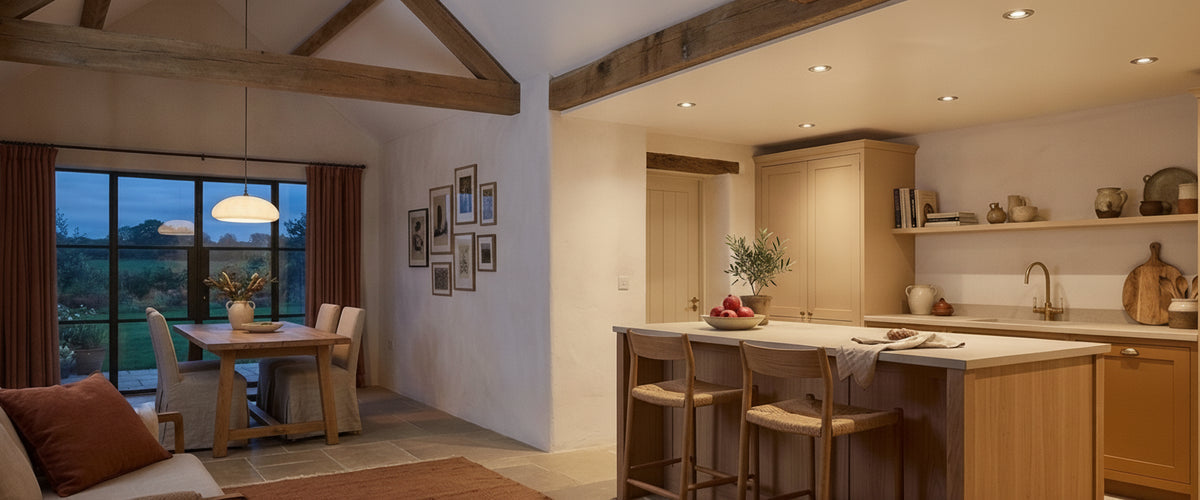

Most rooms that feel harsh, flat or faintly clinical do not have a fitting problem. They have a lamp problem. Swap six poorly specified LED spotlight bulbs for six well chosen ones and the same ceiling, the same plaster and the same stone worktop behave completely differently, usually within about ninety seconds of work per fitting. It is the highest-impact, lowest-drama change available in a finished room, and almost nobody does it on purpose.
At Niori we spend our days thinking about how light moves through alabaster, marble and onyx, and the same physics applies to everything a spotlight touches. Stone, timber, textured plaster and skin all reward a good beam and punish a bad one. Here is how to specify LED spotlights bulbs properly, and what to do when one needs changing.

Key Takeaways
Beam angle decides shape: narrow beams sculpt, wide beams wash. Most homes are over-supplied with 60° and under-supplied with 24°.
2700K flatters warm stone, brass and timber. 3000K suits cooler marble, black granite and task areas.
CRI 90 or above is the difference between veining you can read and a surface that looks printed.
Check the LED spotlight bulbs you are buying are dimmable and compatible with your dimmer before ordering six of them.
Outdoor spotlight bulbs live or die by the fitting's IP rating and whether the lamp is approved for enclosed luminaires.
Most fittings take GU10 (twist) or MR16 (push-fit pins). Integrated LED fittings have no changeable bulb at all.

Why Swapping the Bulb Changes More Than Swapping the Fitting
A downlight or track head is essentially a holder and a reflector. It contributes styling and a little optical control. LED spotlight bulbs contribute the beam shape, the colour, the colour rendering, the flicker behaviour and the dimming curve, which is to say nearly everything you actually perceive. Clients regularly ask us to replace a run of ceiling spots because the kitchen "feels like a dentist's surgery". Nine times out of ten the ceiling is fine and the light bulbs for spotlights sitting in it are 5000K, CRI 80, 120° flood lamps bought in a multipack.
We saw this clearly on a Cotswolds barn conversion where the client had commissioned a pair of alabaster wall lights for the dining wall and could not understand why the stone looked grey after dark. The wall lights were perfect. The six ceiling spots washing the same wall in cold white were bleaching all the warmth out of them. Changing those six LED spotlight bulbs cost a fraction of what a rewire would have, and the alabaster came back to life.
Beam Angle in Practice: What 24°, 36° and 60° Actually Do
Beam angle is the single most useful number printed on a box of LED spotlight bulbs, and the one most often ignored.
Narrow beams sculpt texture; wide beams flatten it.
24° and Narrower
A tight pool of light with a defined edge. This is what you use to graze a stone chimney breast, pick out a sculpture, or throw a controlled circle onto a dining table. On a 2.4m ceiling (about 8ft) a 24° beam lands as a pool roughly a metre across. Use narrow beams sparingly and with intent; six of them scattered across a ceiling produce a spotty, restless room.
36°
The workhorse. Wide enough to cover a section of worktop without harsh scalloping, tight enough to keep some direction and shadow. If you are replacing a mixed bag of unknown spotlight bulbs and want one safe answer, 36° is usually it.
60° and Wider
General wash. Good for hallways, utility spaces and low ceilings where you want even coverage rather than drama. The trade-off is flatness. A 60° bulb spotlight aimed at a marble splashback will light it evenly and make it look like a photograph of marble rather than the real thing. Texture needs shadow, and shadow needs a narrower beam.
If a wall or a piece of art is likely to move, buy the adjustability into the fitting rather than the lamp. A zoomable head such as the Focus Zoom LED Single Spotlight 12W 3000K, Black lets you tighten from a wash to a narrow accent on site, which is far easier than ordering three sets of lamps to find the beam that suits the surface.
One practical note on faces: wide beams from directly overhead are unkind. In bathrooms and dressing areas, light the wall or the mirror surround rather than the top of someone's head. Where the aim is a soft directional glow at eye level, a surface-mounted fitting such as the Ambience LED Wall Spotlight, White is closer to the right design language, and our alabaster wall lights get specified for the same reason, because a diffused stone glow at eye level does what no ceiling spot can.
2700K Versus 3000K: Small on Paper, Enormous on Stone
Three hundred kelvin sounds like a rounding error. On a honed limestone wall it is the difference between candlelight and daylight in mood terms.
2700K is the warm, domestic setting. It flatters cream and honey alabaster, walnut, brass, aged oak and warm-toned travertine. It is the right default for living rooms, bedrooms, dining rooms and any space with a lot of natural stone in warm colours.
3000K is a cleaner white with less amber. It suits cool grey marble, black granite, polished concrete, chrome and nickel, and it holds up better in kitchens and workspaces where you want crispness. Push past 4000K in a domestic room and warm stone goes chalky and lifeless.
Consistency matters more than the exact number. Mixing 2700K and 3000K spotlight bulbs LED across one ceiling is instantly readable to the eye, even for people who could not name what is bothering them. Buy all the LED spotlight bulbs for a room at once, from the same range and batch if you can.
CRI and Dimming: Where Poor LED Spotlight Bulbs Give Themselves Away
Colour Rendering Index measures how faithfully a light source shows colour compared with a reference. Cheaper LEDs sit around CRI 80, which is enough to see by and not enough to make anything look good. The reds go first, which is why food, skin, terracotta and the warm iron-oxide veining in alabaster all look slightly drained. Specify CRI 90+ (some manufacturers quote R9 separately, which tracks deep red specifically) and the difference on natural stone is immediate.
Dimming is the other common failure. LED spotlight bulbs need to state that they are dimmable, and the dimmer module needs to be a trailing-edge type suited to LED loads. Get it wrong and you get flicker, buzzing, a dead zone at the bottom of the dial, or lamps that drop out entirely below 30 per cent. Check the total load too, since many LED-rated dimmers have a minimum wattage that six small lamps may not reach. If you are changing dimmer modules rather than lamps, that is work for a qualified electrician.
Flicker deserves a mention. Low-cost drivers produce visible or sub-visible flicker that some people register as eye strain or headache over a long evening. Reputable brands publish flicker data; it is worth reading before filling a whole ceiling.
Indoor Versus Outdoor Spotlight Bulbs
Outdoor spotlight bulbs are a slightly different conversation, and most of the requirements sit with the fitting rather than the lamp. A garden spike or wall spot needs an appropriate IP rating for its exposure; the two digits cover solids and water ingress respectively, as set out in the IEC IP code. Outdoor LED spotlight bulbs must also be rated for enclosed luminaires, because sealed fittings trap heat and an unsuitable lamp will cook its own driver and fail early.
Beyond that, look for a stated operating temperature range if you are in an exposed or northern location, and prefer narrower beams outdoors than you would indoors. A 24° or 36° beam grazing a stone wall, uplighting a multi-stem tree or picking out a portico reads far better than a wide flood that spills light into next door's bedroom. The Institution of Lighting Professionals publishes useful guidance on obtrusive light that is worth a skim before you aim anything upwards. Warm colour temperatures also matter more outside than most people expect: 2700K keeps a garden looking planted rather than policed.
Matching Bulb Spec to Ceiling Height, Fitting and Surface
Three variables set the answer. Work through them in order.
Ceiling height. On a standard 2.4m (8ft) ceiling, a 36° beam at moderate output is plenty. At 3m to 4m (10ft to 13ft), narrow the beam and raise the output, or the light dissipates before it arrives. Double-height halls almost always want 24°.
Fitting type. GU10 lamps run on mains voltage and twist into place. MR16 lamps run at 12V through a transformer and push in on two pins; retrofitting LED spotlight bulbs into old MR16 circuits sometimes needs the transformer changed, which again is electrician territory. Adjustable gimbal fittings let you aim, fixed ones do not, and that changes the beam angle you should buy.
Surface. Textured stone, brick and rough plaster want a narrow beam close to the wall for grazing. Flat painted walls and artwork want a wider beam from further out to avoid hot spots. Glossy marble and polished onyx will mirror the lamp straight back at you, so aim off-axis.
Scale is the fourth, unspoken variable. A single 7W head like the Radiant LED Single Spotlight 7W 3000K, White carries a worktop or a shelf run without dominating the ceiling plane, whereas a shallow niche, a stair recess or a joinery reveal is usually better served by something much smaller in output and footprint. Matching the physical size of the fitting to the surface it lights matters almost as much as the beam inside it.
Where a room needs atmosphere rather than coverage, the honest answer is often fewer spotlights and more layered fixtures. A pendant, a pair of wall lights and a table lamp will beat a grid of ceiling spots every time. You can browse the full range of pendants, chandeliers and lamps across our lighting collection if the ceiling is doing too much work on its own.
How to Change a Spotlight Bulb Safely
The question we field most often is how to remove bulbs from spotlights without damage. Changing LED spotlight bulbs is straightforward once you know which cap type you have.
A quarter turn anticlockwise releases a GU10; pin caps pull straight out.
Switch off at the wall and at the consumer unit if you are working on a downlight recessed into a ceiling.
Let it cool. Even LEDs get hot at the base, and old halogens will burn you.
Identify the cap. GU10 has two chunky pins with heads. MR16 has two thin straight pins. G9 has two looped wire pins.
GU10: push gently up, twist a quarter turn anticlockwise, and it releases. Do not force it past the stop.
MR16 and G9: pull straight out, keeping the pull square. Rocking side to side snaps pins.
Recessed downlights often have a spring clip or a retaining ring around the lens. Ease the ring off with your fingers, or drop the whole fitting on its springs to reach the holder behind.
Wear a clean glove or use a cloth when handling any lamp, and never touch the glass on a halogen capsule.
Reverse the process with the new lamp, restore power, and test on the dimmer through its full range before doing the other five.
If there is no bulb behind the lens, you have an integrated LED fitting and the whole unit is replaced rather than relamped. If a holder is scorched, discoloured or crumbling, stop and call a qualified electrician rather than fitting a new lamp into a failing socket.
A Buyer's Checklist for Light Bulbs for Spotlights
Cap type confirmed (GU10, MR16, G9) by looking at the old lamp, not guessing.
Beam angle chosen for the surface, not the box that was on offer.
Colour temperature consistent across the whole room.
CRI 90+ wherever stone, food, art or people are being lit.
Dimmable stated on the packaging, and dimmer type checked.
Enclosed-luminaire rating for any sealed or outdoor fitting.
Lumens compared, not watts. Watts tell you consumption; lumens tell you output.
All the LED spotlight bulbs for one room bought in a single batch so tone and output match.
Get those eight right and a mediocre ceiling becomes a decent one. Even the best LED spotlight bulbs only take a room so far, though. Pair them with fixtures that produce their own warm, diffused glow and the space stops relying on the ceiling altogether, which is where alabaster and natural stone have always been at their best. You can see how we approach that across the Niori range.