

The best spot for a wall light in most homes is the one nobody wired. It might be the alcove beside the bed, the stretch of hallway between two doors, or the plastered wall of a listed cottage you are not allowed to chase. rechargeable wall sconce lighting solve that problem without a single cable, and they come with a few quiet compromises in brightness, color and control. Learn those compromises before you buy and a battery sconce can look as considered as anything hardwired. Ignore them and you get a weak, bluish disc on the wall that you stop switching on after a fortnight.
At a glance
- Rechargeable wall sconce lights suit accent and ambient roles: bedside reading, hallways, alcoves, rented or listed rooms. They are rarely the main light in a room.
- Quoted runtimes are almost always measured at low brightness. Expect noticeably less at the level you actually like.
- Shade material decides how the LED reads. Dense stone and deep shades soften glare but absorb output.
- Check color temperature, dimming steps and the charging method before you commit to a wall position.

Why Rechargeable Wall Sconce Lights Open Up Walls You Have Been Ignoring
Most rooms are lit from wherever the original electrician found it convenient to run a cable. That usually means a central ceiling point and perhaps a pair of sockets. The walls, which do most of the work of making a room feel warm after dark, are left blank.
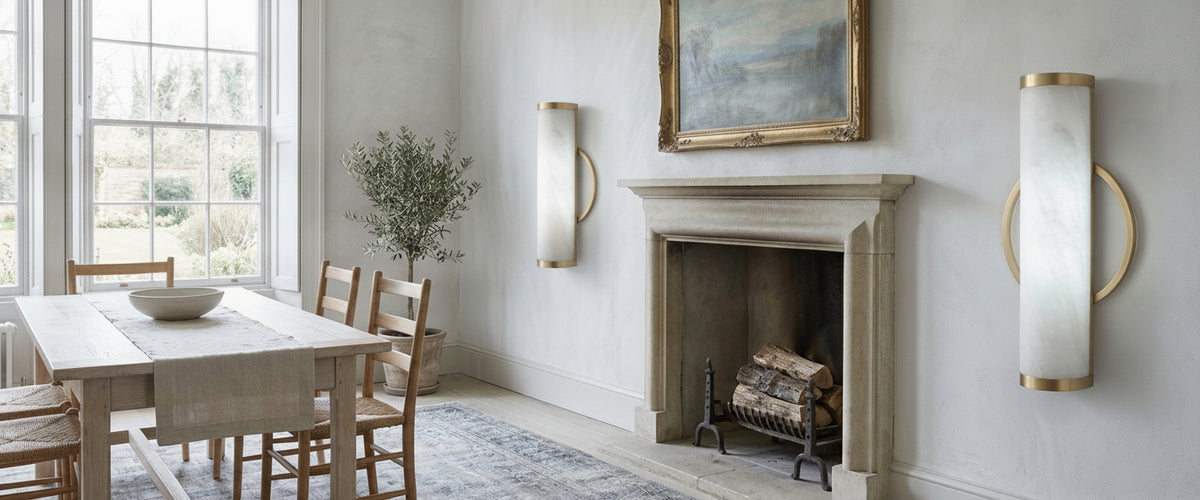
A cord-free sconce changes that calculation. You can light the far end of a corridor, frame a mirror in a cloakroom, or put a soft pool of light beside an armchair that sits nowhere near a socket. Last winter we helped a client in a Grade II listed townhouse in Bath who could not cut into lime plaster without consent. Two rechargeable wall sconce lights either side of the dining room fireplace gave the room the low, side-on light it was missing, and the walls stayed untouched.
The point is placement freedom. A hardwired fitting commits you to a spot; a battery fitting lets you test one. Many designers we work with now use rechargeable led wall lights as a trial run: live with the position for a month, then decide whether it deserves permanent wiring.

What Runtime Figures Mean on a Real Evening
Manufacturers of rechargeable wall sconce lights love a big number. "Up to 20 hours" sounds generous until you realize it was measured at the dimmest setting, which is rarely where anyone leaves a lamp. At full output, the same battery may last a fraction of that.
Think about how you use the room. A bedside sconce read by for half an hour each night will go a long time between charges. A hallway sconce left on from dusk until bed in December may need charging every couple of days. Work out your real hours, assume you will sit somewhere in the middle of the dimming range, and treat the quoted figure as a ceiling rather than a promise.
Battery health matters over years, too. Most rechargeable LED wall lights use lithium-ion cells, which age faster when routinely drained flat or held at full charge in a warm spot. Battery University's guidance on prolonging lithium-based batteries is a useful plain-English read: partial top-ups are kinder than full cycles, and heat is the enemy. So avoid mounting a sconce directly above a radiator, however tempting the alcove.
How Shade Opacity and Depth Change Rechargeable LED Light
The LEDs inside rechargeable wall sconce lights are small, bright point sources. Left bare or behind thin clear acrylic, they throw a hard hotspot and crisp shadows. The shade is what turns that into something you would want in a living room.
Opacity is the first lever. A frosted glass or fabric shade spreads light evenly with little loss. Natural stone behaves differently. Alabaster is a fine-grained form of gypsum, soft enough to be carved thin and translucent enough to glow from within, which is why it has been used for lamps and windows for centuries. Light passing through it picks up the veining and comes out warmer and softer. It also comes out dimmer. When we have held a battery LED behind an offcut of alabaster in the studio, the stone visibly swallowed more light than a frosted glass shade of similar size. Lovely to look at; less useful for reading.
Depth is the second lever. A shallow shade lets you see the LED itself from an angle, which looks cheap. A deeper shade hides the source and pushes light up and down the wall in a controlled wash. If you want the glow of stone and the practicality of a battery, pick a sconce where the stone element is a diffuser or accent rather than a thick enclosure, and accept it as mood lighting. For the full effect of carved stone, a hardwired fitting from our alabaster lighting collection will carry the output the material needs.
Mounting Height, Wall Tone and the Narrow Margin That Works
Rechargeable wall sconce lights have less output in reserve than mains fittings, so placement has to do more of the work. The margin is narrower than people expect.
Height
In hallways and living spaces, a center height of roughly 5 to 6 feet (1.5 to 1.8 meters) keeps the source out of direct sight lines while still washing the wall. Beside a bed, drop it so the bottom of the shade sits a little above shoulder height when you are sitting up, often around 4 feet (1.2 meters) from the floor depending on the bed. Mount a low-output fitting too high and the light never reaches the surface you care about.
Scale should follow that lower height. At bedside level the fitting sits close to your eye line, so a compact piece such as the Briller LED Small Wall Light in clear makes more sense than a broad cluster that crowds the headboard and catches the corner of your vision every time you turn a page.
Wall Tone
Pale walls are your friend. A warm white or soft stone-colored plaster bounces battery light back into the room and makes a modest fitting feel generous. Dark walls, the inky blues and greens popular in London period flats, absorb it. On a dark wall, a rechargeable sconce reads as a jewel-like accent, which can be beautiful, but it will not light the room. Lean into that rather than fighting it: where the wall is deep and the job is decorative, clustered amber glass along the lines of the Briller LED Wall Light Large with amber gold spheres is closer to the right design language than a plain white disc straining to brighten the room.
Texture
Grazing light exaggerates texture. On limewash, exposed brick or stone, that is a gift. On an imperfectly skimmed wall, every ripple shows. If your plaster is uneven, choose a shade that throws light outward rather than straight down the wall.
Dimming and Color Temperature: What Battery Power Costs You
Here is where the trade-offs bite. Mains LED fittings can dim smoothly across a wide range. Many rechargeable wall sconce lights offer three or four fixed steps, often controlled by a touch pad, and the lowest step may still be brighter than you want at midnight. Look for stepless dimming if the sconce is going in a bedroom.
Color temperature is the other compromise. Some rechargeable LED wall lights default to a cool white around 4000K because it reads brighter for the same battery draw. In a home, that looks clinical. Aim for 2700K, or 3000K at most, for living rooms and bedrooms. Tunable fittings that let you shift between warm and cool are useful, but check where they sit when switched on; some reset to cool every time.
A stone or warm-toned shade helps here. Alabaster nudges light toward amber, and brass detailing reflects a warmer cast than chrome or white metal. Where a wall light will sit alongside brass or gold pieces, a brushed gold and glass pairing such as the Bubble LED Glass Wall Light in brushed gold keeps the finish working with the warm light rather than against it. If you are mixing a battery sconce with hardwired pieces in the same room, match the color temperature closely. A 1000K mismatch across one wall is immediately visible.
Are Rechargeable Wall Lights Any Good? A Buyer's Decision Guide
They are good at specific jobs. Use these criteria to decide whether rechargeable wall sconce lights suit your space or whether you should call an electrician instead.
- Choose rechargeable if you rent, live in a listed or conservation property, want to trial a position, or need light where there is no cable route.
- Choose hardwired if the sconce is a main light source, if it will be on for many hours every evening, or if the design relies on a thick stone shade that needs real output.
- Check the role: accent and reading light suit batteries; general room lighting usually does not.
- Check the controls: touch, remote or app. A remote matters if the sconce sits above furniture.
- Check the finish: a battery sconce on show every day should look like a lighting piece, not a gadget. Solid brass, stone and glass age better than glossy plastic.
If you are planning a room that mixes both types, look across our full lighting range so the battery accents and hardwired pieces share a material language. Any new hardwired circuit or fused spur should always be installed by a qualified electrician.
Before It Goes Up for Good: A Short Checklist
- Test the position with tape first. Live with the sconce propped or temporarily fixed for a few evenings. Check it from the doorway and from the sofa.
- Confirm how it charges. A sconce with a removable battery or magnetic detachable body is far easier to live with than one you must unscrew from the wall and cable to a socket.
- Fix it to suit the wall. Use the right plugs for plasterboard, lath and plaster or masonry, and avoid adhesive pads for anything with a stone or glass element. Stone is heavy for its size, and a fall will chip it.
- Plan for the battery's life. Ask whether the cell is replaceable. A beautiful sconce with a sealed battery is a shorter-lived object.
- Care for the shade. Dust alabaster and natural stone with a dry, soft cloth only. Water and cleaning sprays can mark gypsum permanently.
Chosen well, rechargeable wall sconce lights are a quiet fix for the blank walls in a home. Be honest about the job you are asking them to do, pick a warm, well-diffused shade, and save the heavier stone pieces for the walls with power behind them. If you are weighing up both options for a project, Niori can help you plan a scheme and request a tailored quote for hardwired alabaster and natural-stone fittings.