
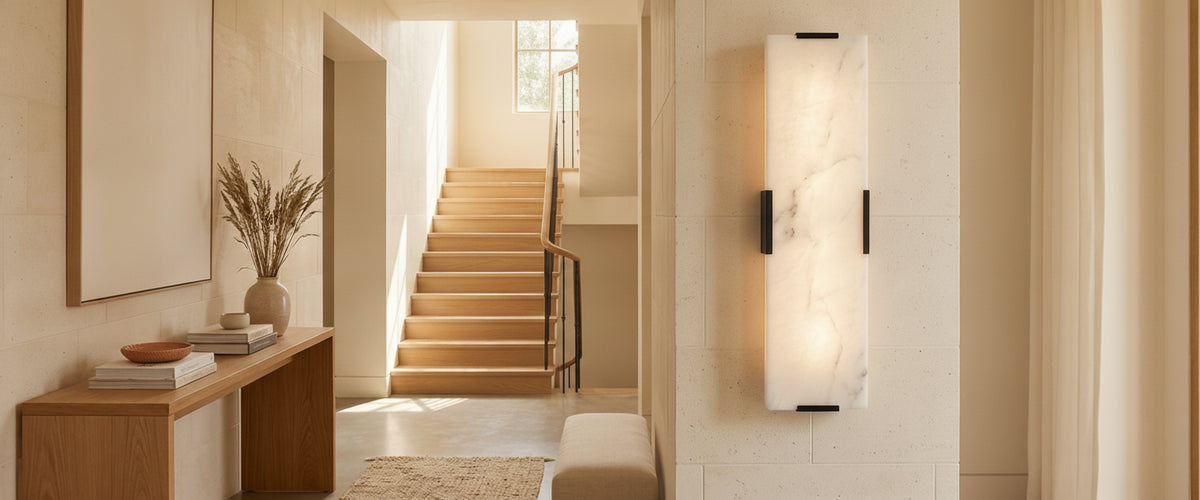

There is a wall in nearly every home that an electrician quietly steers you away from. Solid masonry behind a stairwell. A listed chimney breast. A glazed garden room with nowhere to hide a cable run. A rechargeable wall lights exists for exactly those walls, and when it is chosen well it looks entirely deliberate rather than like a stopgap. Chosen badly, it announces itself: chalky white light, a visible charging port, a body that feels light in the hand and hollow on the wall.

Rechargeable Wall Lights at a Glance
- Best use: walls with no feasible cable route, rentals, listed buildings, terraces, and temporary layouts such as event spaces or seasonal dining rooms.
- Specs that matter: battery capacity in mAh or Wh, quoted run time at full output, charge cycle rating, and charging method (USB-C is the sane default).
- Expect drift: many rechargeable LED wall lights step down output as the charge falls, and cheaper drivers shift colour with it.
- Finish is the giveaway: solid metal, glass or stone reads permanent; thin painted plastic reads portable.
- Not a substitute for: primary ambient lighting in a room you use every evening. No rechargeable wall light replaces a hardwired fixture for that job.

The Real Problem a Rechargeable Wall Light Solves
Cordless sconces solve a routing problem, not a lighting problem. If the light you want sits 1.5 m (about 5 ft) up a solid stone wall in a Victorian hallway, the cost is rarely the fitting itself. It is the chasing, the making good, the redecoration, and in a listed property the consent conversation before any of that starts. Wall lights rechargeable by USB skip the whole chain. You mount a bracket, magnet or plate, and you are lit that afternoon.
What they cannot solve is duty cycle. A rechargeable wall light is a guest, not a resident. It works beautifully as accent light beside a bed, over a console, or along a terrace wall at dinner. Ask it to carry a family kitchen from four o'clock until bedtime, every day, and you will spend your evenings shuttling fittings to a charger. We shipped a pair of cordless up-down sconces to a client with a converted stone steading in the Highlands where the gable wall had no accessible void; they now light the approach to the boot room every evening and get charged once a week. That is the right job for the format. Their main rooms are hardwired, and always were going to be.
Battery Capacity, Run Time and Charge Cycles: The Specs Worth Comparing
Ignore the marketing headline on any rechargeable wall light and read three numbers. First, capacity, given in mAh or (more usefully) watt-hours. Second, run time, and specifically whether the quoted figure is at maximum output or at the lowest dim setting. A fitting advertised at "up to 40 hours" is often quoting its dimmest step; at full brightness the honest figure can be a quarter of that. Third, charge cycles, the number of full charges before capacity meaningfully drops. A decent lithium cell is generally rated for several hundred cycles before noticeable decline.
Charging method matters more than buyers expect. USB-C is worth insisting on, because proprietary barrel connectors become a problem the moment one goes missing. Magnetic pogo-pin bases are elegant on paper and forgiving in practice, provided the contacts are shielded. If a rechargeable wall light will live outdoors, check the ingress protection rating with the charging port covered and confirm the gasket is replaceable.
Charge and store lithium cells sensibly: on a hard surface, away from soft furnishings, and never left on charge unattended overnight. UK fire services have been consistent on this point as battery-powered products have multiplied in the home, and the London Fire Brigade's lithium battery guidance is a sensible ten-minute read before you buy anything battery-powered in volume.
Why Brightness and Colour Temperature Drift as the Charge Drops
This is the detail that separates a considered rechargeable wall light from a novelty. Battery voltage falls as the cell depletes. A well-engineered driver holds constant current and constant colour until it hits a cut-off, then steps down cleanly. A poor one lets the LED dim gradually and, worse, lets the correlated colour temperature slide as it goes.
You notice it at dusk. Two rechargeable wall lights on the same wall, charged at different times, will sit at slightly different warmths, and the eye picks that up instantly against pale plaster. Ask for the CCT (2700K for a domestic evening, 3000K where you want a touch more clarity) and the CRI, which should be 90 or above if the light is falling on skin, art or timber. The Lighting Industry Association publishes plain guidance on how these performance figures should be declared, and reputable manufacturers state them without being asked.
One practical fix: buy an even number and charge them together, in rotation. Mismatched charge states are the most common reason a pair of rechargeable wall sconce lights looks wrong on an otherwise well-lit wall.
Forms and Finishes That Hold Up in a Considered Interior
A rechargeable wall light lives or dies on weight and material honesty. Solid metal bodies in matt black, matt white or brass sit well against plaster and painted timber, and the up-down bar and linear formats now available in cordless versions are quietly architectural. Where a wall wants a horizontal graze of light rather than a vertical accent, a piece such as the Conchita Rechargeable Up Down Bar Wall Light in matt white reads as part of the architecture rather than as an object hung on it. Look at the back plate, the seam lines, and whether the switch is integrated into the underside rather than stamped into the face.
Where stone enters the picture, the maths changes. Alabaster is a gypsum stone with genuine translucency, which is why light passing through it lands as a warm, low-glare wash rather than a point source; the same quality made it a favourite for medieval window glazing and church carving across Europe. That translucency needs a light source of real substance behind it, and a battery-powered emitter rarely has the output to make a thick slab of stone glow convincingly. This is why most stone sconces are mains-fed and why our alabaster lighting range is built around hardwired fittings that can drive the material properly.
A workable compromise in a room where you cannot wire everything: hardwire the alabaster piece that does the heavy lifting, and use rechargeable LED wall lights on the secondary walls for accent, task or approach lighting. The stone carries the atmosphere; the cordless fittings fill in the corners.
Where Rechargeable Wall Sconce Lights Earn Their Place
Room by room, the honest list of places a rechargeable wall light belongs is shorter than the adverts suggest:
- Bedrooms: beside a headboard where there is no socket and no appetite for surface conduit. Aim for the light source at roughly 1.2 to 1.4 m (about 4 ft to 4 ft 8 in) from the floor, just above shoulder height when seated. Scale matters more than output here: a short body like the Conchita Rechargeable Up Down 22cm Wall Light stays clear of the pillow line, while the 32cm version suits wider walls, landings and stairwells where a longer graze of light looks intentional.
- Hallways and stairwells: particularly in period properties with solid walls. Up-down formats grazing the plaster give you direction without glare.
- Garden rooms and terraces: weather-rated cordless sconces on a boundary wall for evenings outside, brought in over winter.
- Rentals: anything that mounts on an adhesive or single-fix plate and leaves with you.
- Hospitality: private dining rooms and marquees where the layout changes. Venue managers in particular value being able to relight a wall without an electrician's visit.
- Alcoves, bookcases and art walls: short bursts of accent light that only run when the room is in use.
Where hardwiring is the honest answer: primary living rooms, kitchens, bathrooms (where zone regulations apply regardless of power source), any fitting that needs to run six hours a night, and anything driving a substantial stone or glass diffuser. If you are building or renovating and the walls are already open, put a cable there. It costs less now than it will in three years. Any fixed wiring work should be carried out by a qualified electrician working to current UK regulations.
Dimming, Motion Sensing and Smart Control: Marketing Versus Reality
Three claims dominate the category, and they deliver unevenly.
Dimming on rechargeable wall lighting is usually stepped rather than continuous: three or four fixed levels via a touch pad or button. Stepped dimming is fine for accent work and frustrating if you want the last 5% at bedtime. Continuous dimming exists but is less common, and remote-controlled versions add a handset you will inevitably lose. Note also that dimming extends run time considerably, which is why the advertised hours look so generous.
Motion sensing is genuinely useful on approach paths and in utility spaces, and genuinely irritating in a bedroom. Check the sensor can be disabled, and check the timeout period. Thirty seconds is too short for a stairwell.
Smart control is where expectations most often outrun the product. Bluetooth range is short, app quality varies wildly, and a rechargeable wall light kept in standby to listen for commands drains faster than one that simply switches on. For most homes, a well-made cordless fitting with a good tactile switch beats a mediocre one with an app.
The Pre-Purchase Checklist
- Confirm run time at full output, not at the lowest dim step.
- Check the charging connector is USB-C or a shielded magnetic base.
- Ask for CCT and CRI figures in writing; look for 2700K to 3000K and CRI 90+.
- Confirm whether the battery is user-replaceable. Sealed units have a finite life as products.
- Verify the IP rating and gasket detail if the fitting goes outside.
- Check the mounting method suits your wall type, and whether it can be removed without damage.
- Buy pairs together so charge state and colour stay matched.
- Decide honestly how many hours a night the light will run. Above four, plan to hardwire.
- Ask what the warranty covers on the cell specifically, not just the fitting.
Care, Charging Habits and Long-Term Life
Lithium cells prefer a partial life. Repeatedly running a rechargeable wall light to empty and back to full ages it faster than topping up between roughly 20% and 90%. If a rechargeable wall light goes into storage over winter, store it around half charged rather than flat, in a dry space at room temperature, and top it up every few months.
Clean metal bodies with a barely damp cloth and dry immediately; keep moisture away from the charging port entirely. If you are mixing cordless fittings with stone pieces elsewhere in the room, treat the stone differently again. Alabaster is soft and water-sensitive, so it wants a dry, soft brush or lint-free cloth and never a household spray. Anyone comparing both approaches across a project will find it useful to browse the full lighting range side by side before committing to a wiring plan.
One last point on budget. Prices for rechargeable wall lights swing enormously, and the driver is not badge value but engineering: cell quality, driver control, ingress protection, material weight and finishing all move the number, as does scale and installation complexity on the hardwired pieces you pair them with. Tell us the walls, the hours and the look you want, and we will quote against that rather than against a generic spec sheet.